Key points:
- As of May 2026, senior-level job postings were up 14.7% year-over-year.
- Compared with January 2025, postings were up 13.5% for senior-level roles, but down 6.7% for mid-level roles and 6.3% for entry-level roles.
- Entry-level job postings have been trending downwards since peaking in 2022, declining 7.5% year-over-year as of May 2026.
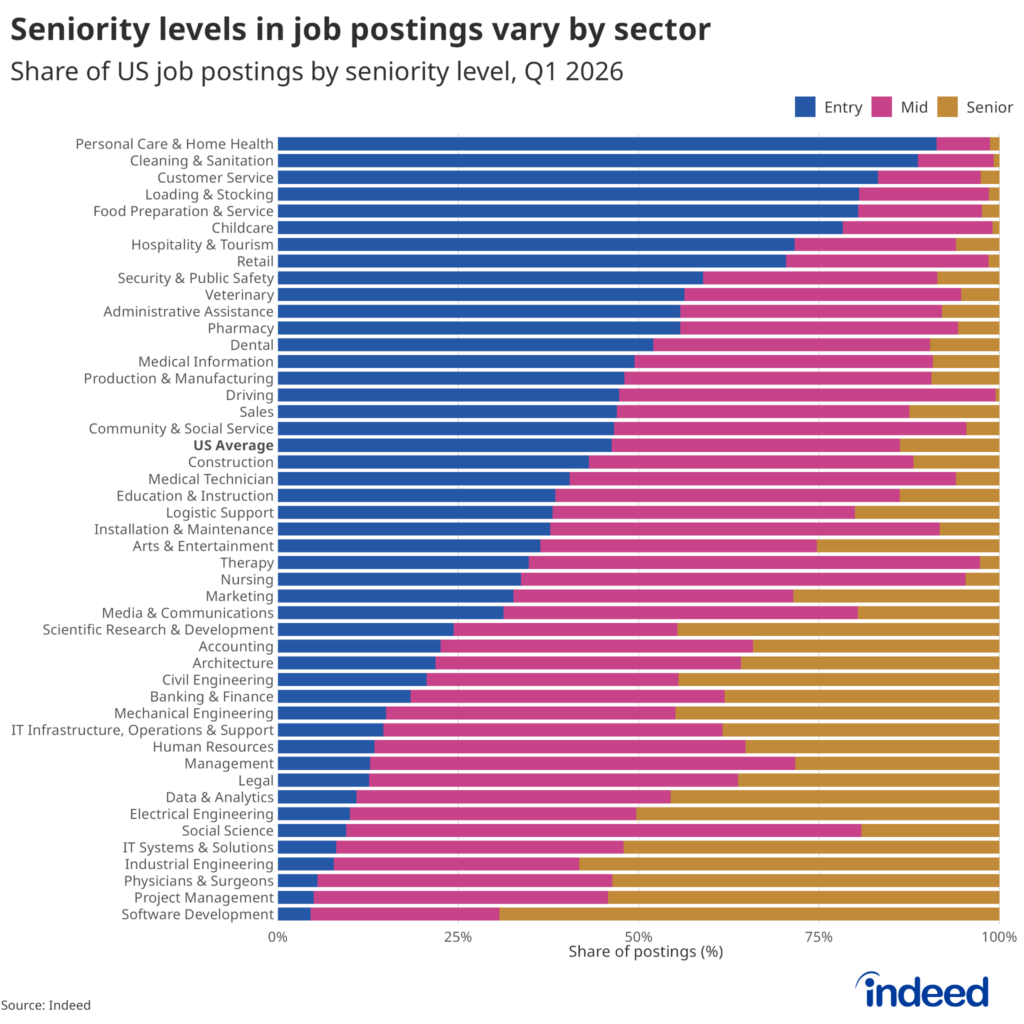
- Even after the recent uptick, only about 14% of postings are for senior positions nationwide, while almost half (46%) are for entry-level positions.
- Software development tops the list, with senior-level positions accounting for 69.3% of job postings in Q1 2026, while driving has the lowest share, at 0.5%.
Over the past year, recent graduates have created profiles to search for jobs on Indeed in droves. Employers might be more interested in hiring their parents.
Postings for senior-level positions on Indeed surged by almost 15% between May 2025 and 2026, anchored by strong demand for more experienced workers in industries including tech, engineering, and other professional services. While postings for entry- and mid-level positions also saw slight upticks, the senior-level surge comes amid a broader divergence in labor demand across seniority levels.
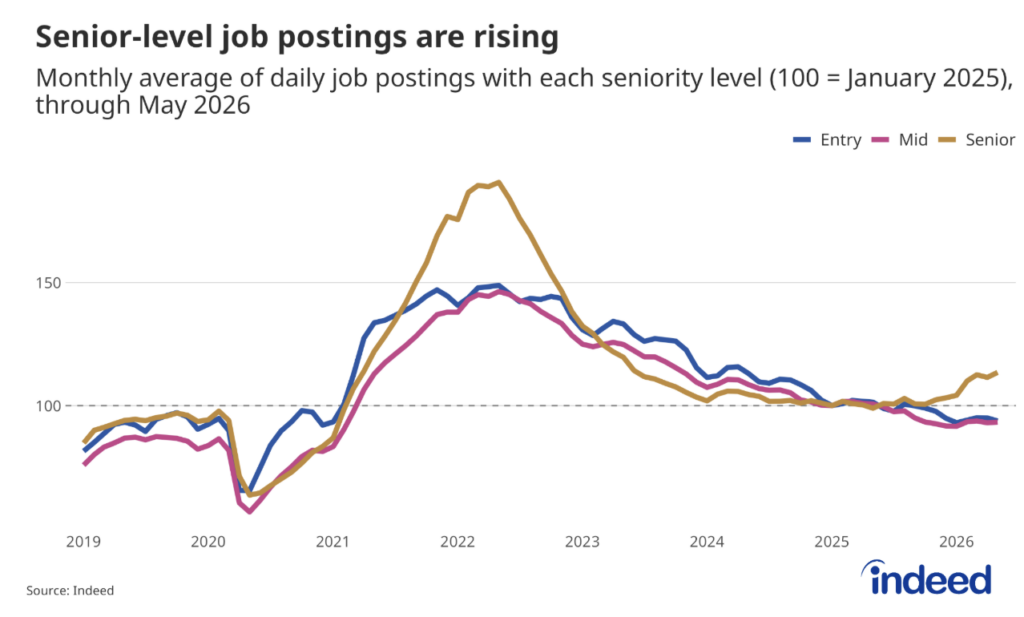
Postings for entry- and mid-level positions have largely trended together since 2019, hitting their post-pandemic peak in 2022 and gradually decreasing afterward. When indexed to their January 2025 level, entry-level job postings were down 6.2% as of May 2026.
It is important to note that while demand for more experienced workers has been growing rapidly, it is still quite low relative to entry- and mid-level positions. Even after the recent uptick, only about 14% of postings are for senior positions nationwide, while entry- and mid-level postings represent 46% and 40%, respectively.
Classifying job postings
Indeed recently adopted a new method for categorizing job seniority based on the responsibilities and training required. Rather than relying on job titles or stated years of experience, these classifications are intended to reflect the tasks associated with a position. This improved methodology allows us to analyze how the share of postings is changing across sectors in a more holistic way (for full details, see the methodology section below).
Differences across industries
There is a growing belief that AI is reducing demand for junior workers. But researchers at the New York Fed recently argued that the rise of remote work is more closely linked to recent graduates’ labor-market woes. Meanwhile, others have pointed to the Fed’s most recent rate hikes and corporate efforts to right-size after the pandemic-era hiring boom. All of these factors may be at least partially at play in keeping demand for entry-level workers somewhat muted.
The share of job postings that are entry-level positions varies widely by sector, ranging from 91.3% in personal care & home health to 4.5% in software development in Q1 2026. Overall, roles that disproportionately demand senior-level workers are largely white-collar occupations, a fact consistent with each of the competing theories above. Meanwhile, industries with a heavier demand for junior positions tend to be less exposed to these disruptions.
Furthermore, while some industries have seen entry-level postings grow as a share of total demand since 2019, others have tilted increasingly toward senior roles. Whether a sector falls into one camp or the other tends to track closely with how exposed that industry is to the forces that have reshaped white-collar hiring over the past several years: AI, remote work, and the post-pandemic boom and subsequent normalization.
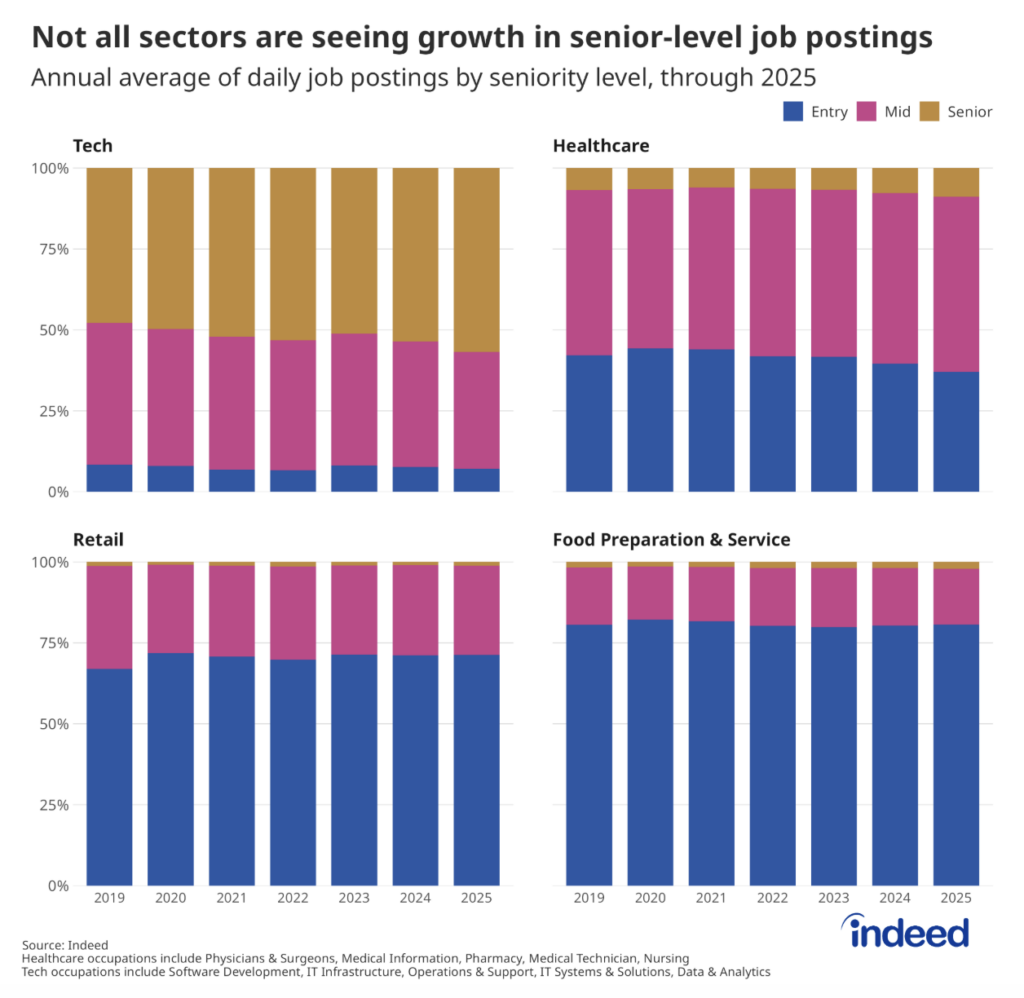
Broadly speaking, sectors with high AI exposure and/or more opportunities to work remotely, like tech, tend to have fewer entry-level roles. Sectors that typically require more on-site work and are less exposed to AI, such as healthcare and retail, tend to offer fewer senior-level roles.
The divergence across sectors is stark. Between 2019 and 2025, the share of entry-level job postings for retail workers rose by 4.4 percentage points. But entry-level postings in healthcare moved sharply in the opposite direction, falling by 5.2 percentage points over the same period. Tech saw a more modest decline in the entry-level job share of just over one percentage point. Still, given how small its entry-level share already was, even marginal shifts could carry outsized consequences for workers trying to break into the field. At the same time, mid-level jobs declined by 7.7 percentage points, suggesting that the 9 percentage-point growth in senior-level job postings in tech has primarily come at the expense of mid-level job postings.
Food preparation and service tells a subtler story: entry-level positions still account for more than 80% of postings; unlike other industries, the split has stayed remarkably stable since 2019.
Conclusion
For workers early in their careers, the primary causes of this shift may matter less than the consequences, whether driven by AI, remote work, monetary policy, or other factors. Entering the labor market during periods of weak hiring can have long-term adverse effects, reducing wages for up to a decade, even after economic conditions improve. Entry-level workers are also generally more likely to be paid hourly rather than an annual salary, and Indeed data has shown that hourly pay is growing more slowly in the current environment. For the economy at large, today’s entry-level workers are tomorrow’s senior leaders. To that end, the full effects of reductions in junior hiring today may not be felt for years to come.
Methodology
The three seniority classifications — Entry, Mid, and Senior — are assigned by the Indeed taxonomy team’s algorithmic text classification system. A single posting cannot carry more than one label at a time.
As mentioned in the text, the new Indeed methodology is meant to represent the tasks associated with a position. For example, does a job involve managing other workers? What hard and soft skills are vital to the role? Are there occupational licensing requirements? The table below summarizes how these and other factors affect each posting’s classification.
| Level | BroadResponsibilities | Typical Required Experience (Years) | College Degree or Licensing | AdditionalCertifications or Licenses |
| Entry | Roles that focus on soft skills and require minimal experience | 0-1 | Sometimes | No |
| Mid | Independent contributors or managers handling day-to-day business operations | 2-4 | Sometimes | Sometimes |
| Senior | Focuses on strategic vision or requires advanced specialized knowledge | 5+ | Often | Sometimes |
Notes: By Indeed Hiring Lab. The table displays factors used to determine if an Indeed job posting is coded as entry-, mid-, or senior-level. Postings were coded using algorithmic text classification with over a 99% coverage rate. Manual checks of a randomly selected sample of coded postings yielded a success rate of about 95%.
The levels assigned to postings also take into account an occupation’s typical minimum education and certification requirements. Entry-level postings for software engineers, for example, tend to require a bachelor’s degree, while an entry-level position as an esthetician
generally requires basic licensing. Any licensure or degree requirements beyond these minimum standards, though, push a posting for these roles to higher experience levels. Still, for many occupations, entry-level roles do not require hard skills or a specific experience. In this case, the presence of any additional certification shifts the posting to at least mid-level.
Job posting counts are calculated as monthly or quarterly averages of daily figures, which avoids double-counting postings relisted under a new job ID within the same period.