
Key points:
- Even for experienced workers, it is rare to apply for senior-level positions. Only 12% of applications from workers with 10+ years of experience were for senior-level roles in May 2026, while close to half were for entry-level jobs.
- In industries with few senior-level roles, competition from experienced workers likely makes the job search more difficult for younger workers.
As demand for entry-level workers has slowed, increased attention has been paid to the difficult labor market conditions facing many young workers and recent college grads. But the effects of reduced entry-level hiring might be felt much more broadly, even by more experienced workers. According to Indeed data from May, almost half of applications from job seekers with 10 or more years of work experience went to entry-level roles.
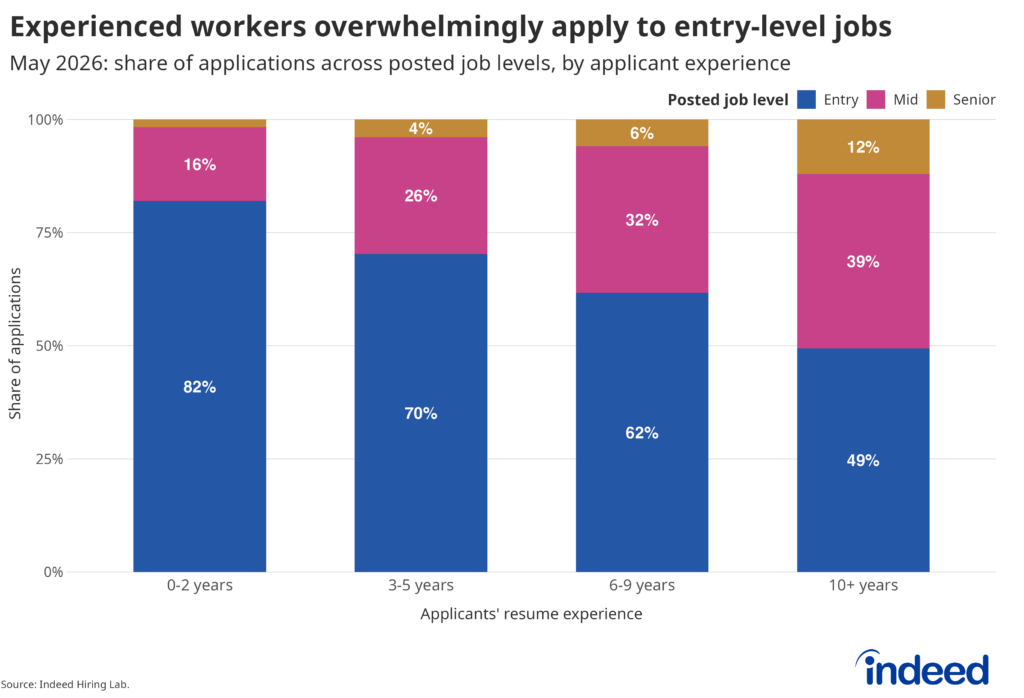
While we generally tend to associate higher levels of work experience with upward career advancement, many jobs offer limited opportunities to formally move into higher-level positions with new responsibilities. Teachers’ aides, for example, often hold the same job responsibilities for their entire tenure in the occupation. The same is broadly true for roles as diverse as administrative assistants, long-haul truckers, nail technicians, and home healthcare aides. As a result, workers in occupations like these tend to work entry- and mid-level positions later into their careers.
In May 2026, almost two-thirds (62%) of applications started on Indeed by job seekers with 6-9 years of work experience were for entry-level roles, with 32% and 6% going to mid- and senior-level roles, respectively. While the share of workers applying for entry-level work does fall as their years of experience increase, the limits in upward job mobility are hard to ignore. Even as job postings for senior roles rise overall, just 1-in-8 (12%) of applications from candidates with 10+ years’ experience were for these roles in May.
These limited opportunities to move up the career ladder may be contributing to growing labor market discontent. While the shares presented above have been fairly stable over the past two years, they vary drastically across sectors, with tech and healthcare applicants showing two of the sharpest divides.
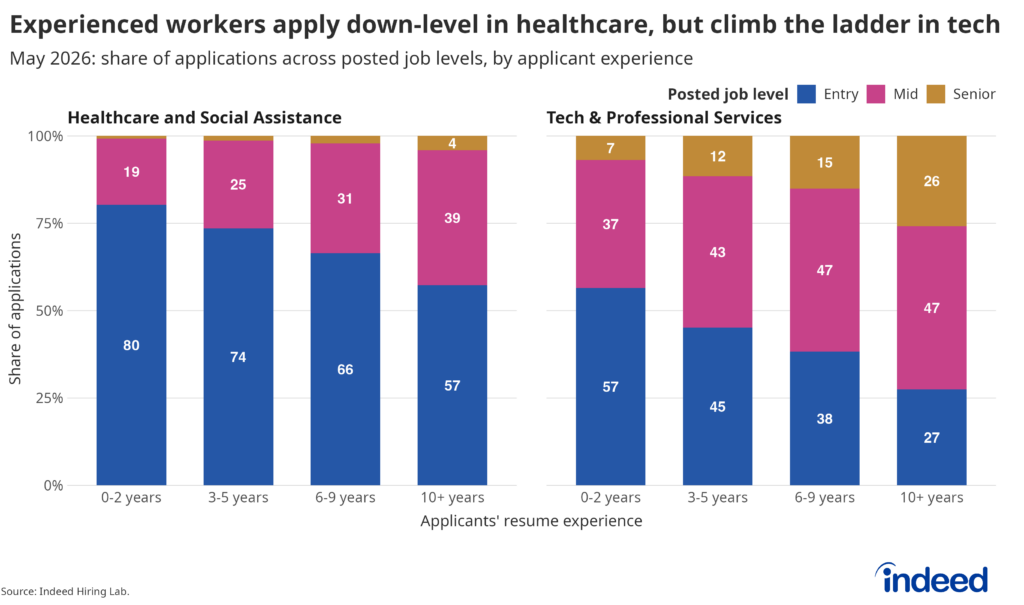
Among workers with 10+ years of experience, those applying for healthcare jobs are more than twice as likely to apply for entry-level positions as those in tech and professional services. With much of recent job growth occurring in healthcare and social assistance, many workers likely entered roles in the past year that may not offer much room for advancement. Meanwhile, strong demand for senior-level workers in tech and professional services provides these workers with more opportunities to take on new roles and responsibilities as they gain experience. Even so, those opportunities may be limited — according to the BLS, employment in these industries has largely held flat over the past year.
These dynamics are significant to workers currently applying for jobs because they affect who they compete with. For job seekers new to the labor force, competition from more experienced workers may make it even more difficult to stand out in a crowded field of qualified candidates. Indeed, across all entry-level postings in May, 30% of applications came from workers with 10+ years of experience — more than any other group.
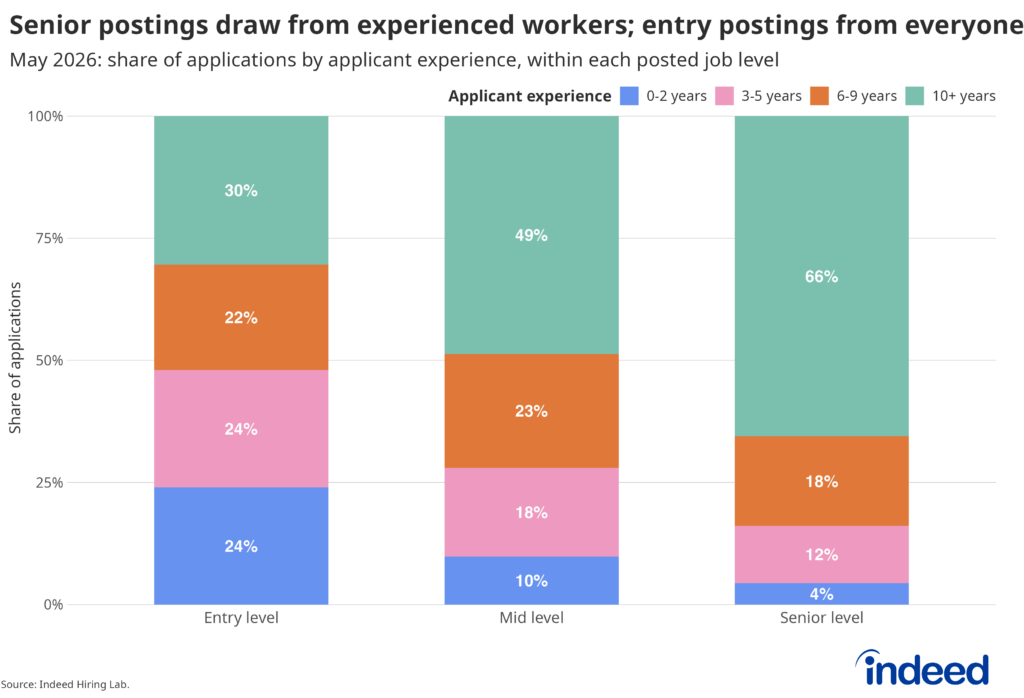
Beyond current macroeconomic conditions, the propensity of experienced workers to apply for entry-level roles should also affect how we think about the labor market more broadly. Debates over minimum wage laws, for example, often assume minimum wages will apply only to young people at the start of their careers. Our data makes it clear that entry-level roles extend far beyond inexperienced workers.
Methodology
The three seniority classifications — Entry, Mid, and Senior — are assigned by the Indeed taxonomy team’s algorithmic text classification system. A single posting cannot carry more than one label at a time. The methodology is meant to represent the tasks associated with a position. For example, does a job involve managing other workers? What hard and soft skills are vital to the role? Are there occupational licensing requirements? The table below summarizes how these and other factors affect each posting’s classification.
| Level | Broad Responsibilities | Typical Required Experience (Years) | College Degree or Licensing | Additional Certifications or Licenses |
| Entry | Roles that focus on soft skills and require minimal experience | 0-1 | Sometimes | No |
| Mid | Independent contributors or managers handling day-to-day business operations | 2-4 | Sometimes | Sometimes |
| Senior | Focuses on strategic vision or requires advanced specialized knowledge | 5+ | Often | Sometimes |
Notes: By Indeed Hiring Lab. The table displays factors used to determine if an Indeed job posting is coded as entry-, mid-, or senior-level. Postings were coded using algorithmic text classification with over a 99% coverage rate. Manual checks of a randomly selected sample of coded postings yielded a success rate of about 95%.
The levels assigned to postings also take into account an occupation’s typical minimum education and certification requirements. Entry-level postings for software engineers, for example, tend to require a bachelor’s degree, while an entry-level position as an esthetician
generally requires basic licensing. Any licensure or degree requirements beyond these minimum standards, though, push a posting for these roles to higher experience levels. Still, for many occupations, entry-level roles do not require hard skills or a specific experience. In this case, the presence of any additional certification shifts the posting to at least mid-level.