
Key Points:
- The indexed share of new graduates with Indeed profiles that were created or modified during their year of graduation increased dramatically between 2023 and 2025 – growing by 67% among bachelor’s degree recipients and 61% among master’s degree recipients.
- The acceleration coincides with a significantly harder job market for new graduates. The unemployment rate for recent grads hit 5.7% in Q4 2025, a three-year high, while the share of unemployed Americans who are new workforce entrants reached a 37-year peak.
- The surge is not uniform across fields of study. Fields where graduates are typically placed through more-established routes, including clinical rotations, student teaching, and/or apprenticeships, show stable Indeed engagement regardless of broader market conditions. Fields with open, competitive job markets show the sharpest increases in profile creation.
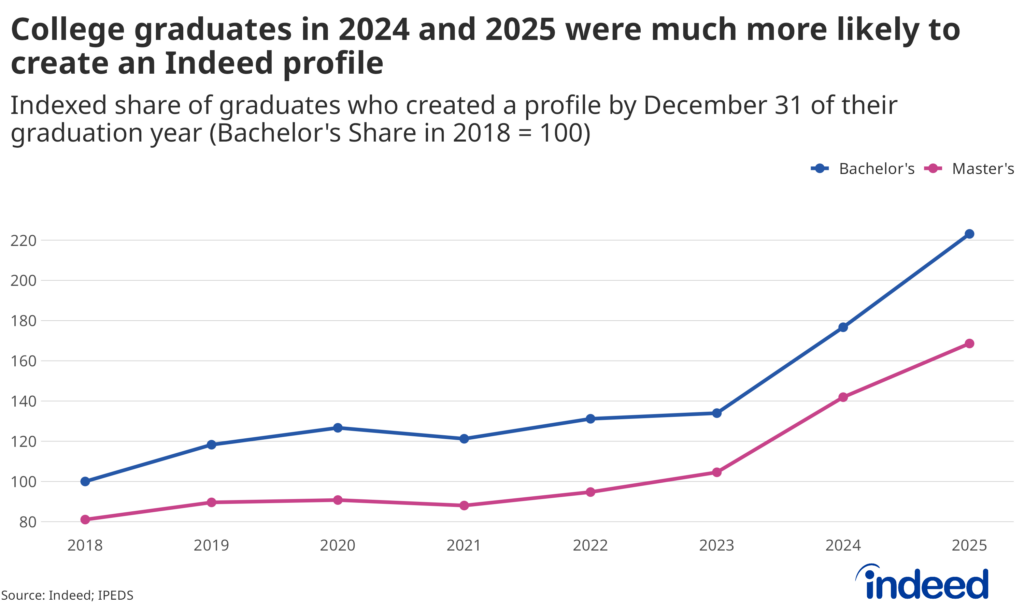
For years, the share of college graduates who created profiles on Indeed by the end of their graduation year grew slowly and steadily. Then, starting in 2024, it surged.
Among bachelor’s degree recipients, the indexed share of US graduates who created or modified their Indeed profile during their year of graduation rose from 100 in 2018 to 134 in 2023 – a gradual 34% climb over five years. It then jumped to 177 in 2024 and 223 in 2025. Put another way, profile creation rose by 34% over the five years from 2018 to 2023, then shot up another 67% in just the two years between 2023 and 2025. Master’s degree recipients followed the same arc: a slow rise from 81 to 105 between 2018 and 2023 (+29% in five years), then a sharp acceleration to 169 by 2025 (+61% in two years).
Part of this movement is simply that the total number of profiles on the Indeed site has grown over time. But the more recent surge in profile creation among soon-to-be or recent grads also reflects a change in the graduate hiring landscape. In previous years, grads might have relied on campus recruiting, converted internships, and/or word of mouth to land a job. But now, they are increasingly turning to a job search platform. The large jump in profile creation amongst 2024 and 2025 grads is not fully a platform trend – it’s a signal that something has changed in the labor market itself.
A tougher market
There’s substantial evidence that the new-graduate job market deteriorated sharply in 2024 and 2025. The Federal Reserve Bank of New York’s labor market dashboard (which tracks outcomes specifically for recent college graduates) shows the unemployment rate for recent grads rising to an average of 5.7% in the fourth quarter of 2025, the highest in three years and notably above the overall unemployment rate. According to Oxford Economics, since mid-2023, new labor market entrants have accounted for 85% of the total rise in unemployment. Fortune and the Groundwork Collaborative found that the share of unemployed Americans who are new workforce entrants hit a 37-year high in 2025.
The numbers from the hiring side are just as stark. Job postings on Handshake, a campus-focused platform, fell 15–16% year-over-year between August 2024 and August 2025, while applications per posting rose 26–30%. The Cengage Group found that only 30% of 2025 graduates secured full-time jobs in their field, down from 41% the year before. According to the Cleveland Fed, the job-finding rate for high school grads and college grads (measured as the fraction of the unemployed who find a job on a monthly basis) was nearly equal throughout 2025, a fact that would have seemed very unlikely even a decade ago.
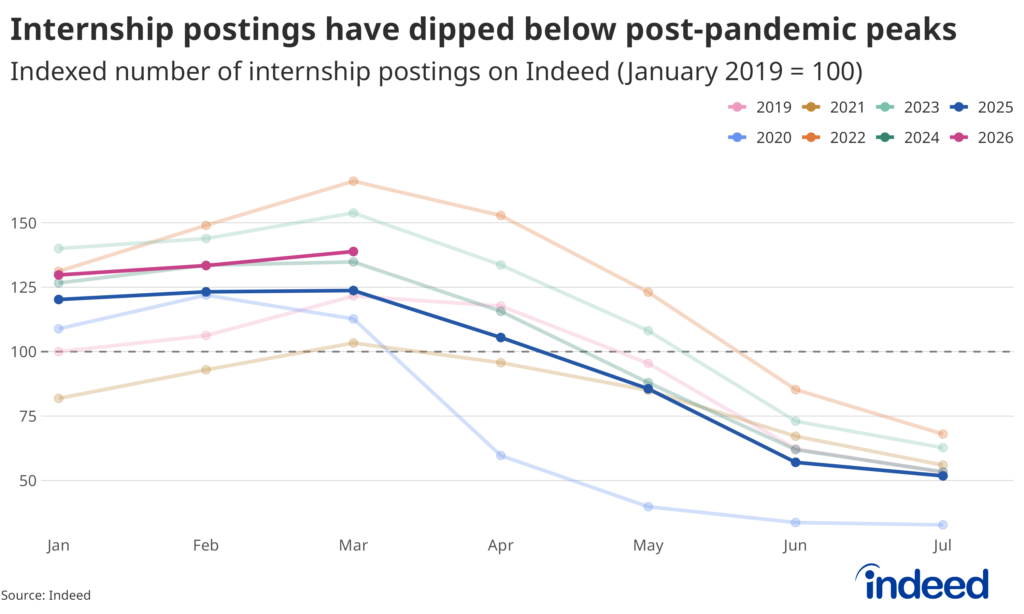
On Indeed, junior-level job postings fell 7% year-over-year in 2025, while senior-level postings rose 4%. At the start of 2025, there were 5% fewer internship postings than there were at the start of 2024, and the number of available opportunities continued to shrink throughout the year. By the end of last year, overall demand for interns had fallen to its lowest level since 2020. For those looking for a silver lining, demand for interns picked up at the start of this year and is in line with or even slightly ahead of 2024 levels so far.
The market is tougher, but not for everyone
The surge in profile creation is not happening uniformly across fields of study (commonly referred to as majors). Looking at the data by CIP codes – government field of study classifications – a clear divergence emerges. These data, rather than just including bachelor’s and master’s degree recipients, include all secondary education attainments, ranging from certificates to doctorates.
In order to look at the distribution of profiles across fields of study, and to show the change over time, we index health professions – the median field of study in 2023 with respect to Indeed profile creation – to 100. Fields of study are then ranked based on 2025 graduates’ likelihood of having an Indeed profile that was created or modified during their graduation year.
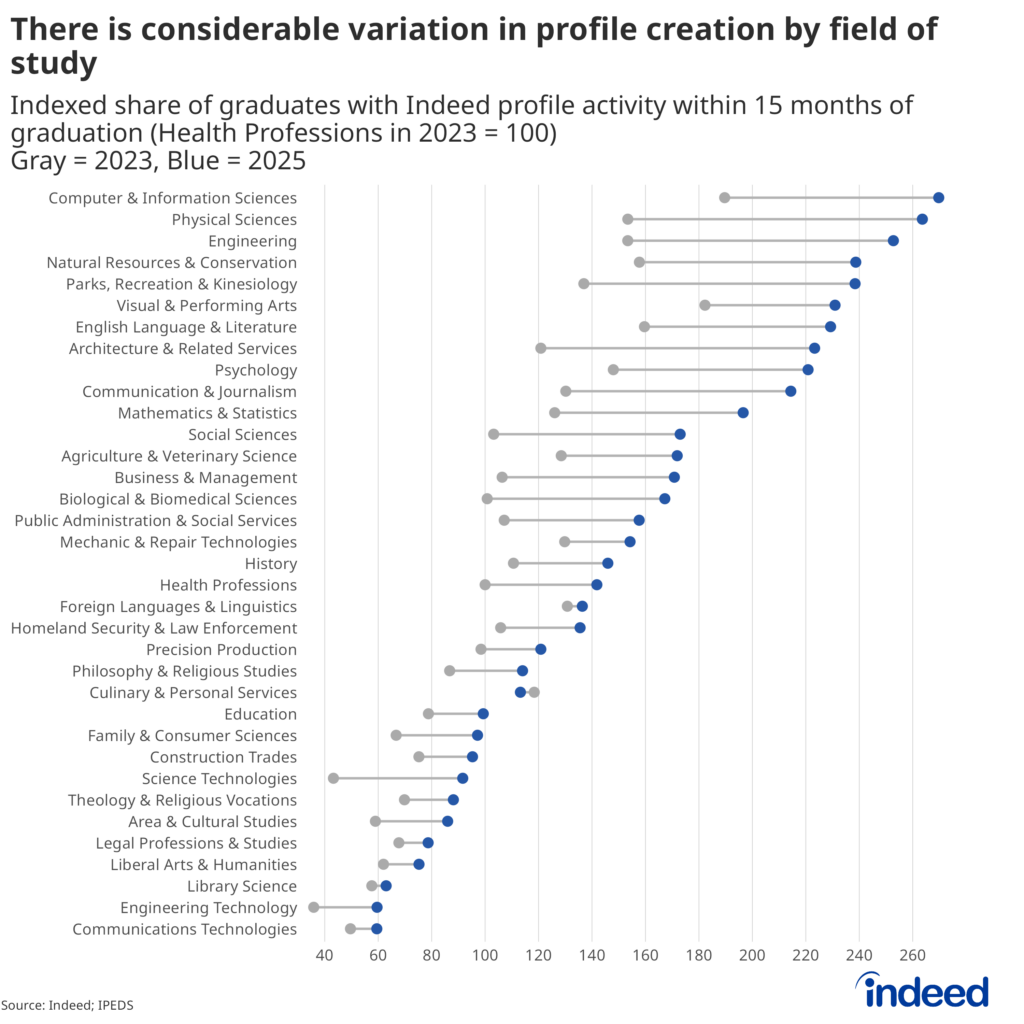
In 2025, computer science graduates had the highest likelihood of profile creation/modification among all fields of study analyzed. But computer science grads already had a relatively high share of graduates with Indeed profiles – it led the list in 2023, too, albeit at a lower level. Focusing on growth instead of the overall level, engineering, physical sciences, architecture, and parks, recreation & kinesiology all stand out, with the share of grads in all these fields that created/modified a profile jumping by the largest margins between 2023 and 2025. Psychology, social sciences, English, and communication & journalism all moved substantially as well. This aligns with reporting on difficulties faced by white-collar entrants. At the other end, culinary arts, library science, legal professions, and education barely moved.
If you look at the change over a longer period of time, examining growth in profile creation between 2018 and 2025, a clear dichotomy across fields of study is revealed.
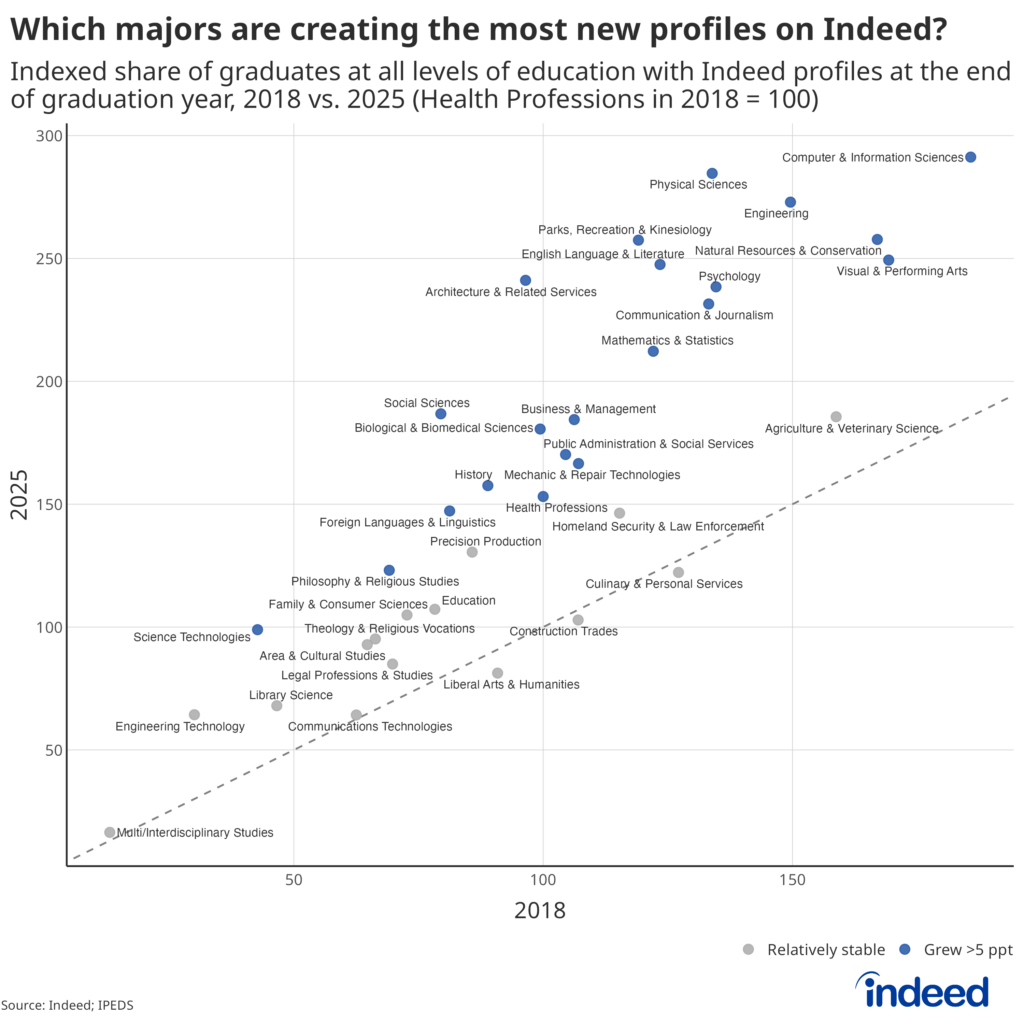
Profile creation grew relative to the 2018 baseline across most fields. But a distinct cluster showed little to no change; fields that have roughly the same share of graduates with profiles on Indeed year after year, regardless of what the broader job market is doing.
Pipelines vs. open markets
The field of study data aligns closely with a structural feature of certain fields: the presence of embedded placement pipelines that route graduates into jobs before they may ever need to create a profile on Indeed. Education majors complete multi-semester student teaching placements that function as extended job interviews. Districts hire directly from their own classrooms. It is no coincidence that special education (0.7% unemployment), elementary education (1.2%), and secondary education (2.1%) have some of the lowest unemployment rates of any major in the country, per NY Fed data, or that their Indeed profile creation has remained largely flat.
Nursing graduates complete clinical rotations in the hospitals that often end up hiring them. At 12.8%, nursing has the lowest underemployment rate (the share of graduates working in jobs that typically do not require a college degree) of any major tracked by the NY Fed. Our own research found that 92% of nursing roles require specific certifications, creating a credentialed pipeline that is difficult to enter from the outside but more straightforward for graduates who have already trained within it.
Construction trades also often operate through apprenticeship systems and more informal labor markets. Legal professions funnel graduates through law school and on-campus interview programs.
Notably, many of the CIP codes with the lowest profile creation growth rates are associated with majors/fields of study that are dominated by certificates and associate degrees that are generally granted at community colleges rather than at four-year institutions. This includes CIPs like communications and engineering technologies, which includes technical majors in fields like audio engineering, drafting, and surveying, which are typically offered at the certificate or associate degree level. This differs in important ways from the communication and journalism CIP which is dominated by majors typically found at four-year institutions, like journalism and public relations. This distinction is important. Community colleges are uniquely focused on workforce development and typically offer students work-based and experiential learning opportunities that may lead to more direct employment opportunities.
In each of these cases, the institutional structure does the matching, leaving less need for extensive job-board browsing.
The fields of study that moved most on Indeed tend to share the opposite characteristic: relatively open labor markets where the path from graduation to employment runs through active searching rather than pre-established relationships. When the market tightened in 2024 and 2025, graduates in those fields searched harder. The share creating profiles on Indeed reflects that.
What to watch
The acceleration of graduate profile creation in 2024 and 2025 is large enough to warrant attention beyond the immediate data. Whether it reflects a durable shift in how new graduates approach the job market or a cyclical response to a specific period of labor market stress will become clearer as conditions evolve. The fields that were largely unmoved deserve scrutiny as well; their stability through a difficult period speaks to the durability of institutional pipelines, but also to the limited fields of study these pipelines serve.
For now, the data tells a consistent story: more new graduates are creating profiles on Indeed, and it’s very likely many of them are there because their job searches have gotten harder.
Methodology
We track cohorts of college graduates based on the information contained in their Indeed profiles, including date of graduation, degree/certificate earned, and field of study. Data are subject to revision from prior publications due to proactive changes to extraction tools and definitions.
The share of graduates is calculated using the number of college graduates in the U.S. by degree and field of study produced annually by the federal government. As of publication, 2025 graduate numbers were not available from the U.S. Department of Education, via IPEDS, so the number of graduates in 2025 was interpolated using 2018-2024 specific growth rates by degree type (bachelor’s or master’s) and field of study. Given the very small likelihood of large swings from year to year, this method results in appropriately conservative growth estimates.
The number of job postings on Indeed.com, whether related to paid or unpaid job solicitations, is not indicative of potential revenue or earnings of Indeed, which comprises a significant percentage of the HR Technology segment of its parent company, Recruit Holdings Co., Ltd. Job posting numbers are provided for information purposes only and should not be viewed as an indicator of the performance of Indeed or Recruit. Please refer to the Recruit Holdings investor relations website and regulatory filings in Japan for more detailed information on revenue generation by Recruit’s HR Technology segment.