
Key points:
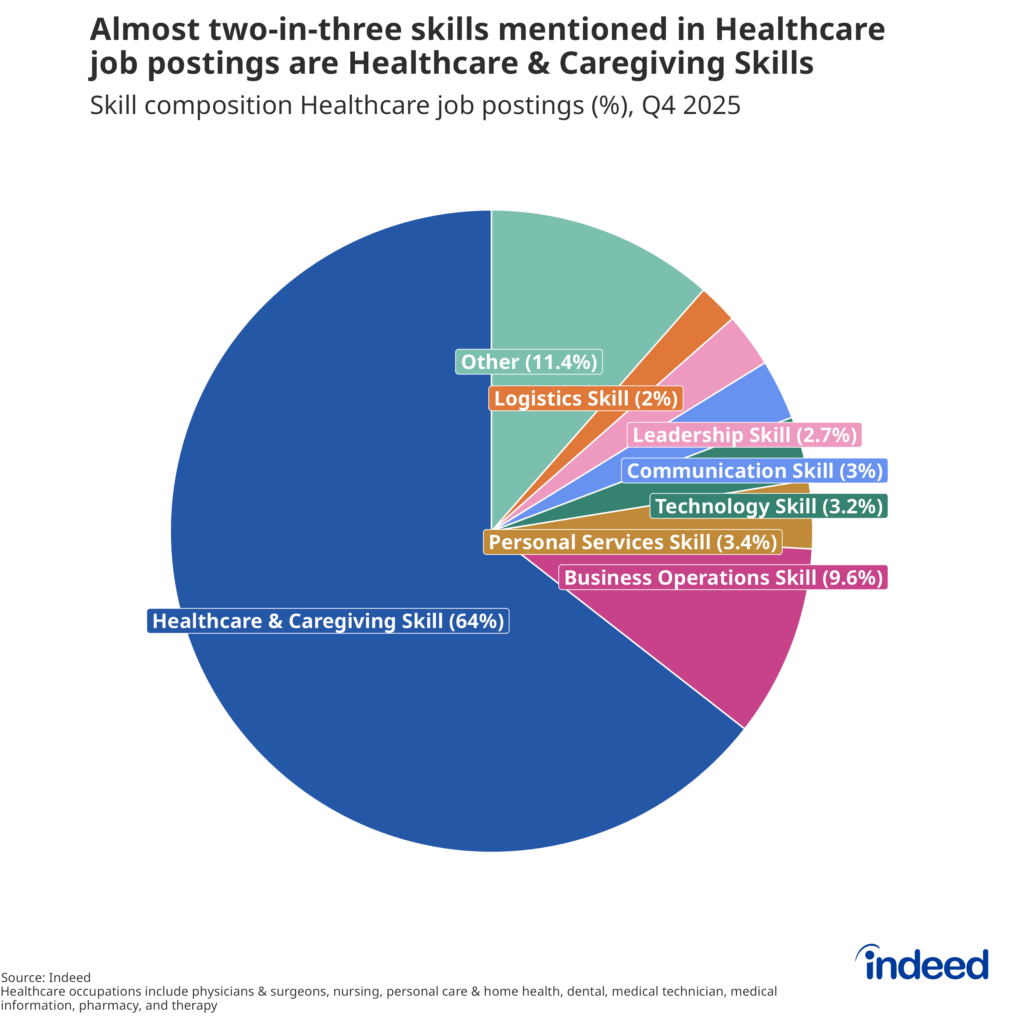
- Almost two-thirds (64%) of skills in a typical healthcare role come from the healthcare & caregiving skill category, reflecting the sector’s high regulatory bar and strict requirements for specialized competencies, education, and licensing.
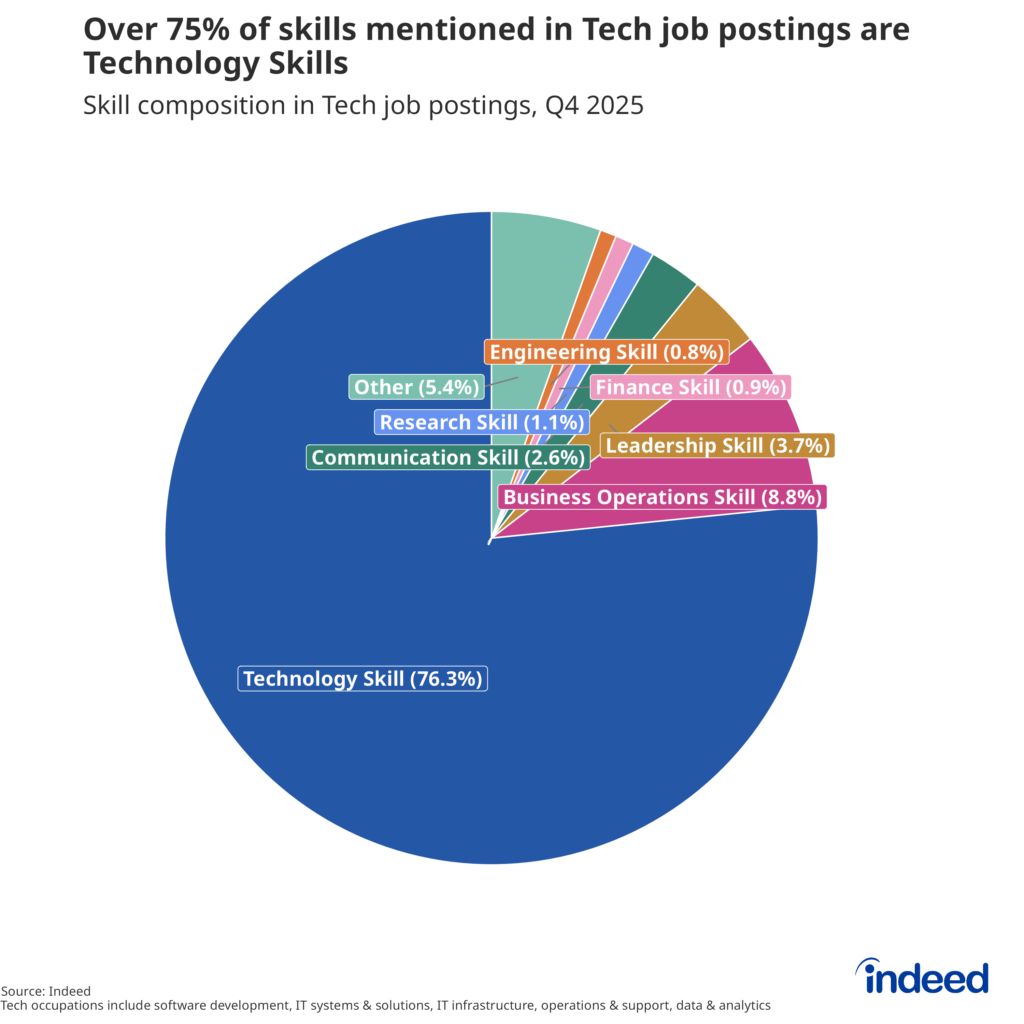
- More than three-quarters of the skills in a typical tech role (76.3%) come from the technology skill category, suggesting that foundational systems knowledge remains crucial even as AI changes how many tech roles are performed.
- Skill‑diverse occupations may be more accessible than workers expect, as some skills are ubiquitous across the labor market.
Skills requirements in US jobs are wide-ranging — from a diverse mix of capabilities across multiple areas to a concentrated skill set requiring expertise and qualifications in a single discipline. A new Hiring Lab analysis shows that while jobs in most sectors typically fall into the former category, those in healthcare and tech are most likely to require a very concentrated skillset.
Hiring Lab analyzed more than 3,000 individual skills across 47 broad categories (including 108 subcategories encompassing 45 occupations). We found that almost a quarter of the analyzed occupations are “skill-concentrated,” meaning that 50% or more of the required skills for that role come from a single category. These jobs are primarily found in the healthcare and tech sectors. However, even in skill-concentrated occupations, there is variation in other expertise that may be valuable for advancing one’s career and may also ease a transition to skill-diverse occupations.
Most occupations require a diverse skillset
In Q4 2025, the average US job posting on Indeed required 14 individual skills, ranging from 7 skills in the driving sector to more than 20 in software development and project management sectors. While the number of skills required generally increases with the complexity of a job, their concentration — i.e., how the required skillset is distributed across different categories — indicates the level of specialization of an occupation. Among the 45 broad occupation groupings analyzed (ranging from “accounting” to “software development”), 11 are considered “skill-concentrated” — more than 50% of the skills mentioned in job postings from these sectors come from a single skill category. In the remaining 34 “skill-diverse” occupations, no category accounts for a majority share in the skill composition.
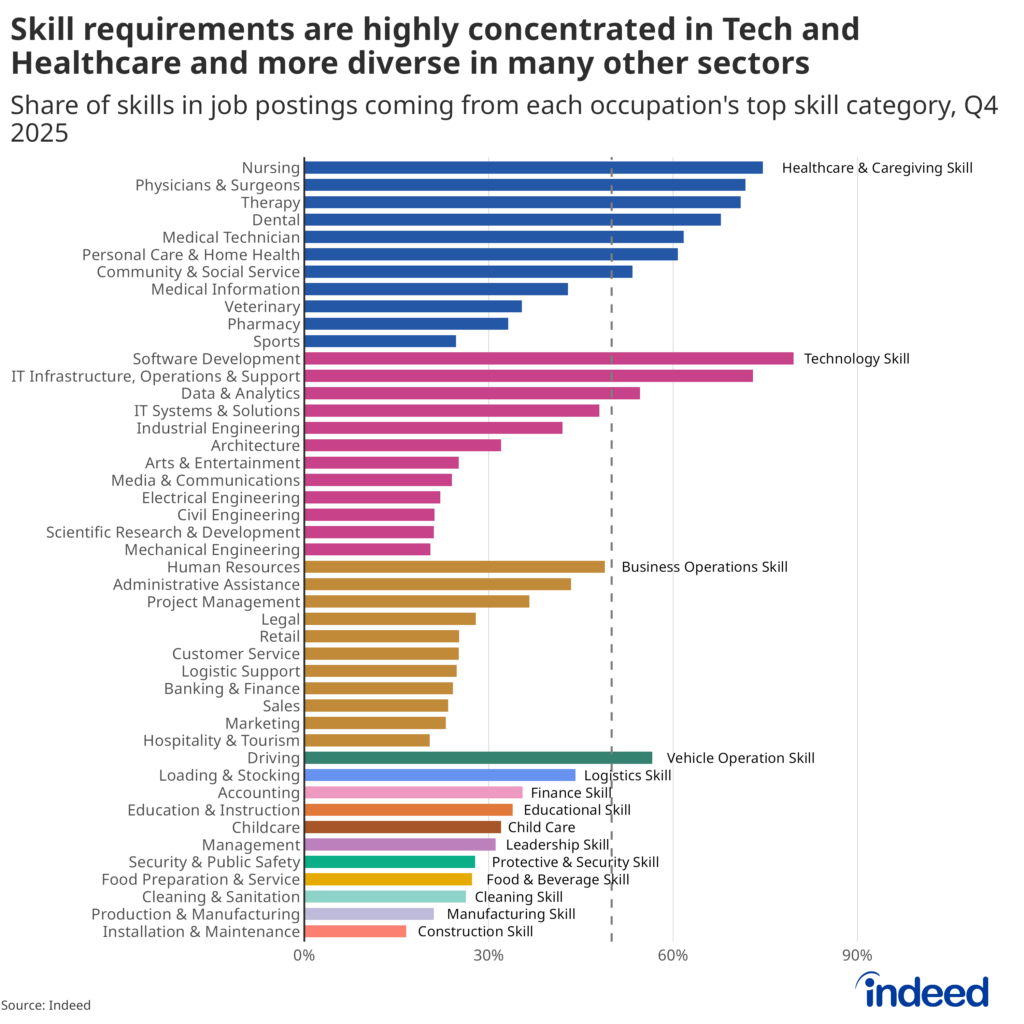
Other than driving — where, unsurprisingly, vehicle operations skills are at the core of most jobs — all of the skill-concentrated occupations are in the healthcare and tech sectors. Software development leads the list, with technology skills making up more than 75% of the skill composition. In IT infrastructure, operations & support, 73% of skills mentioned are technology skills. Similarly, healthcare occupations — including nursing, physicians & surgeons, and therapy — have a high concentration in the healthcare & caregiving skills category, ranging from 61% to 74%. Human resources, which just misses the 50% cutoff that would make it “skill-concentrated” for purposes of this analysis, still draws nearly half its skills from the business operations category. As we previously reported, almost all jobs in this occupation (and over 70% of all jobs) mention at least one business operations skill. But interestingly, in no occupation do business operation skills make up more than 50% of the required skills.
Healthcare’s high regulations make for very skill-concentrated occupations
Looking at the 8 individual healthcare occupations as an aggregated “healthcare” sector — physicians & surgeons, nursing, personal care & home health, dental, medical technician, medical information, pharmacy, and therapy — we found that 64% of skills listed in these job postings are in healthcare & caregiving skills. This large concentration reflects the sector’s highly regulated industry standards and requirements, often requiring specialized competencies, education, and/or licensing. Unlike sectors that may hire based on “potential,” healthcare employers demand verifiable proof of qualifications or experience, in large part because tasks are performed on patients with a low tolerance for error. Consequently, job postings are exceptionally explicit regarding such requirements. Furthermore, the high demand for healthcare professionals may lead employers to focus more on necessary core skills and less on nice-to-have skills.
The demand for specific secondary skills within healthcare roles (outside of healthcare skills) fluctuates significantly by role. Business operations skills are far more prominent in job postings for medical information (making up 29.7% of skills mentioned in job postings) and pharmacy (21.6%). These are jobs where workers may be expected to manage business-focused administrative systems, including billing and scheduling, to ensure smooth operations at healthcare facilities. Conversely, personal services skills are more prevalent in personal care and home health roles (12.9%), where the job scope often extends beyond medical nursing to general home assistance.
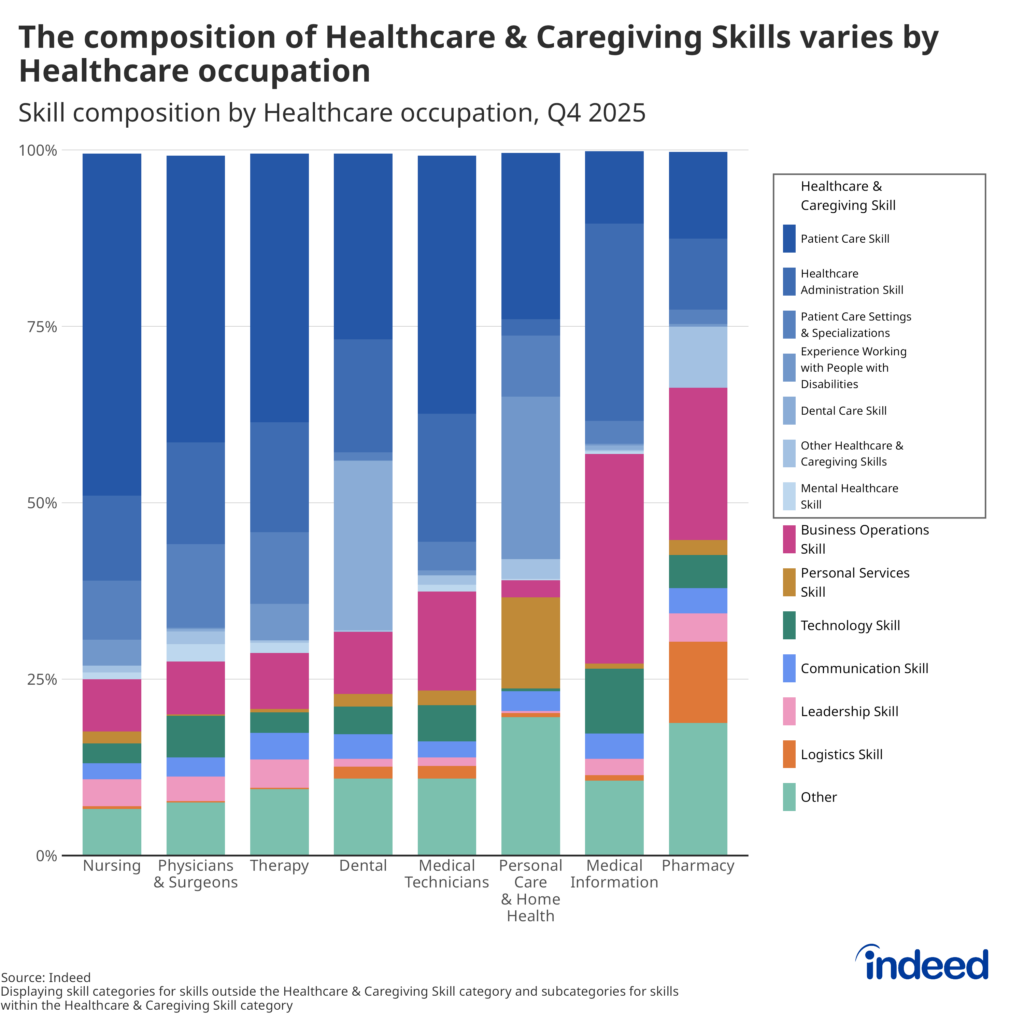
Even the core healthcare and caregiving skills category isn’t uniform; it includes several skill subcategories that show up differently across occupations. When analyzing these subcategories, we found that “patient care” skills dominate in nursing (48.5% of skills in the typical nursing role come from this subcategory), where the physical performance of clinical tasks is paramount. In contrast, healthcare administration skills lead in medical information roles (28%), where expertise in billing and documentation of treatment is more important than performing the treatment itself. Dentistry naturally requires more specialized dental care skills (24% of skills in the typical dental role come from the dental care subcategory).
Technical fluency remains the cornerstone of tech jobs
Similar to healthcare, combining four individual occupations — software development, IT systems & solutions, IT infrastructure operations & support, and data & analytics — into a broader “tech” sector reveals that 76.3% of skills mentioned in tech job postings are technology skills. This high concentration is partly due to the nature of tech listings, which often require multiple individual but related competencies, including proficiency in coding languages like Python, R, or Java. Furthermore, the skill concentration in tech suggests that, despite the rise of AI, core technical competence remains essential. The proliferation of AI tools has not replaced the demand for underlying technical fluency, as using AI-assisted development tools still requires foundational coding and systems knowledge.
The level of concentration and composition of technology skills also varies by occupation in the tech sector. Software development is intensely skill-concentrated, with almost four-in-five required skills (79.4%) coming from the technology category, and a strong focus on “software development” and “programming language & framework” skills (together, 56.2% of software development jobs include at least one of these skills).
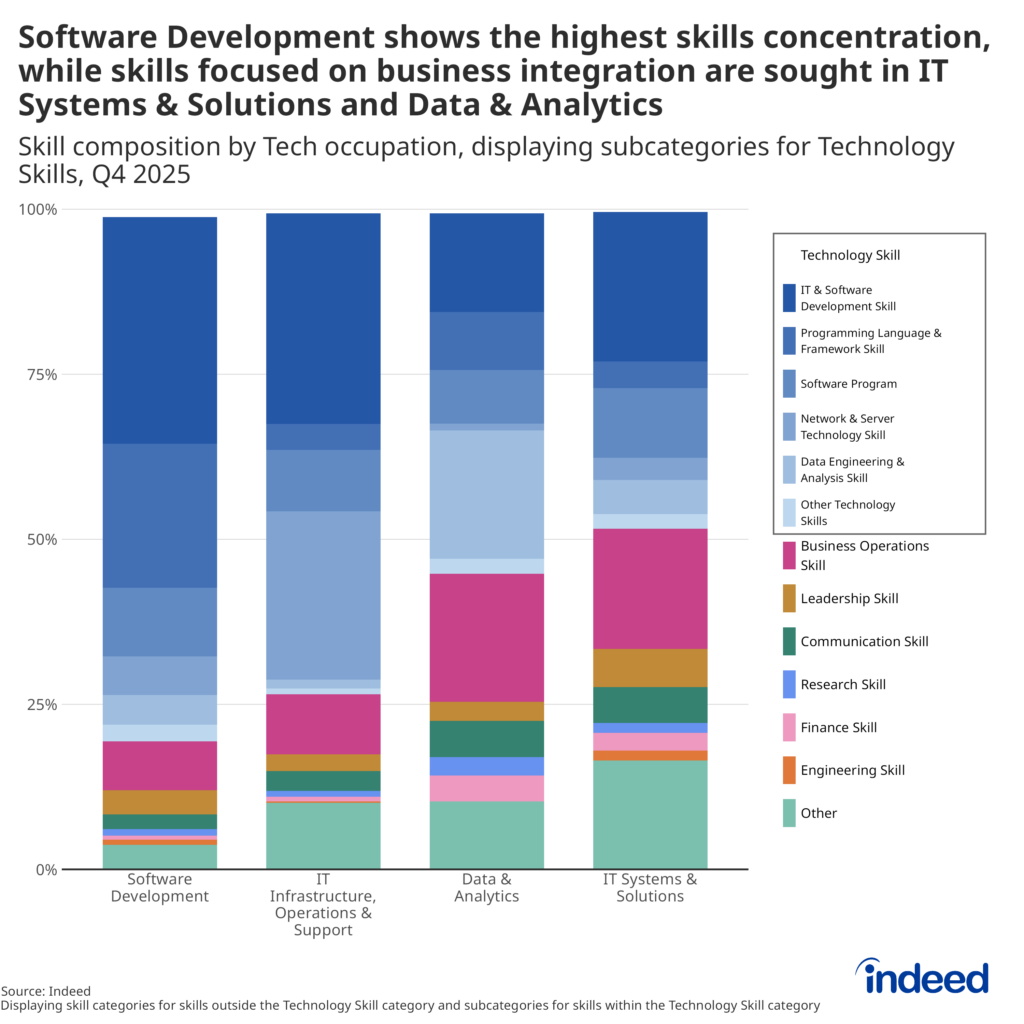
On the other hand, in the IT systems & solutions sector, less than half (48%) of required skills are from the technology category — more than in many non-tech professions, but far below the intensity seen in software development. Instead, skills from the broader business operations (18.2%) and leadership and communications (together 11.2%) categories account for a larger share of skills in the typical IT systems job. This reflects the emphasis on integrating technology products into workflows in these roles, thus requiring a solid understanding of the value chain of a business and cross-team collaboration. Business operations skills are similarly represented in data & analytics (19.4%), where data engineering & analysis skills (19.4%) dominate the technology skills category.
Skill-diverse occupations may be more accessible than workers realize
Entering skill-concentrated fields like tech or healthcare remains challenging. As a likely result, software engineering and nursing see some of the lowest rates of workers entering these sectors from other occupations. Healthcare roles are also far more likely to carry licensing requirements. Workers looking to break into these occupations must therefore devote substantial resources to acquiring the necessary credentials and competencies. That immobility has longer-term implications too: Hiring Lab’s recent workforce projections show that the high barriers to entry in healthcare are part of what makes labor shortages in the sector so difficult to resolve.
But for those looking to exit a concentrated field or simply want to stay mobile, some skills travel further than others. Business operations skills stand out for their near-universal presence; over 70% of job postings in Q4 2025 required at least one business operations skill, and, on average, they accounted for 20.4% of the skills composition across occupational groups. Similarly, leadership skills are valuable not just for advancing within one’s current field but also for easing a transition into project management (where they make up 11.7% of the skills composition) or management more broadly (31.1%).
Skill-diverse occupations, too, may be more within reach than workers expect. There are two ways to think about what skill diversity in an occupation actually means. On one hand, it may reflect a genuine requirement for breadth of expertise. A marketing manager, for instance, might need to draw on communication, language, and sales skills in equal measure, whereas a nurse’s role centers far more narrowly on patient care. On the other hand, skill diversity can also signal openness to a broader range of candidates, which means workers from adjacent fields may find themselves more competitive than they’d expect. A software developer, for example, might be a strong fit for an HR role that involves building and managing HR software.
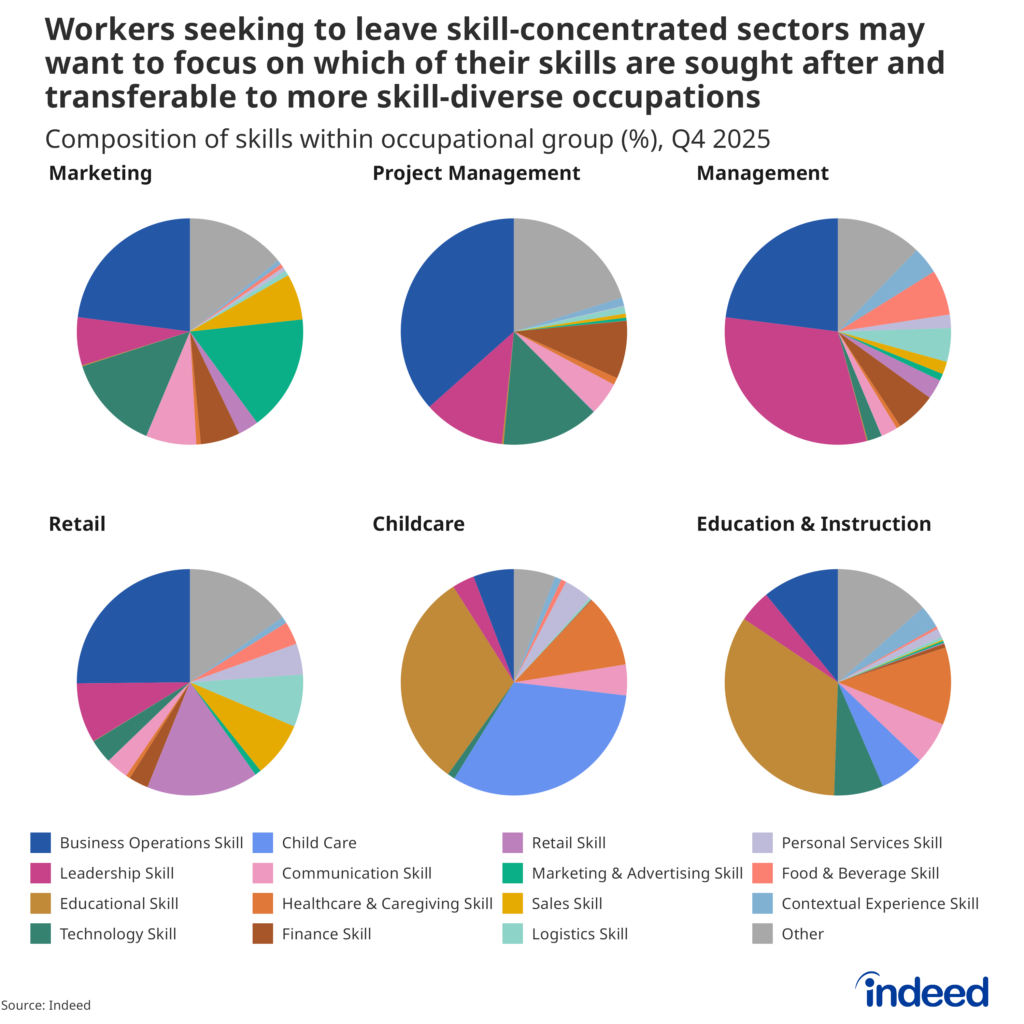
This has real implications for both job seekers and employers. Job seekers may be eligible for a wider range of roles than they realize, particularly in skill-diverse occupations where their background, even if unconventional, checks more boxes than expected. Employers, in turn, stand to benefit from broadening their view of what a qualified candidate looks like. Overlooking applicants simply because they come from a different industry or job title may mean missing out on people who already possess the core competencies the role demands and who may bring a fresh perspective.
Methodology
Data used in this analysis are based on the extraction of more than 3,000 skills — across 47 categories and 108 subcategories — from US job postings on Indeed between October 1, 2025, and December 31, 2025 (Q4 2025). The 45 occupational categories analyzed may encompass any number of individual job titles under a broad heading. For example, the “nursing” segment could include pediatric nurses, nursing assistants, and registered nurses, among other titles. For extraction, a deep learning model, along with Indeed’s internal taxonomy and classification systems, were used, shaping how individual terms in job descriptions are grouped, labeled, and counted. Skills are aggregated across multiple hierarchical levels.
Two metrics were analyzed: (i) Skills mentions, i.e., the average daily share of job postings mentioning at least one skill from a certain skill category, and (ii) Skills composition, i.e., the average daily share of a skill or skills category that makes up for the total number of skills mentioned within an occupation.
Indeed’s skill taxonomy continuously evolves through the addition of new skills, refinement of skill categories, and advancement of extraction methods from rule-based keyword matching to model-based extraction using machine learning. While these improvements enhance data quality, they may contribute to differences in results over time alongside genuine labor market trends.
The number of job postings on Indeed.com, whether related to paid or unpaid job solicitations, is not indicative of the potential revenue or earnings of Indeed, which comprises a significant percentage of the HR Technology segment of its parent company, Recruit Holdings Co., Ltd. Job posting numbers are provided for information purposes only and should not be viewed as an indicator of the performance of Indeed or Recruit. Please refer to the Recruit Holdings investor relations website and regulatory filings in Japan for more detailed information on revenue generation by Recruit’s HR Technology segment.