Key points:
- Employers added an average of 114,000 jobs per month over the first five months of 2026, more than triple the roughly 36,000 monthly pace seen over the same stretch in 2025.
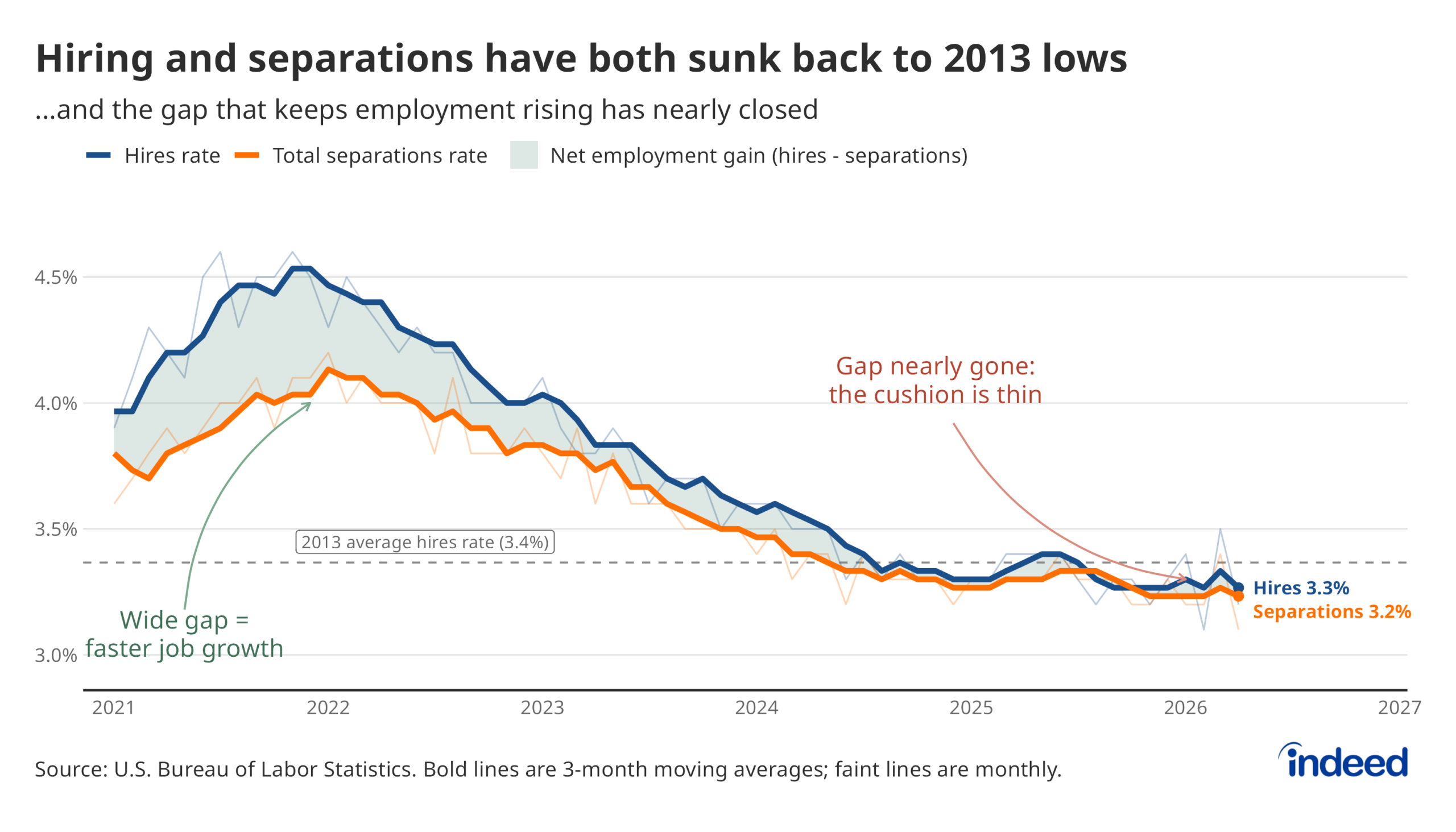
- The hires rate remains near its weakest level since 2013, leading to fewer total hires in 2026 than in 2025.
- Quits, layoffs, and other separations have fallen even faster than hires, leading to a rise in net employment.
The United States labor market is pulling off something that shouldn’t quite add up. Job growth has been solid to start 2026, as employers have added an average of 114,000 jobs a month over the first five months of 2026 — more than triple the roughly 36,000 monthly pace a year ago. But hiring activity remains low, with employers bringing on new workers at a rate consistent with sluggish 2013 levels. Fewer people are getting hired, but the economy keeps adding jobs anyway, an equation that only adds up when you consider not only the people starting jobs, but also those ending them.
The “low-hire, low-fire” shorthand for describing the current labor market makes the two forces sound balanced — but they aren’t. The April hires rate is low at 3.2%, but the separation rate (which includes quits, layoffs, and discharges) is even lower at 3.1%. Each rate is represented as a share of the nearly 160 million US jobs, so even that sliver of a gap adds up to a lot of workers. The gap between hires and separations also shares an important connection to the headline numbers from the jobs report. According to the BLS, “the JOLTS figure for hires minus separations can be used to derive a measure of net employment change… [which is] comparable to the net employment change from the [jobs report].” Right now, that arithmetic is positive, not because workers are pouring in at high rates, but because relatively few are heading out. With a thin trickle through the front door and an even thinner one out the back, the building fills a little more each month.
All this makes the recent gains less a sign of strength than one of stillness. Growth that leans on people staying put rather than employers ramping up hiring is a fragile kind of growth. The trends also square with data showing challenges in finding work for some recent graduates and unemployed job seekers. Employment growth is always preferred to contraction, and a win is a win, but a labor market that depends on workers not leaving to keep its numbers positive doesn’t carry much of a cushion. We last saw this in late 2025, when job growth turned negative, as separations exceeded hiring.
The last few job reports have looked solid, but separations are unlikely to remain this quiet forever. Unless hiring can pick up the pace and avoid being drowned out, all it would take is an uptick in quits, layoffs, or other separations to lead to softer reports.