Key points:
- Nonfarm employers added 115,000 jobs in April and the unemployment rate remained unchanged at 4.3 percent, according to the US Bureau of Labor Statistics.
- Average hourly earnings for all employees rose 0.2% from March and 3.6% year-over-year.
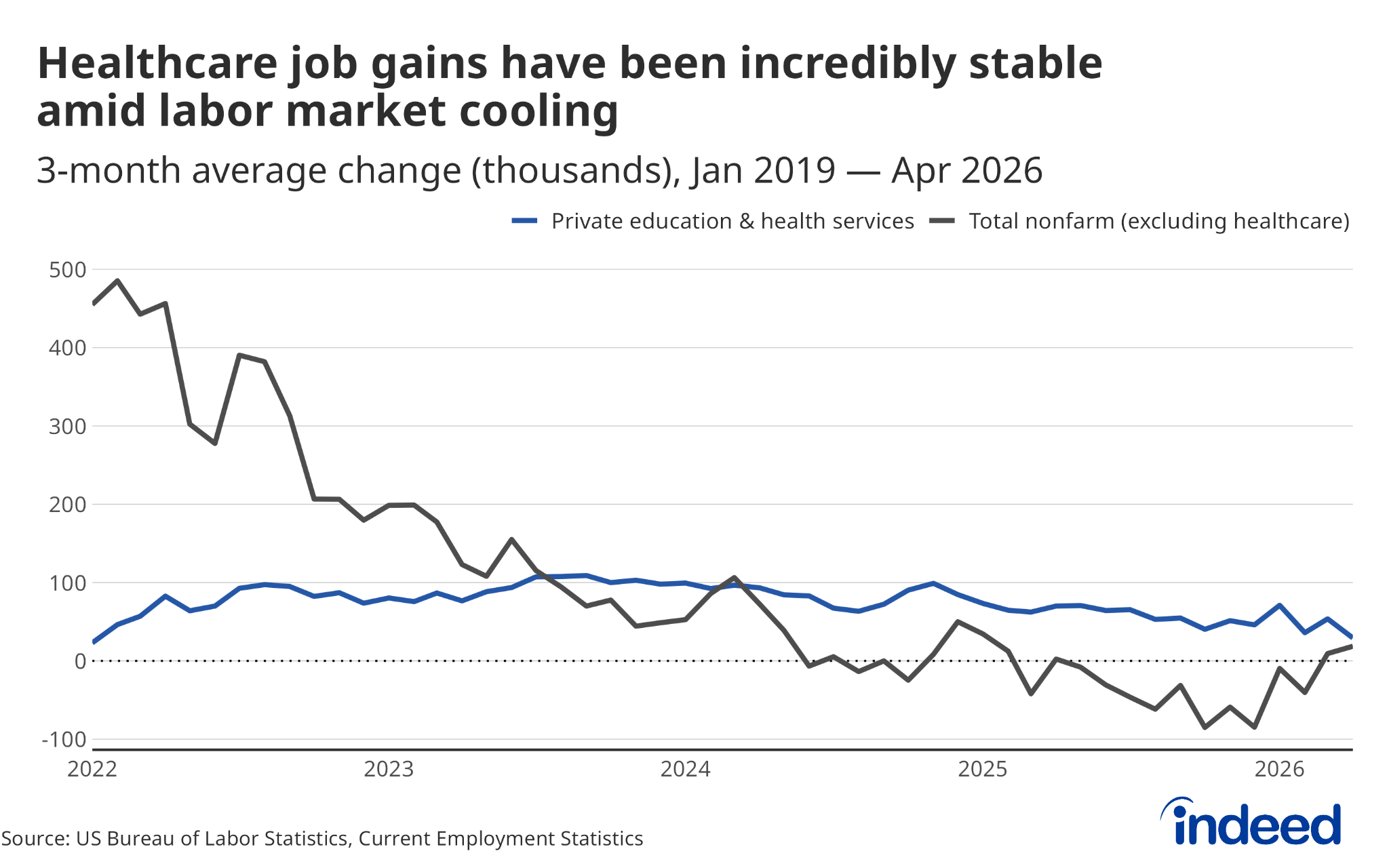
- Over the past year, healthcare employment has grown by 618,000 jobs, while employment in all other sectors has fallen by 367,000.
The US labor market achieved an encouraging milestone in April, logging its first consecutive months of job gains in a year. But while April’s report was generally positive, the progress feels more like a tentative first step than a confident stride forward. Some indicators have improved slightly in 2026, but the broad market still feels effectively pinned in place, with job openings and hiring activity largely moving sideways. The continued deterioration in several key metrics is unsettling, including duration of unemployment and the overall labor force participation rate. And while the broader healthcare sector continues to show strength, that strength is relative – it is more holding steady while other sectors slowly erode.
Healthcare has been the dominant story in monthly job creation for years now, and it continues to mask deeper weakness elsewhere. While healthcare job gains have remained relatively stable, their growing share of total job creation stems primarily from the collapse in other sectors. When averaged together, the headline numbers seem to be stabilizing. But remove healthcare from the equation, and the US labor market is actually losing more than it is gaining – shedding employment in 10 of the last 12 months (on a 3-month average basis). Total employment (excluding healthcare) is down 367,000 since April 2025, while private education and health services is up 618,000 jobs over that same period. This concentration of job growth in a single sector is a clear vulnerability, particularly as broader economic risks continue to mount.
Over the last few years, the labor market has looked a lot like a circus performer strapped to a spinning wooden wheel while knives were being thrown – only somehow, the blades keep missing. Just like a knife-throwing act, the labor market has continued to avoid harm, which is impressive given the Federal Reserve’s historically rapid series of rate hikes, trade wars, the uncertain rise of AI, and widespread volatility – all in the past year or so alone. The audience may be holding its collective breath to see if the conflict in Iran, the latest dagger pointed at the labor market, leaves any lasting wounds. If recent history is any guide, it may yet prove foolish to bet against the labor market’s resilience.