
Key points:
- Overall labour demand is softening in Europe, though some occupations and countries continue to see strength.
- The European Central Bank (ECB) raised interest rates at its June meeting in an effort to dampen overall demand and bring inflation to heel.
See our full European Labour Market Overview chartbook for a more comprehensive view of the European labour market.
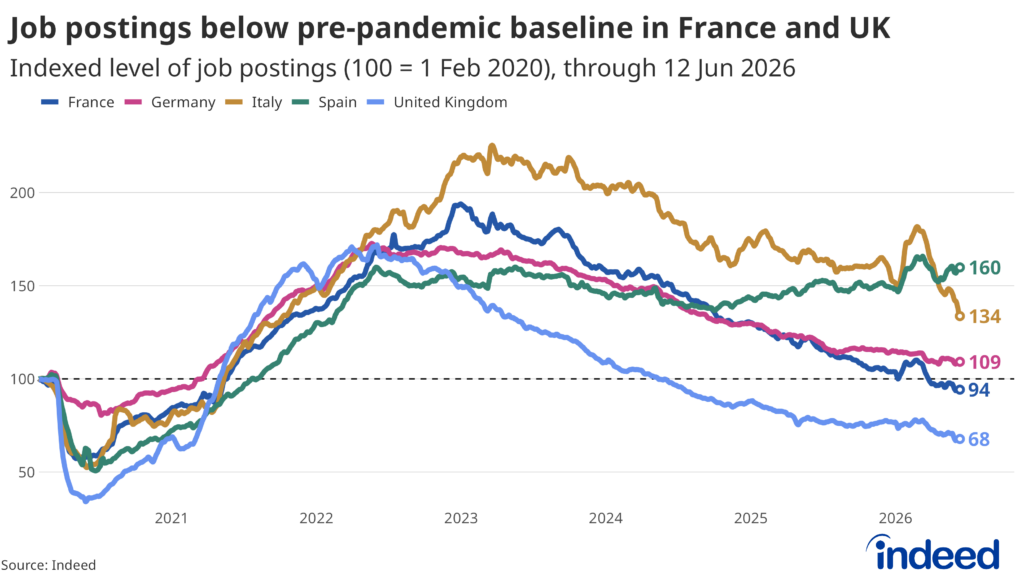
Labour demand continues to soften across Europe. Since the start of the year, the Indeed JPI has fallen 7.5% in the Euro Area, with notable declines in Belgium (-16.2%), Italy and the UK (-11.8%), and in France (-9.2%). A bright spot is Spain, which has seen an 8% increase in job postings year-to-date. With unemployment in the euro area at a still-low rate of 6.3%, the European labour market is broadly solid. Still, the overall decline in the number of job postings reflects an ongoing loss of momentum.
The slowdown is not affecting all sectors equally: while opportunities are scarce in some professions, others are booming. Defence job postings, in particular, are elevated across Europe, with labour demand concentrated in France but with notable growth in Italy. Healthcare postings have also seen ongoing strength this year across the largest European economies. Meanwhile, labour demand for white-collar occupations continues to falter.
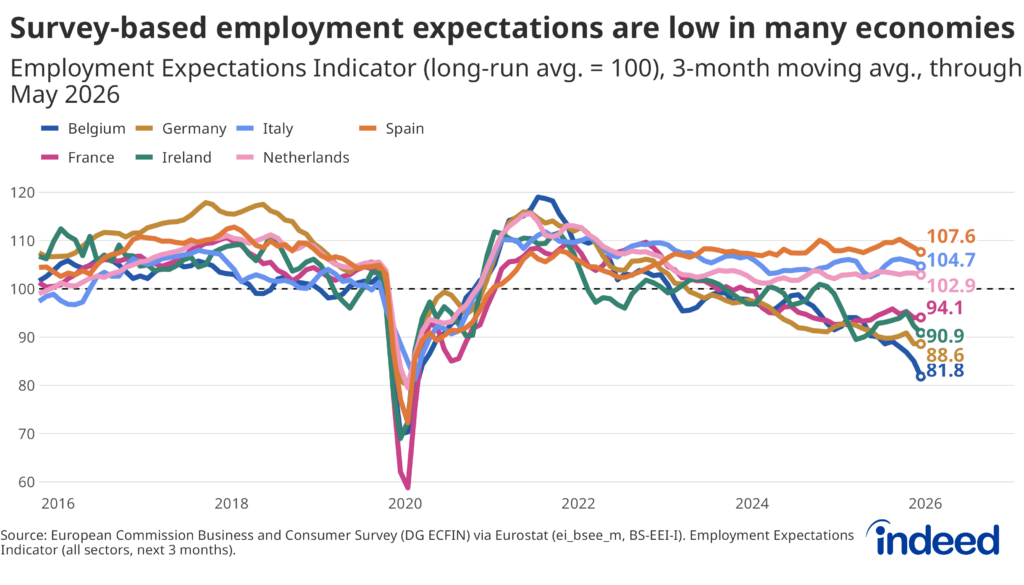
Both consumers and businesses in Europe remain concerned about the state of the labour market. Expectations to hire continued to score below average in May, with hiring plans notably low in services, according to the European Commission’s Business and Consumer Survey. Meanwhile, consumers are more worried about increasing unemployment than at any time in the past decade (outside of the pandemic). Survey responses were collected between the 1st and 21st of May, meaning that participants responded before the European Central Bank (ECB) raised interest rates for the first time in nearly three years, and also before recent peace negotiations de-escalated the US-Iran conflict in the Middle East.
If the US-Iran deal holds and energy prices continue to decline, a more benign inflation outlook could diminish the appetite among ECB monetary policymakers for substantial increases in interest rates this year. At the margin, that could help rebuild employer confidence and put a floor under hiring demand.
See our full European Labour Market Overview chartbook for a more comprehensive view of the European labour market. Other data, including the Indeed Wage Tracker, is regularly updated and can be accessed on our data portal.