
Key points:
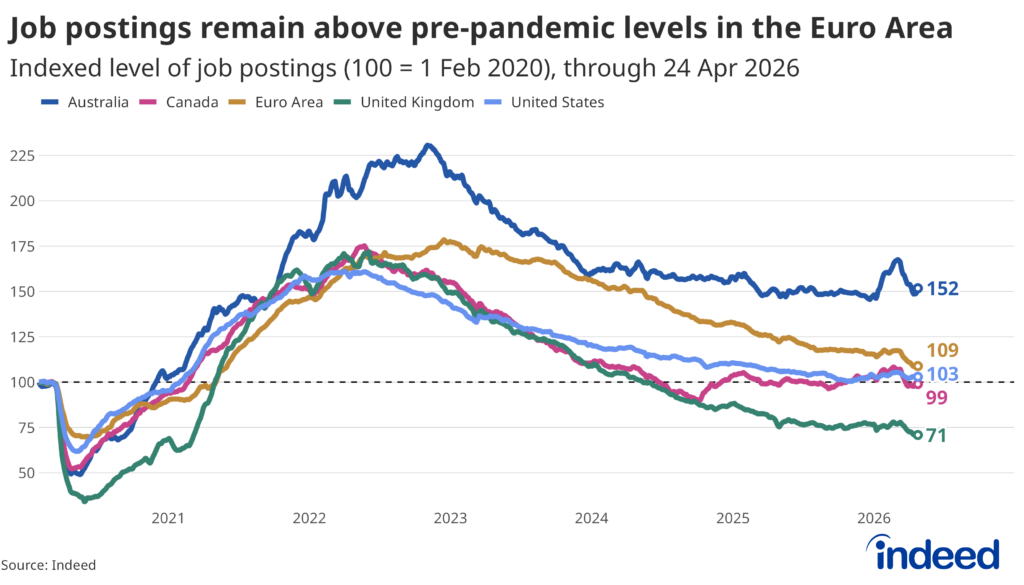
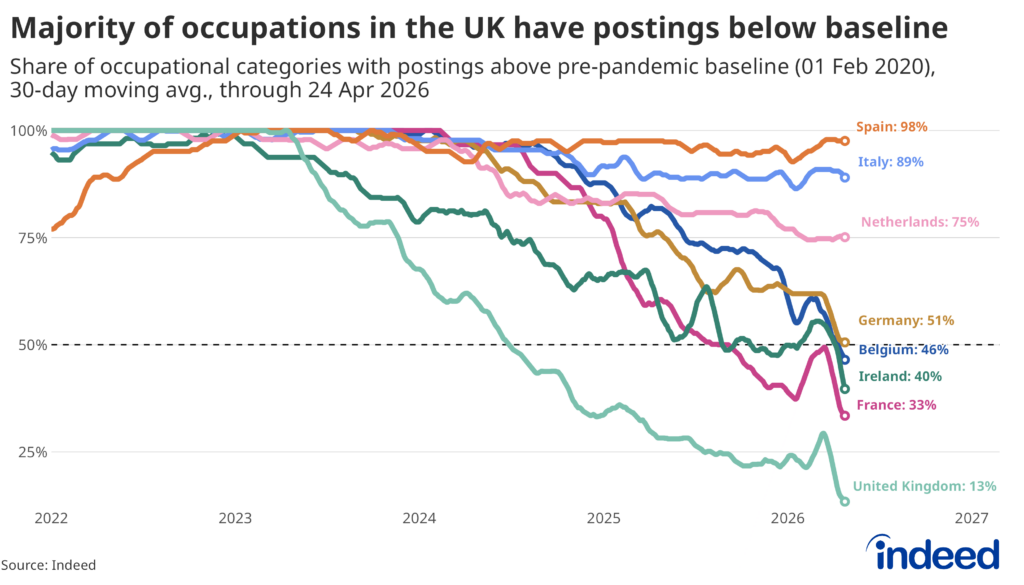
- Job postings remain higher in the Euro Area relative to the pre-pandemic baseline, but momentum has slowed, and hiring is concentrated in fewer occupational categories.
- Risks, including elevated policy uncertainty and skyrocketing oil prices, cloud the outlook for a meaningful improvement in labour markets.
See our full European Labour Market Overview chartbook for a more comprehensive view of the European labour market.
Job postings in Europe have resumed their years-long decline after a period of stabilisation last fall. Even as openings move lower, Euro Area postings remain about 9% higher than the pre-pandemic baseline, leaving European job postings on stronger footing than the US and Canada (where postings are more on par with February 2020 levels). Meanwhile, though the total number of job postings remains elevated in many cases compared to before the pandemic, demand is increasingly concentrated in a shrinking number of occupations.
Hiring is no longer growing across the board. Spain (98%) and Italy (89%) stand out with postings above baseline across a vast majority of occupational categories, but most other countries exhibit a marked narrowing of hiring breadth over the past year. In France (33%) and Ireland (40%), the scope of elevated demand has tightened considerably. Most striking is the United Kingdom (13%), where hiring softness is broad-based, though education & instruction continues to see strength.
Risks, including elevated policy uncertainty and skyrocketing oil prices, cloud the outlook for a meaningful improvement in European labour markets. Measures of economic sentiment and employment expectations both plummeted over April, with a sharp drop in employment plans among managers in services in particular. Still, many pockets of strength (whether occupational, country-specific or AI-related) remain even as the European labour market as a whole continues to cool.
See our full European Labour Market Overview chartbook for a more comprehensive view of the European labour market. Other data, including the Indeed Wage Tracker, is regularly updated and can be accessed on our data portal.