
Key points:
- Wage and salary information has become much more commonplace in Canadian job postings over the past few years, with 57% of Canadian postings on Indeed containing pay information as of June 2026, up from ~20% six years ago.
- Recent progress on salary transparency has been driven by British Columbia and Ontario, provinces affected by pay disclosure legislation. The share of postings in Ontario that include pay information has risen roughly 30 percentage points over the past year.
- Some of the sectors with the largest increases in pay transparency following Ontario’s policy changes this year were the same that saw the largest gains in AI mentions in postings, an effect of the same legislation.
The Hiring Lab publishes its Pay Transparency Tracker, updated monthly, on the Hiring Lab Data Portal.
Wage and salary information is much more common in Canadian job postings than it used to be. In June 2026, more than half of Canadian postings on Indeed contained pay information, up from 1 in 5 postings six years ago. This is a win for proponents of salary transparency (the practice of regularly including wage data in job postings), who argue that disclosing pay in job ads helps to inform job seekers’ application decisions, improves the hiring process for employers by slimming the applicant pool to those for whom compensation expectations match, and even removes potential for wage discrimination.
Salary transparency in Canada largely rose organically for a few years following the pandemic. Changes to the Indeed platform itself in 2020 contributed somewhat to the upswing as employers were prompted to include pay information when posting a job ad directly to the site. At the same time, the need to attract job seekers amidst the tight labour market coming out of the pandemic — alongside changing HR norms more broadly — likely had a hand in driving pay transparency higher.
Since 2023, however, legislation in British Columbia and in Ontario has driven all further increases. Salary transparency in the rest of Canada has stalled at ~40% for roughly three years.
Progress on salary transparency increasingly legislation-driven
The B.C. government started requiring employers to include information about compensation in job postings on November 1, 2023, at which time we wrote about the immediate effects of the law. Now, we are beginning to see an impact in the Indeed data from new legislation in Canada’s most populous province.
As a part of Ontario’s overhauled Employment Standards Act, as of January 1, 2026, employers with at least 25 employees have been required to include details on expected pay in job ads. Transparency began rising modestly in advance of the legislation taking effect, and just before it was implemented, 49% of postings in Ontario included explicit pay information, according to our Indeed Pay Transparency Tracker. As of June 2026, that figure had risen to 71%, an increase of roughly 30 percentage points over the past year.
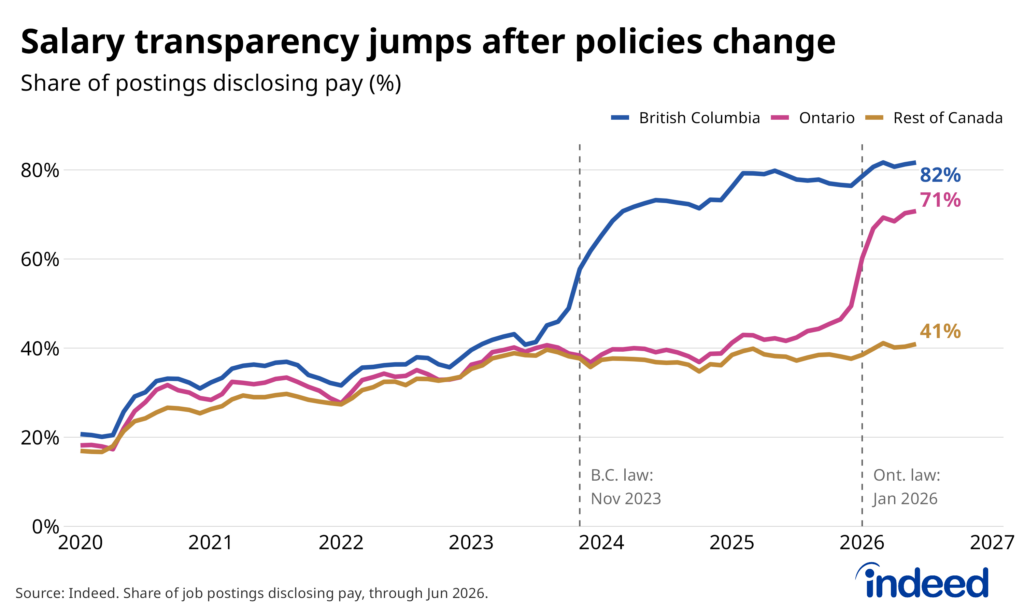
Crucially, spillovers to the rest of Canada from these policies have been muted thus far. While the share of transparent postings did tick up outside of Ontario around the January 1 implementation date, the improvement is marginal. To date, only 41% of Canadian job postings outside of B.C. and Ontario include pay data.
Some fields still without widespread pay transparency in Ontario
Within Ontario, the share of postings explicitly including pay information jumped after the policy change across effectively all sectors we track, with a median gain of 31 percentage points from June of last year to June 2026. In general, some of the largest increases occurred in occupations that were least likely to disclose salary information previously. Many engineering roles, in particular, stand out: the share of postings disclosing compensation rose 43 percentage points in mechanical engineering and 46 percentage points in civil engineering. Transparency was already relatively high in the construction sector, so had less room to grow. Even so, the field still saw a 17 percentage-point gain in transparency over the past year.
Meanwhile, other fields with more lackluster increases in transparency tended to be higher-paying. According to the legislation, employers are not required to disclose expected compensation if it exceeds $200,000 annually. It makes sense, then, to see postings for the highest-paying roles see the smallest change in transparency (in fact, transparency in postings for physicians & surgeons fell 1ppt). Meanwhile, job postings for therapists, dentists, and in banking & finance all saw among the smallest gains in transparency. The new legislation simply does not affect these sectors to the same degree as those less likely to pay a salary above $200,000.
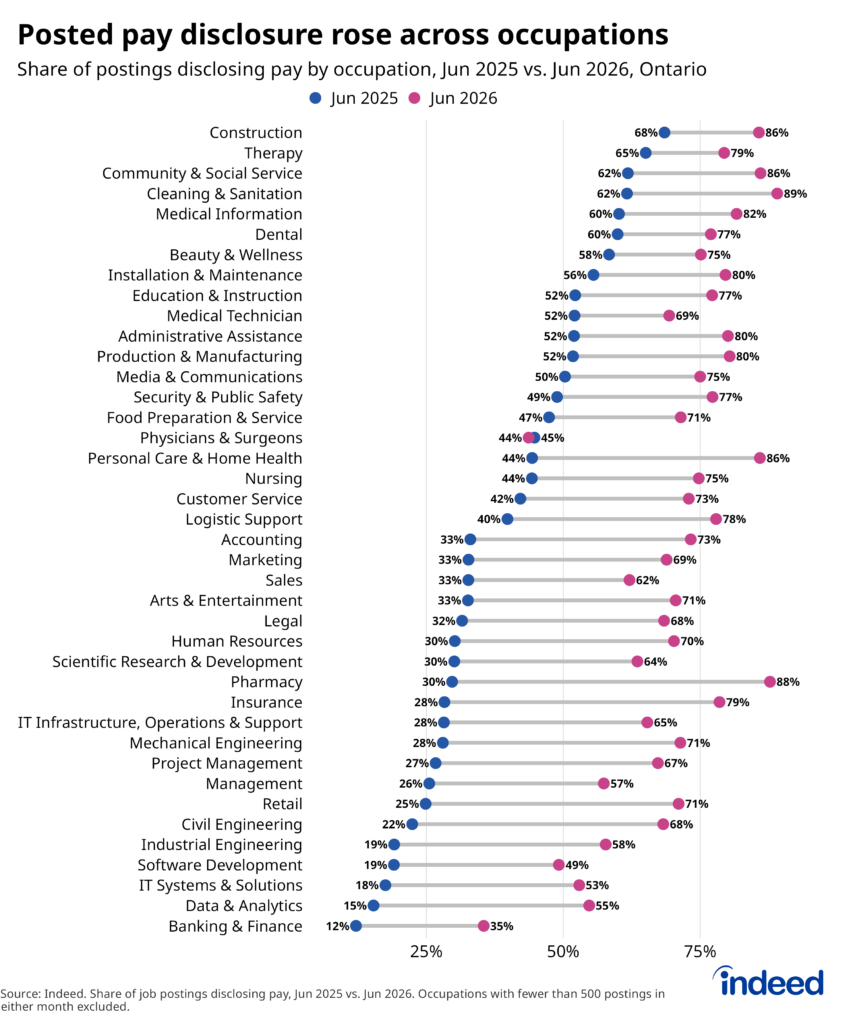
A second driver of increased pay transparency at the sectoral level is compliance rates. In Ontario, the new policy not only required employers to disclose expected compensation in public job postings, but also to disclose AI use in the hiring process. The same sectors that saw the largest increases in our Indeed AI tracker also led the way in heightened salary transparency.
Even so, as of June 2026, no more than 90% of postings in any single occupation analyzed included salary data — a hint that there is still some room to grow and that some employers may not yet be fully compliant with the new requirements.
More transparency, but less certainty, in expected compensation
Even with improvements in overall salary transparency, job seekers in Ontario still often lack exact details about what a new opportunity will pay. Of the jobs that do provide information, the majority disclose an expected salary range, rather than a single figure. Only 16% of “salary transparent” job postings in Ontario quoted exact pay in June, effectively the same share as in Canada as a whole.
Moreover, job seekers in Ontario might notice that these ranges are wider than they used to be. For the first half of last year, the median posted salary range width was roughly 16%. In the first half of this year, it had widened to 18%. Put another way, it’s the equivalent of a job posting last year noting that a job might pay between $100k and $116k, while the same job posting this year might note that pay was between $100k and $118k. The move in ranges suggests the employers who were hesitant about sharing pay information pre-policy have been moderately less precise once they do disclose.
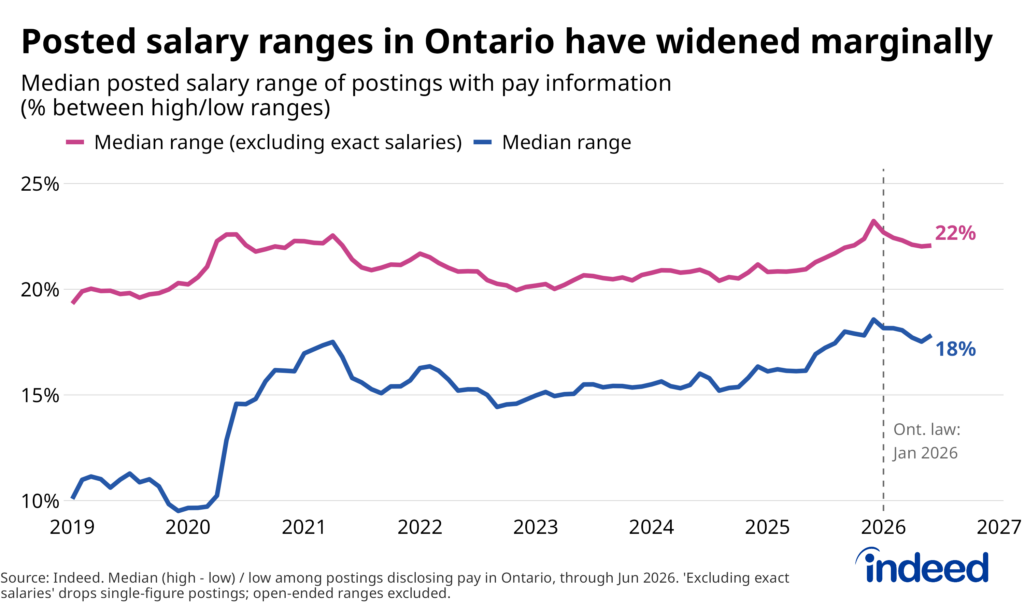
For employers, including pay details via ranges maintains optionality while still attracting job seekers who might otherwise not apply to a position lacking any wage information. For Canadian job seekers who report that higher pay is the number one reason they search for new roles, more specific insight into what new job opportunities might pay is always welcome news.
Conclusion
Many job postings across Canada still lack any information on pay, but recent legislation in B.C. and Ontario has driven disclosure higher, and helped push Canada as a whole up the rankings of pay-transparent advanced economies. Prior to the recent jump, Canada’s pay transparency rate was broadly in line with that of the United States. Now, Canada has definitively overtaken the US (49%), and as of June, trailed only Japan (a global standout with 97% of postings including pay detail) and the UK (58%).
Still, in an international salary transparency race among the 11 economies regularly tracked by Hiring Lab, the bar is getting higher. While an EU-wide regulatory initiative to boost transparency has largely stalled on the continent so far, a separate proposal in the UK aims to elevate transparency there even further. With organic growth stalling outside of B.C. and Ontario, Indeed data suggest that Canada’s future trajectory in these global rankings will largely reflect the presence or absence of new provincial mandates.
Methodology
We define salary-transparent jobs as job postings on Indeed that provide explicit wage or salary information. In the analysis, the “Rest of Canada” consists of job postings in Canada for which the province is identifiable and is not either British Columbia or Ontario. We include Prince Edward Island among the “Rest of Canada” for ease, even though it does enforce pay transparency legislation due to the province’s small size relative to the Canadian labour market.
All figures are self-reported and reflect Indeed’s user base, which may differ from the overall US workforce.