
Key points:
- It’s been harder for job seekers to find new work in recent years, but workers starting new roles are less likely to lose their jobs, or leave work entirely than they used to. The shift has been particularly pronounced among workers who’ve been with their employer a year or less, reflecting a drop in “quick quitting”.
- Layoff rates are down similarly from pre-pandemic levels among short and long-tenured employees, while voluntary leaver rates have plunged among recent hires.
- The decline in quick quitting has occurred across age groups as well as most industries, with the largest declines occurring in sectors where it was previously most common, like non-durable goods manufacturing, information, culture and recreation, and accommodation and food services.
- Pessimism about finding new work is a likely driver of the drop in quick quitting, but the trend could also reflect improved job satisfaction among recent hires.
Slow churn has been a defining feature of the Canadian labour market in recent years: Monthly hiring rates are down, according to the Labour Force Survey, but so too are separations, including both job losses (i.e., layoffs and discharges), and voluntary quits. These trends have combined to create a difficult situation for unemployed job seekers, who are finding it difficult to return to work, or even break into the labour market in the first place. However, the jobs that are being started are lasting longer, with separations down, particularly early on in employment relationships.
Historically, employees who are new to their jobs (with tenure of one year or less) are over twice as likely to transition out of work in a given month compared to longer tenured workers. In the last year (as of April 2026), the monthly employment separation rate averaged 2.0% among recent hires, compared to 0.7% among those who’d been at their employer longer than 12 months. This gap mainly reflects higher layoff and discharge rates among recent hires (1.5% vs. 0.5%), but also greater rates of people voluntarily leaving employment, either for unemployment, or out of the labour force entirely (0.5% vs. 0.2%).
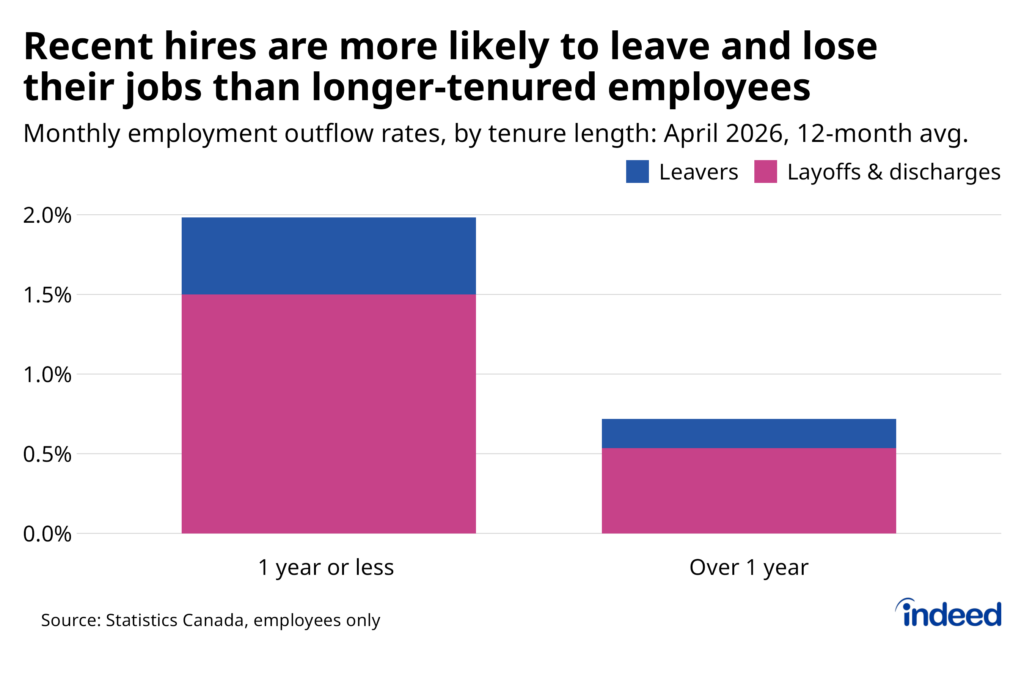
Separations are down among both short- and long-tenured employees in recent years, but the declines have been particularly sharp among new hires. In the last year (through April 2026), employment outflow rates among workers with tenure of one year or less were down 20% compared to their 2017-2019 monthly averages, a steeper decline than the 11% drop among longer-tenured employees. This greater decline in separations among new hires reflects a plunge in quick quitting. While layoff and discharge rates were down about 13% among both groups, quit rates of employees leaving work entirely were down 34% among new hires, compared to just a 4% decline among long-tenured workers.
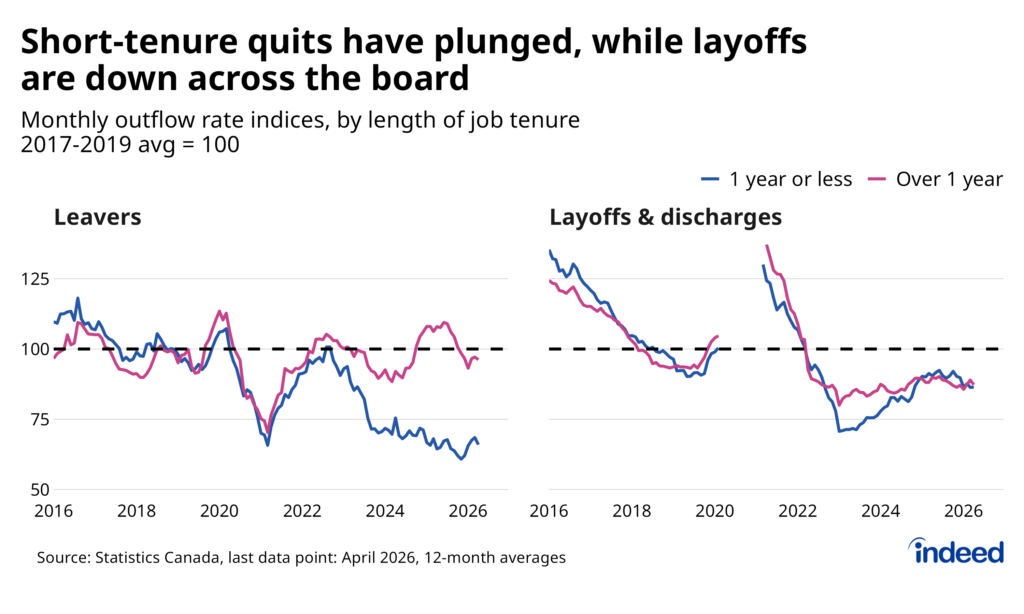
This data on job leavers focuses specifically on people leaving their jobs for non-employment, rather than those switching employers. However, job hopping has also evolved similarly to short-tenured (but not long-tenured) quits: According to the LFS, over the year through April 2026, the share of employees changing employers in a given month was down 41% compared to their 2017-2019 averages. Statistics Canada doesn’t publish details on which workers are changing jobs, but the tight correlation with trends in quick-quitting suggests that the drop in job hopping has also been concentrated among recent hires.
Declines in quick quitting have been widespread
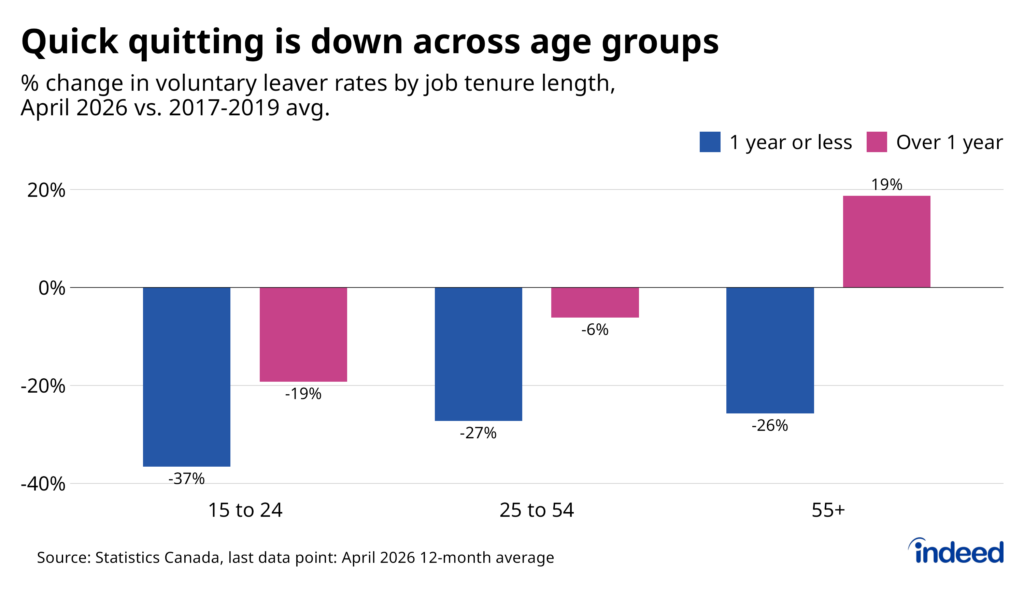
The divergence in quit rates by job tenure has occurred across age groups. Compared to pre-pandemic rates, voluntary outflows from employment by new hires are down among youth (age 15-24), core-age (age 25-54), and older employees alike. Leaver rates of longer-tenured employees have also slipped among core-age and (particularly) younger workers, but by smaller magnitudes than recent hires. By contrast, rising retirements have boosted outflows among older workers.
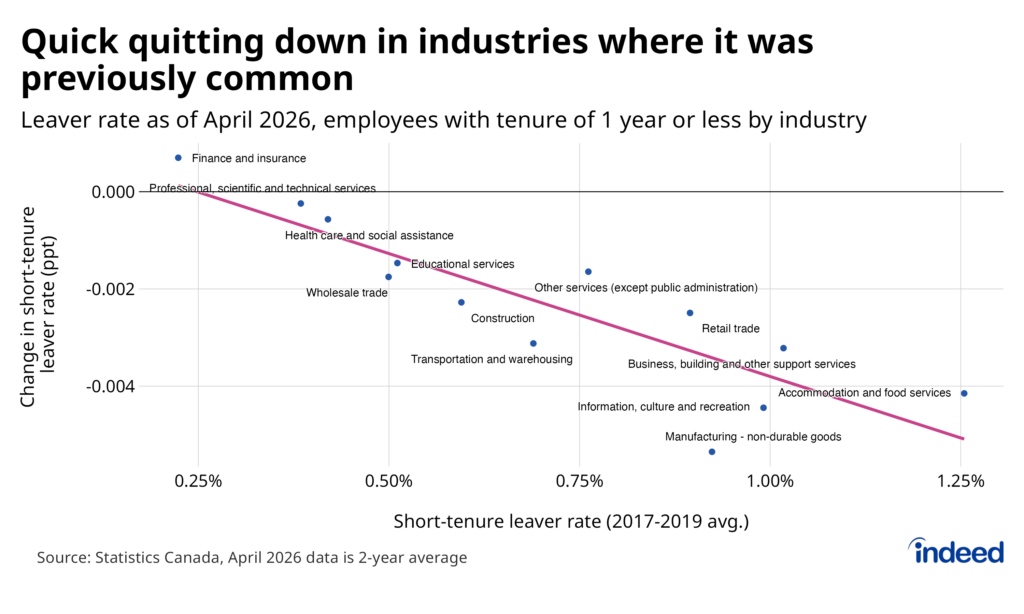
Fewer short-tenured exits have also been widespread across industries. Over the two years through April 2026, quick quitting was either flat or down in 12 of 13 industries with sufficient data (though in several cases it was rare to begin with). In percentage point terms, the declines were largest in the industries where it was previously more common, including non-durable goods manufacturing, accommodation and food services, and information, culture and recreation. The latter is a particularly prominent industry in the summer job market, which has underwhelmed in recent years.
Both push and pull factors could be at play
The term “job hugging” has emerged in recent years to describe workers holding on to their jobs longer than they used to. This trend is present in Canada, but with a twist: the decline in people leaving work is mainly concentrated among recent hires.
Confidence in finding a new, suitable job is a key “pull” factor in someone’s decision to temporarily stop working. The falling leaver rate might simply be a signal of Canadian workers’ pessimism about their job-finding prospects. But at the same time, quits are also driven by “push” factors, like whether people are satisfied with their jobs.
Can either factor explain why the decline in quits has been so concentrated among recent hires? One possibility is that the new employees have been more sensitive than longer-tenured workers to weak hiring conditions when deciding whether to jump ship. However, it could also be that recent hires are more satisfied with their new jobs than they were before. Job seekers have more information than they used to on both the job openings active in their area and the quality of the employers looking to fill them. An improved matching process can mean new employment relationships are more likely to be a good fit, and other research has found that short employment stints have declined as job search technology has evolved.
From an employer’s point of view, the drop in quick quitting is a relief. Fewer new hires leaving means less time and money spent on recruiting and onboarding their replacements. For job seekers, the impacts are more ambiguous. Vacated positions can create new opportunities for other job seekers, so slower churn might make it tougher for the unemployed to find work. However, if quick quitting is down because new hires are more satisfied with their jobs, then eventually most job seekers are probably coming out ahead.
Methodology
Data in this post is based on Indeed‘s analysis of the Statistics Canada’s Labour Force Survey, using the Public-Use Microfiles. All data points cited in the post are non-seasonally adjusted 12-month moving averages, unless stated otherwise. Self-employed workers are not included in this analysis.
Employment outflows for a given month are tallies of the number of people newly out of work (with duration of jobless 1 month or less), grouped by whether they lost their job, or voluntarily left, and whether their tenure at their previous employer was over 12 months or not. To calculate outflow rates by job tenure, these outflow metrics are divided by the number of employees in the previous month, grouped by whether their tenure at their current employer is over 12 months or not.