
Key points:
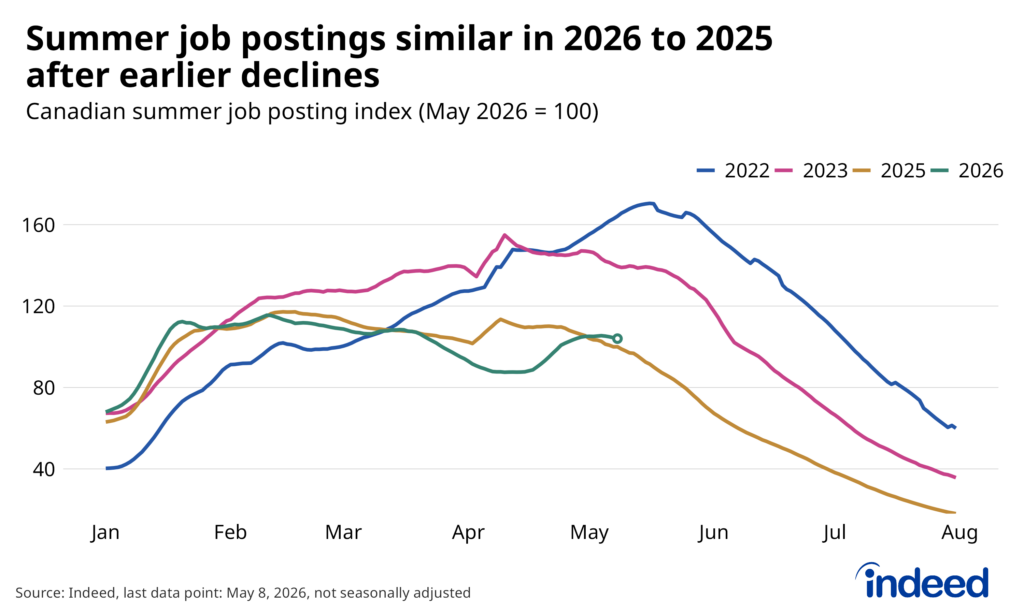
- After declining steadily between 2022 and 2025, Canadian summer job postings have been stable so far in 2026, and as of early May, were up 4% from a year earlier. Over the past few years, trends in summer job postings have broadly mirrored those in overall job postings.
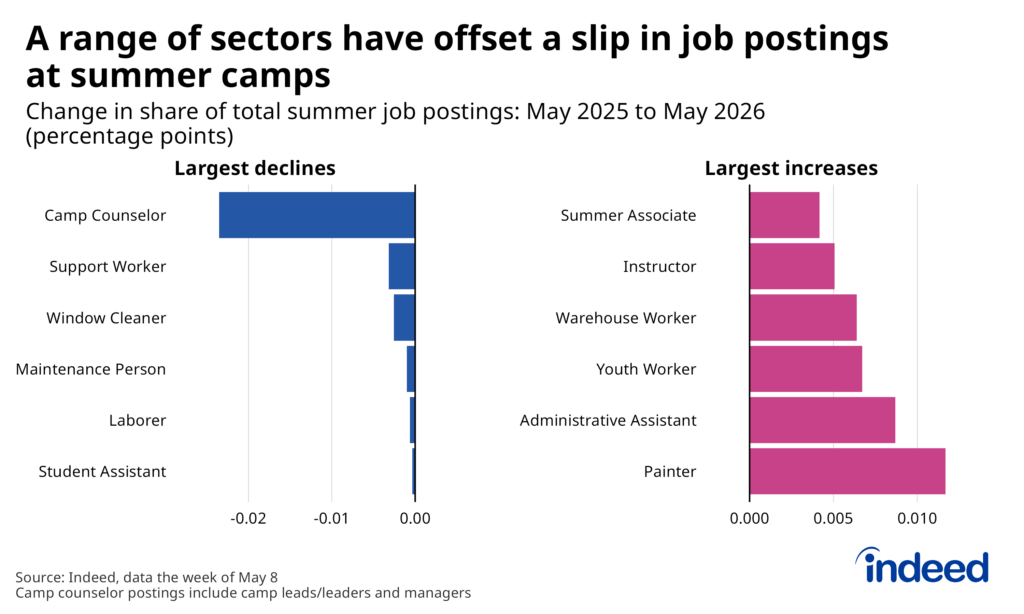
- Jobs at summer camps remain the most common category of summer postings, but have slipped compared to 2025, offset by stronger seasonal demand for painters, administrative assistants, warehouse workers, and youth workers.
- The typical summer pop in youth employment rates has been somewhat smaller in recent years, as weak labour market conditions have carried into seasonal employment. Flat summer postings suggest this pattern will continue in 2026.
The annual summer job recruiting cycle generally starts ramping up in January, before beginning to cool in mid-May. However, aside from its unique monthly trajectory, summer job postings have been evolving in line with broader economic trends. For 2026, this has meant a relatively stable summer hiring appetite compared to 2025, after declining over the prior three years, suggesting we could see another soft summer labour market for Canadian youth.
We track seasonal demand by tallying Canadian job postings on Indeed that explicitly include the term “summer” (or été) in their job title. Aside from a temporary dip in April, summer job postings throughout 2026 have remained at similar levels to 2025 and, as of May 8, 2026, were up 4% from a year earlier. This stabilization from a year ago marks a break in trend after consecutive declines between 2022 and 2025, with summer job postings in early May 2026 still down 37% from their 2022 peak.
Summer camps are consistently the largest source of summer job postings, with camp counselors, leads, and managers together comprising 13% of summer job postings as of early May 2026. However, this share was down somewhat from the 15% seen at this time last year. Offsetting softer demand for these roles was greater seasonal demand among a range of fields, including painters, warehouse workers, and administrative assistants. There was also growth in summer job postings for youth and community care workers, highlighting how delivering services for youth is a key part of the seasonal economy.
Like summer job postings, as of early May, total Canadian job postings on Indeed were also roughly flat year over year, and the two series have evolved quite similarly since 2023. In early May 2026, 0.98% of total job postings included “summer” in their title – three years earlier, the share was 0.96%. These parallel trends highlight how demand in Canada’s seasonal job market links to developments in the rest of the economy. Not only is seasonal employment impacted by the broader strength of household and business spending, but the health of the labour market as a whole plays a key role in determining who is available to work.
Summer youth employment jumps have been more muted amid the weaker job market
Every year, youth employment rates jump as the school year ends with first post-secondary, and then high school students start summer jobs. However, these typical seasonal jumps have been more muted of late. In years with stronger labour markets, such as 2018, 2019, and 2022, youth employment rates rose by an average of 11 percentage points on a non-seasonally adjusted basis between March and their July peak. Since 2023, the jumps have been in the range of 9.1 to 9.4 percentage points, on average, a net 16% drop in the rate of youth entering summer employment.
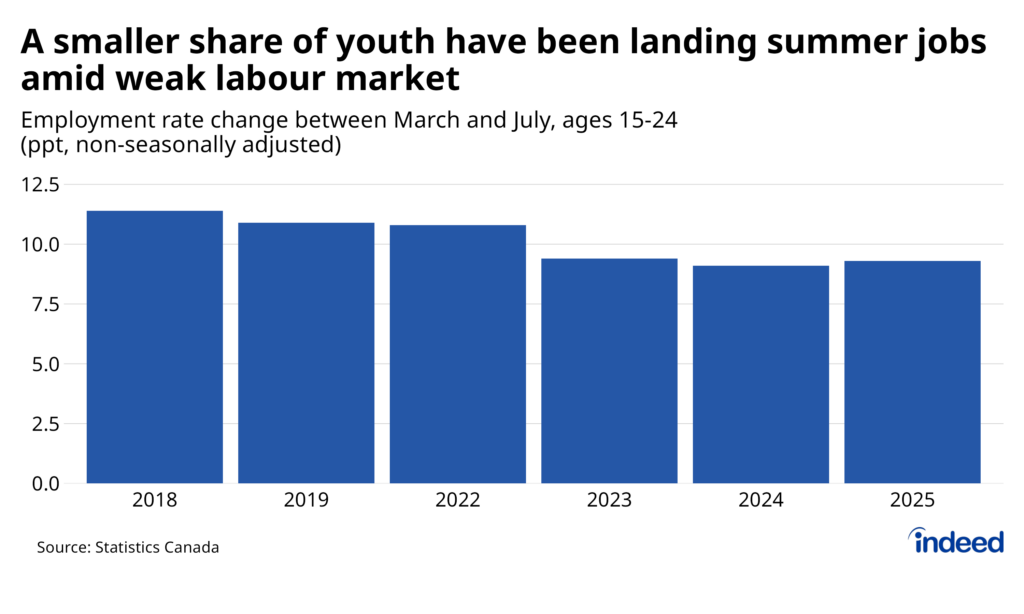
The youth job market has been in distress since 2023, particularly among teens, and the muted seasonal jumps in youth employment rates have been one result. The share of Canadians under 25 who are working has been low year-round recently, but with youth labour force participation jumping at the end of the school year, the difficult labour market is felt most widely during the summer months.
Like for Canadian job postings overall, the similar level of seasonal hiring appetite compared to 2025 suggests it’s unlikely the summer job market will deteriorate further in 2026. But given the low starting point, the labour market is seeking a rebound, not just stability. Even amid a weak labour market, many youth will find summer jobs this year, though they might not be of the same quality they’d find during stronger conditions. However, a greater share than normal will find it tough to find work, meaning both missed paychecks and a chance for work experience that could help establish their early career trajectory.
Methodology
We track summer hiring appetite by tallying Canadian job postings on Indeed that include the term “summer” or “été” in the job title, excluding postings with job titles that also include “intern” or “internship”. We track internship postings separately, tallying the presence of the latter two terms in job titles. This method doesn’t capture the full extent of seasonal demand but provides a gauge of recent trends and how season postings compare to the prior year. All posting data presented reflects 7-day trailing moving averages.
The number of job postings on Indeed, whether related to paid or unpaid job solicitations, is not indicative of potential revenue or earnings of Indeed, which comprises a significant percentage of the HR Technology segment of its parent company, Recruit Holdings Co., Ltd. Job posting numbers are provided for information purposes only and should not be viewed as an indicator of performance of Indeed or Recruit. Please refer to the Recruit Holdings investor relations website and regulatory filings in Japan for more detailed information on revenue generation by Recruit’s HR Technology segment.