
Key points:
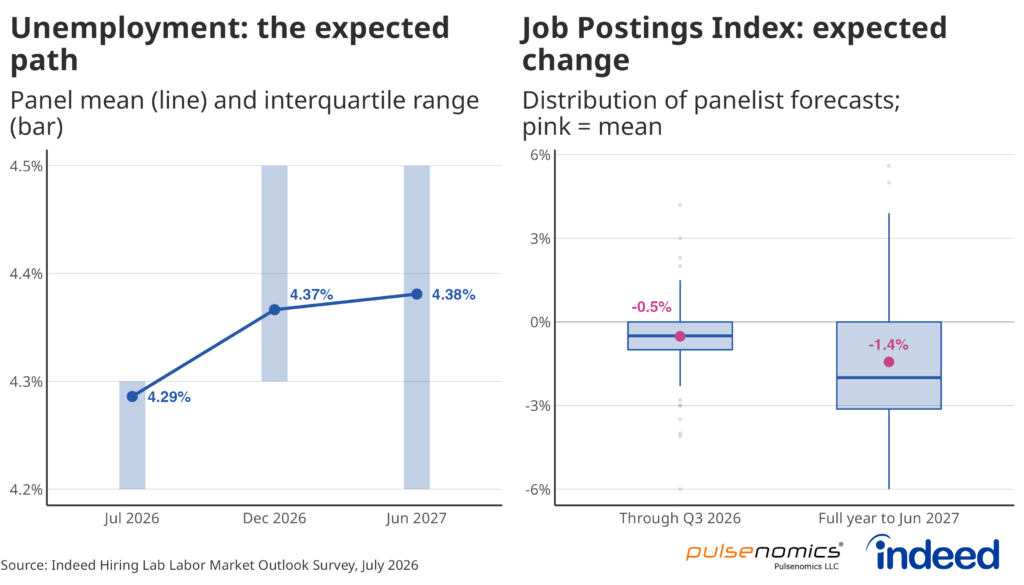
- A majority of economists recently surveyed by Indeed said they expect a gentle economic cooling over the next year, not a downturn. The Indeed Job Postings Index (JPI) is expected to fall by 1.4%, on average, through June 2027, and unemployment is forecast to drift up from its current 4.2% to roughly 4.4% by year-end.
- The panel was divided on the near-term impact of AI on the jobs market, and leaned slightly negative. A small majority (52%) said they expect AI to be at least a mild drag on employment over the next year; 35% said they expect a net gain; 13% said they expect no effect.
- A larger majority (57%) of panelists said they expect downward pressure on the wages of college-educated workers over the next year, versus 34% who said the same for workers without a degree.
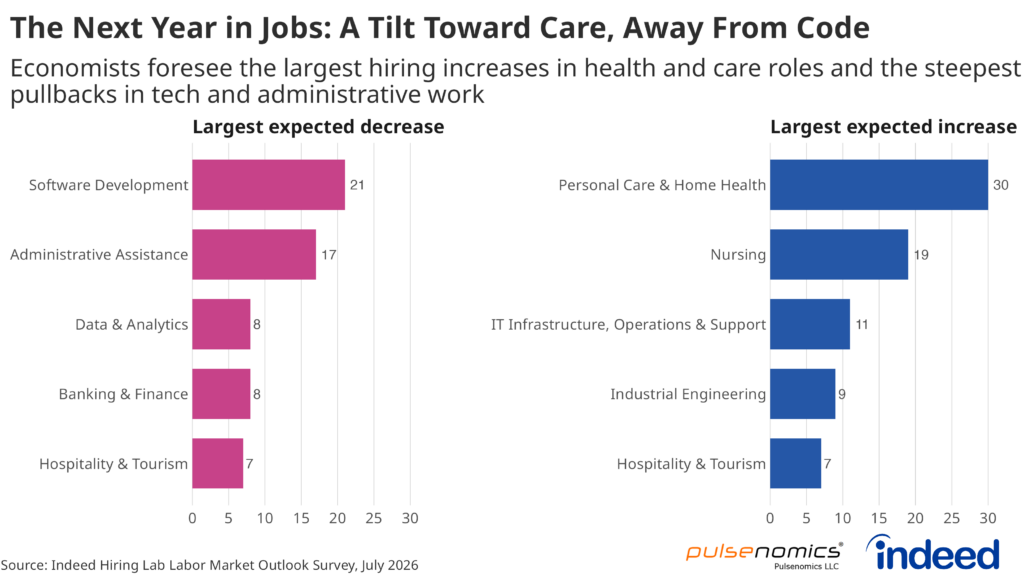
- The fastest-growing work is hands-on and beyond AI’s reach. Personal Care and Home Health, along with Nursing, top the list of sectors where economists expect postings to grow in the next year.
Results from a new, Indeed Hiring Lab-sponsored survey of more than 100 US economists and labor market experts, conducted by Pulsenomics, paint two distinct pictures of the near-term economic outlook. The macro outlook appears remarkably settled, with unemployment expected to stay somewhat muted and job postings to remain largely flat. But the AI outlook is anything but.
The Indeed Hiring Lab Labor Market Outlook Survey is a new quarterly read on where the US labor market is headed, bringing together dozens of labor and macroeconomists from the nation’s top research universities, financial firms, think tanks, and other institutions. It is a forward-looking complement to the real-time hiring data we publish every day.
When a group like this converges, it is worth paying attention. When it splits, that tells us something, too. This quarter, it did both.
A market that has cooled, not one that is cooling
The panel’s near-term macro view is one of managed, undramatic softening. On average, panelists expect the Indeed Job Postings Index — a measure of hiring demand published by Indeed Hiring Lab — to be about 0.5% below its June level by the end of September. A year from now, in June 2027, it is expected to be about 1.4% lower than today, a decline that is expected to slow rather than snowball as 2026 turns into 2027. On average, the panel’s unemployment predictions follow a similar gentle arc: up to 4.3% in July and about 4.4% by year-end, where it is expected to remain through mid-2027.
Even the disagreement is narrow. The most optimistic quarter of the panel said they see unemployment easing back toward 4% by mid-2027; the most pessimistic said they expect it to be near 4.7%. That is a tight band for a one-year forecast, and it fits a view we have held for most of 2026: this is a labor market that has cooled, not one that is still cooling. It is bumping along the bottom, and these results show it is expected to keep doing so.
The reshuffle is inside the office
The AI picture is where the panel splits. Asked whether AI will be a net positive or net negative for US employment over the next year, a small majority (52%) said it would be at least a mild drag, about a third (35%) said a net gain, and 13% predicted no effect. The one thing economists broadly agree on is AI’s impact on productivity. Nearly all respondents said they expect AI to raise productivity over the next three years, but 70% expect only a modest-to-moderate boost, and just 4% expect a transformative one, well below the loudest claims in either direction.
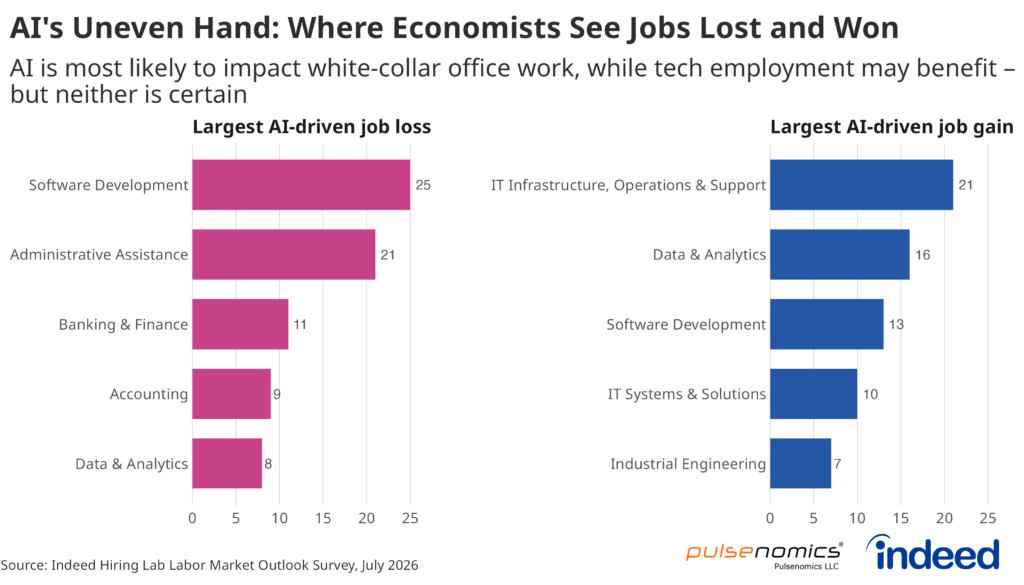
The most revealing result is not how much AI will change employment, but in which sectors. When asked to name the occupations they expect to see the largest AI-driven job losses and gains over the next year, Software Development appeared on both lists.
Not a single panelist named the same occupation as both the biggest loser and the biggest winner. Instead, Software Development likely landed near the top of both lists because the economists surveyed don’t agree on which way AI will break for software developers. Economists who said they expect software to shed jobs tended to name adjacent technical fields as the winners: Data and Analytics, and IT Infrastructure. Those who said they expect software to gain tended to name routine white-collar roles as the losers: Administrative Support, Marketing, and Human Resources. The through-line is reallocation within white-collar and technical work, away from routine, rules-based tasks, and toward roles that complement AI rather than compete with it.
AI comes for the college wage
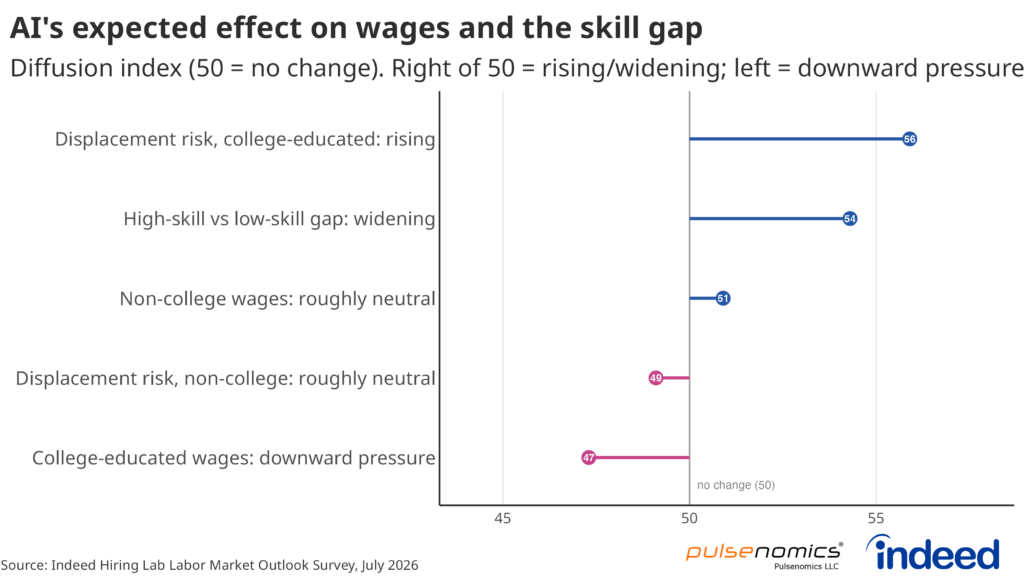
Surveyed economists said they expect AI to put more pressure on the wages of college-educated workers than on those without degrees. A majority (57%) said they expect AI to place at least slight downward pressure on college-degree holders’ wages over the next year, versus only about a third (34%) who said they expect the same for non-college-educated workers. Almost two-thirds (61%) said their assessment of AI’s potential to displace college-educated workers had increased at least somewhat over the past year. The college-credentialed worker, long assumed to be safe from technology-driven displacement, is currently the one the panel is expressing the most worries about.
But those results appear to conflict with other survey data. A slim majority of respondents (51%) also said they expect AI to widen the wage gap between high- and low-skill workers, and not one panelist said they expected that gap to narrow significantly. How can AI depress college-educated workers’ wages and widen the skilled wage premium at the same time?
The answer may be because “college-educated” and “high-skill” are no longer necessarily the same. The roles the panel expects AI to hit hardest are solidly in the white-collar world — Software Development, Administrative Assistance, and Banking & Finance. The roles it expects AI to reward are a narrower, more technical tier that works alongside the technology. Some of these roles, like engineering, require a four-year college degree, but others, including technicians and IT support, do not. Average college wages are expected to soften even as the distance between the top and the bottom grows. The split is inside the office, not along the white-collar/blue-collar line.
What this means for the Great Mismatch
Step back, and one theme runs through both pictures. The sectors economists expect to grow fastest over the next year, especially Personal Care & Home Health and Nursing, are hands-on, in chronically short supply, and almost entirely beyond AI’s reach. The sectors expected to decline are generally well-supplied, white-collar ones. In the panel’s view, AI and other factors are more likely to act on the part of the labor market that may have workers to spare, and leave alone the parts that largely don’t.
This echoes the findings of a recent Hiring Lab projection that forecasts employment and population trends through 2040. That work used a search-and-matching model to project the next 15 years, while this survey is the pooled judgment of more than 100 forecasters about their expectations for the next year. But those different horizons and methods both draw a line with roughly the same shape: AI exerting greater force on the well-supplied white-collar middle, and demographics driving demand toward care and health roles where workers are scarce.
The defining challenge of this labor market is less about how many people are working than about its architecture: Who works where, which jobs are being rebuilt, and how easily workers can move toward the work that needs doing. The unemployment rate may barely budge over the next year, but that doesn’t mean that labor market dynamics aren’t rapidly shifting. They are. We will track how this panel’s views evolve over time as the data comes in.
Methodology
The Indeed Hiring Lab Labor Market Outlook Survey is a quarterly survey of professional economists and experts, sponsored by Indeed and administered in partnership with Pulsenomics LLC. The inaugural Q2 2026 wave was fielded in July 2026 and drew responses, in whole or in part, from 120 economists and experts across academia, financial institutions, and independent research organizations. Panelists were not required to provide answers for every question asked. Panelists’ expectations are their own and do not necessarily represent the views of their affiliated organizations or employers. Some panelists elected to keep their individual responses confidential; those responses are included in the summary statistics but not shown at the individual level. The number of responses varies by question, from roughly 120 for the JPI and unemployment questions to between 70 and 100 for several of the AI questions.
JPI expectations are reported as percent changes from the June 2026 level of the Indeed Job Postings Index: a third-quarter figure (September 2026 versus June 2026) and a full-year figure (June 2027 versus June 2026). For the AI questions, the diffusion indices summarize the balance of opinion for each question. The index formulation reflects the direction and intensity of survey responses on a 0 to 100 scale (50 = neutral).
The Indeed Job Postings Index (JPI) and the findings, projections, and opinions expressed in the Indeed Hiring Lab Labor Market Outlook Survey are provided for informational purposes only and are not indicative of the potential revenue, earnings, or financial performance of Indeed, which comprises a significant percentage of the HR Technology segment of its parent company, Recruit Holdings Co., Ltd. Survey results, projections, and labor market data referenced herein reflect the views of survey panelists and Indeed’s Hiring Lab researchers at the time of publication; they represent estimates that may change and may differ materially from Indeed’s or Recruit’s own assessments, forward-looking statements, or actual results. Nothing contained herein should be viewed as an indicator of the performance of Indeed or Recruit, or construed as investment advice. Please refer to the Recruit Holdings investor relations website and regulatory filings in Japan for more detailed information on revenue generation by Recruit’s HR Technology segment.