
Key points:
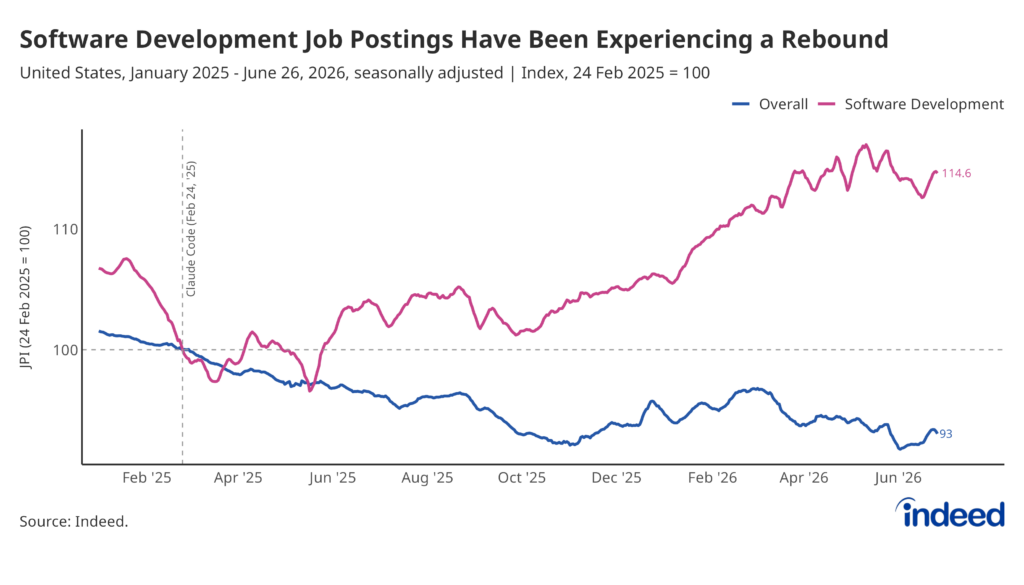
- US software development job postings have grown by almost 15% since the launch of Claude Code in late February, 2025, while overall job postings fell by 7% over the same period.
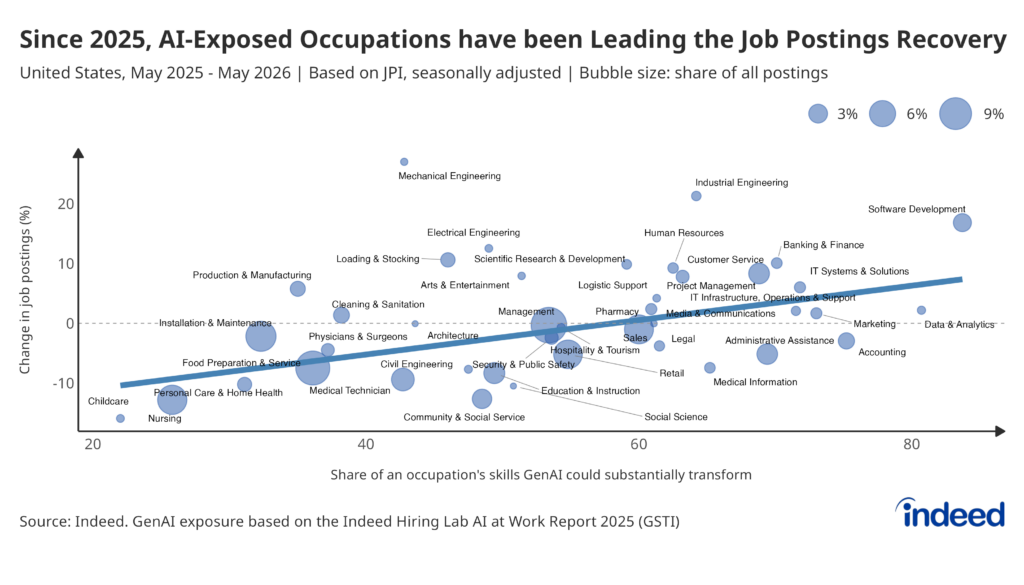
- Job postings for occupations with more potential exposure to AI-driven change, including software development, generally fell the most between 2022 and 2026. But over the past year, the most AI-exposed occupations have generally seen the largest rebound in postings.
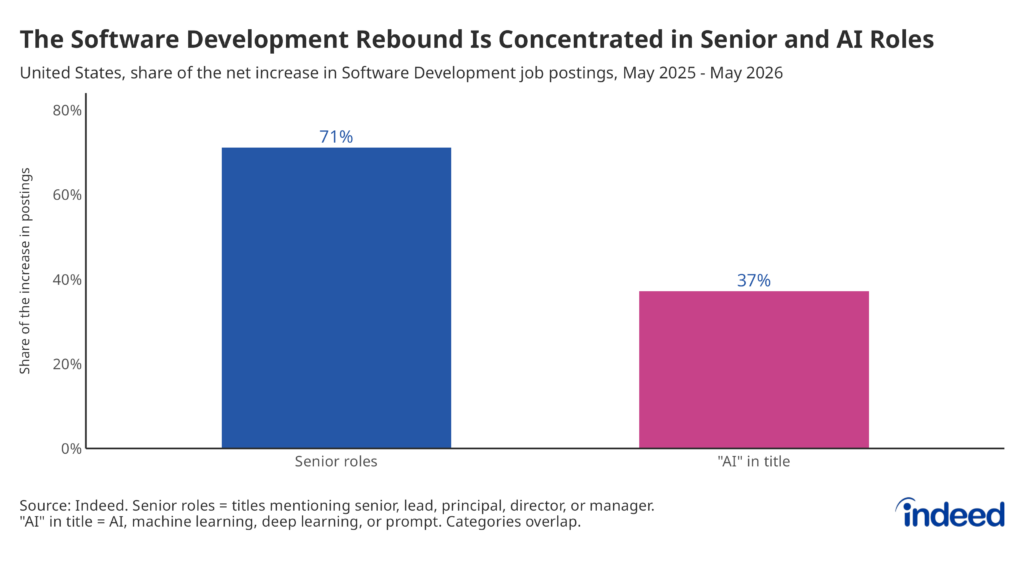
- 71% of the increase in software development job postings between May 2025 and May 2026 is from senior roles, and 37% is due to jobs that mention AI in their title.
Software development job postings have rebounded over the past year, even as overall job postings continue to slowly decline, a surprising reversal after years of contraction in tech and other sectors highly exposed to AI-driven change. And while correlation does not imply causation, the introduction of Claude Code and other widely available agentic AI tools at roughly the same time as software roles started to bounce back is a coincidence that cannot be ignored.
Claude Code was introduced in late February, 2025. Since that date, the number of job postings for software developers published on Indeed in the US has risen almost 15%, while job postings overall have declined by 7%. February 2025 was also when the term “vibecoding” was first coined, meant to describe the plain-language interactions that allow AI to handle the technical coding while human developers focus on creating and refining a product vision. There were, of course, many other factors influencing the market both then and now, but the near-term rebound over the past year-plus is striking regardless.
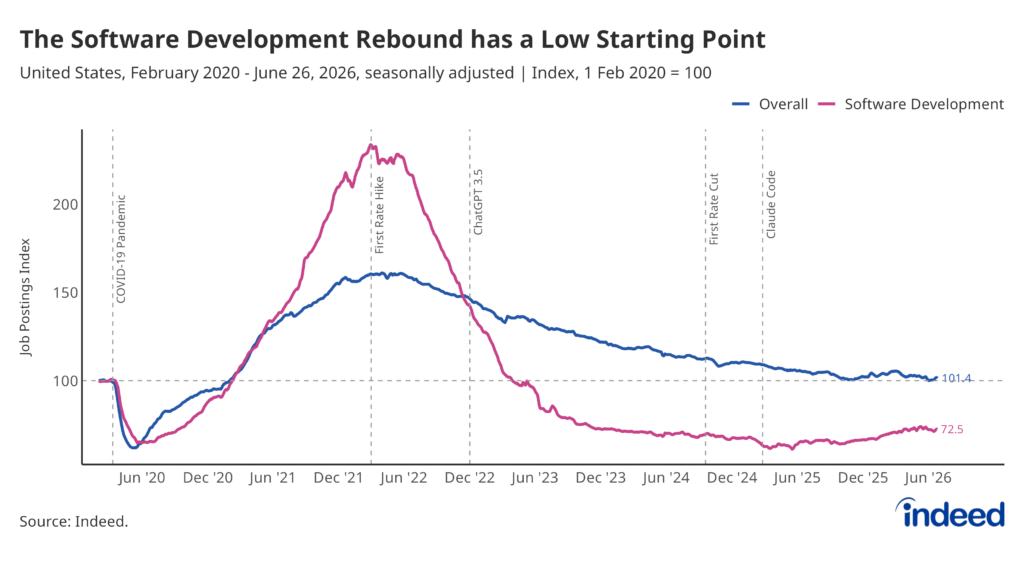
However, it is important to note that the rebound has a low starting point. Even after the recent rise, software development job postings remain about 27.5% below their pre-pandemic level, while overall job postings are essentially the same as in February 2020.
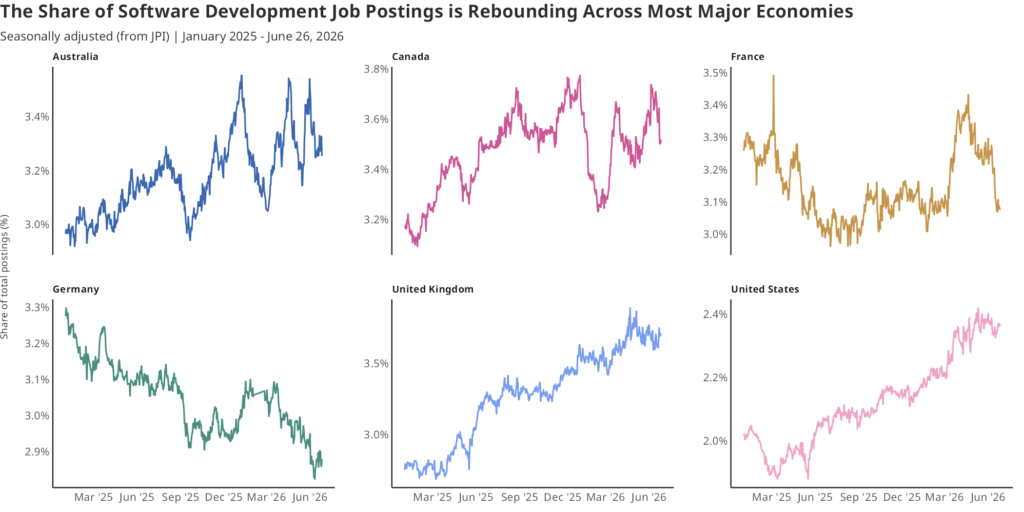
The 2025-2026 software rebound is not unique to the US, either. With the exception of Germany and France, the share of all job postings that are software development jobs has been on the rise in most large, developed economies analyzed by Hiring Lab. English-speaking countries seem to have more consistent positive trends, suggesting companies and workers in these nations may be earlier adopters of agentic AI tools. Many AI and tech hubs are located in English-speaking nations, and overall AI usage is higher in many of them than in non-English-speaking peers.
Are other occupations exposed to AI experiencing a similar rebound?
When comparing changes in job postings between May 2022 (the peak of the labor market) and May 2026, we see that the more exposed to AI an occupation is, the more it declined. As other researchers have argued, the declines in vacancies for AI-exposed occupations began before the release of ChatGPT in late 2022.
Correlation does not imply causation, but this uncontrolled relationship between the change in job postings and AI exposure is statistically significant. Occupations that represent a larger share of job postings on Indeed tend to be in the lower and middle of the distribution of AI-exposure.
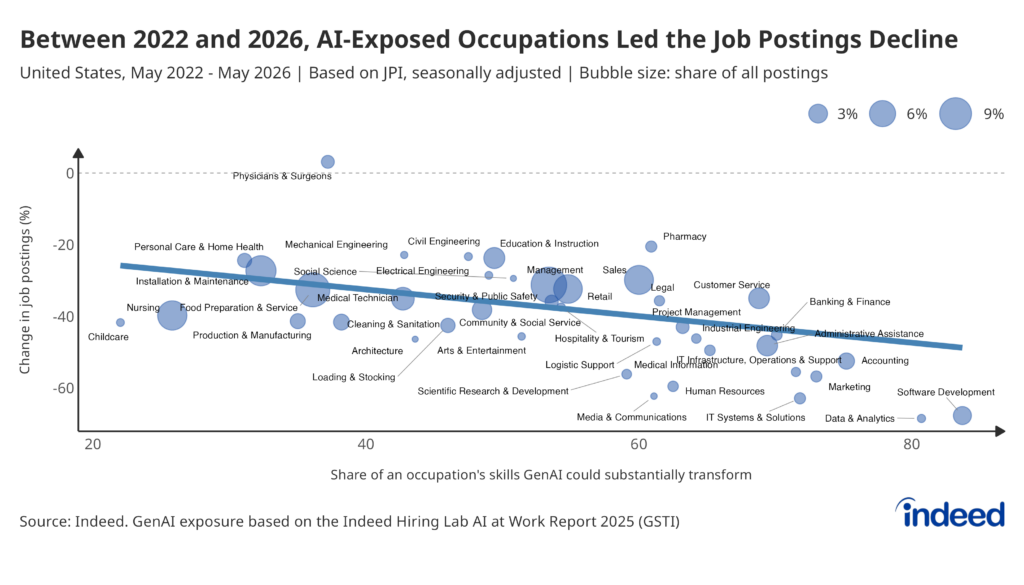
However, when analyzing the more recent period in which software development job postings have rebounded, the relationship and story flip: the more exposed to AI an occupation is, on average, the more it rebounded. This is true not just for software development, but also other AI-exposed occupations.
A senior, AI-fluent rebound
Notably, the rebound is concentrated: 71% of the increase in Software Development job postings between May 2025 and May 2026 came from senior roles, and 37% came from jobs that mention AI in their title. This suggests demand is growing for experienced professionals who can work with AI, not necessarily a broad-based recovery across all software roles.
This preliminary evidence is in line with previous research focused on the disproportionate impact of AI on entry-level jobs. Even with the Software Development rebound, the job market could still be experiencing a seniority-biased technological change.
Conclusion
The relationship between AI exposure and job postings appears to be flipping, from job destruction to job creation. While there may be many factors influencing the rebound in postings in AI-exposed occupations besides AI complementarities, it’s telling that AI-related roles play a large part in the increase in software development. This is not only a software development story: AI mentions in job titles are spreading to roles across a range of other white-collar occupations.
The impact of AI in the labor market might be evolving as the technology itself mutates. Agentic AI might have been a structural change, and there might be others coming along. The future of work may depend in large part on the slope of the relationship between AI exposure and job postings. Job seekers, employers, and policymakers should keep a close eye on how that relationship evolves over time.