
Key Points:
- Foreign-trained workers are increasingly important to well-functioning healthcare systems worldwide, including the United States, the United Kingdom, Australia, New Zealand, and Canada.
- From July 1, 2025, to June 30, 2026, around 5.3% of all clicks on physician & surgeon job postings globally came from job seekers outside the country where the role was posted, compared to 1.7% for nursing postings.
- India and the Philippines are prominent sources of healthcare talent for many countries, though proximity to foreign work is an important consideration for many job seekers.
Healthcare workforce shortages are a critical challenge for many economies. Aging populations are driving demand for doctors, nurses, and elder-care workers — demand that cannot be addressed through domestic training alone. As a result, international recruitment has become a key battleground for the healthcare industry, with workers moving not just from lower- to higher-income economies, but also between high-income economies.
Indeed’s data highlights the global nature of healthcare talent, though it varies considerably across occupations. Globally, 5.3% of clicks on physician and surgeon job postings from July 1, 2025, to June 30, 2026 (hereafter, the 2025-26 period) came from job seekers outside the country where the job was posted, compared with 1.7% for nursing postings. Indeed does not cover every labor market, but it captures most major economies.
Clicks on overseas job postings provide an early signal of migration intent and have historically tracked closely with actual migration flows across OECD countries. That makes Indeed’s data a useful early indicator of where talent is likely headed next, often well before official migration statistics catch up.
Healthcare differs from many other industries because of its high barriers to entry. Specialized skills, formal qualifications, and professional registration requirements can all limit the domestic supply of quality workers and make the industry difficult to transition into from other sectors. Six of the ten occupations most likely to require licensure requirements are in the healthcare industry. These structural constraints make immigration a particularly important source of workforce growth and a key way to address persistent labor shortages, particularly in healthcare.
An increasing number of doctors and nurses are born overseas
Across the OECD, 19.6% of doctors and 8.8% of nurses were trained outside of the country where they work in 2023, both up considerably since 2010. However, it can be much higher in some countries: 43% of doctors and 52% of nurses in Ireland, for example, were foreign-trained as of 2023, compared to just 11% of doctors and 3.1% of nurses in France.
For doctors, the share of foreign-trained doctors has increased strongly in several countries since 2010, including Germany (+8.5 percentage points), the United Kingdom (+8.5 percentage points), Ireland (+7.7 percentage points), and Australia (+5.6 percentage points). While for nurses, growth has been particularly strong in the United Kingdom (+11.4 percentage points) and New Zealand (+9.2 percentage points).
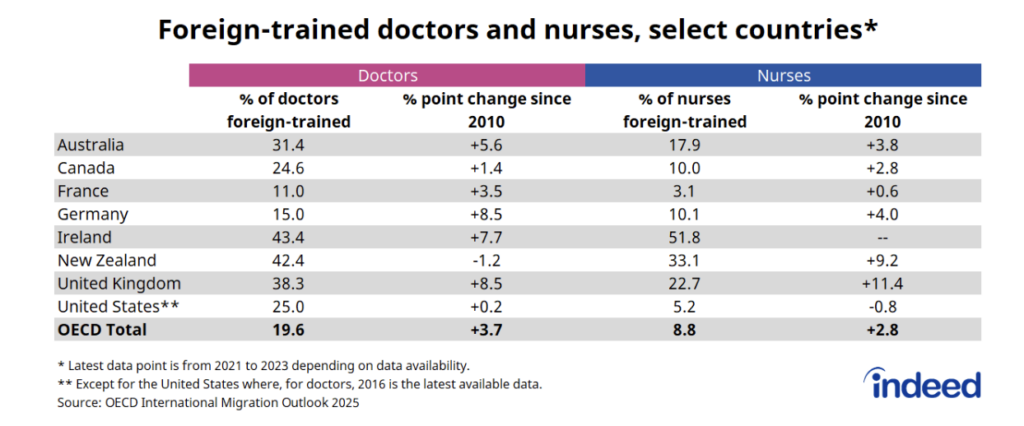
The reliance on foreign-trained workers is, in some cases, quite staggering. In the United Kingdom, the number of nurses increased by almost 120,000 between 2010 and 2023, with foreign-trained nurses accounting for 83% of those gains, according to the OECD. In Switzerland, around 86% of the increase in doctors over the same period was driven by internationally trained workers.
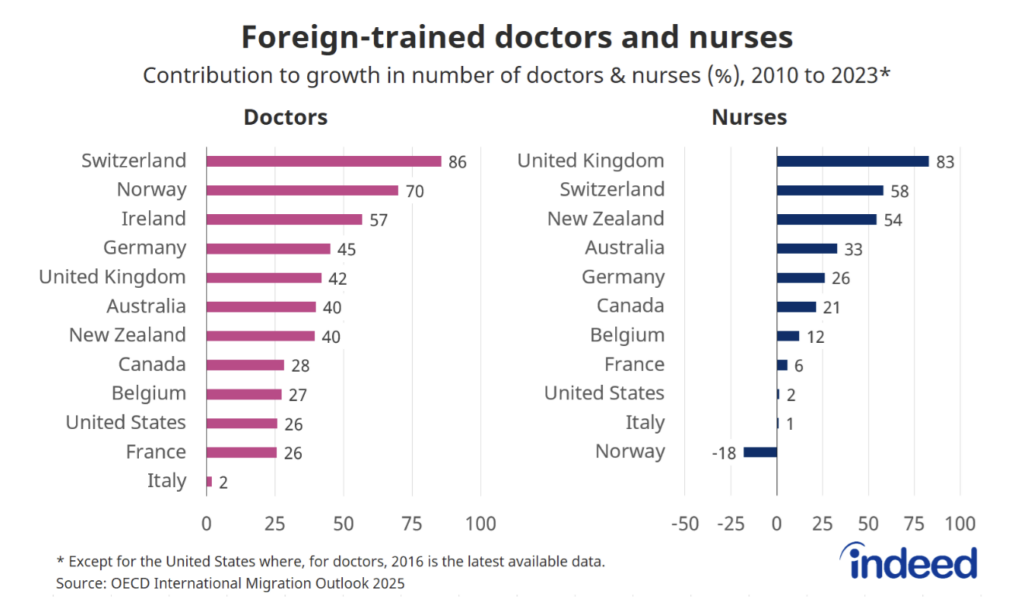
However, immigration of healthcare workers can be imbalanced in some countries. Norway provides a clear example: foreign-trained doctors accounted for 70% of doctor growth in Norway from 2010 to 2023. But over the same period, the share of internationally trained nurses fell in Norway, subtracting 18% from the overall nurse workforce.
The United States is another example. Foreign-trained doctors accounted for around one-quarter of the growth in the doctor workforce, but just 2% of the growth in the nurse workforce. That imbalance also shows up in Indeed’s data — physician postings in the US draw four times the foreign-click share that nursing postings did over the past year (3.6% vs. 0.9%).
In absolute terms, the United States remains the largest destination for internationally trained healthcare workers. Around 38% of foreign-trained doctors across the OECD are in the United States, ahead of the United Kingdom (11.7%), Germany (9.2%), Australia (5.9%), and France (4.7%). And the same trend is observed for nurses, with the United States a destination for 29% of nursing migrants, followed by the United Kingdom (18.4%), Germany (14.3%), Australia (8.9%), and Canada (5.6%).
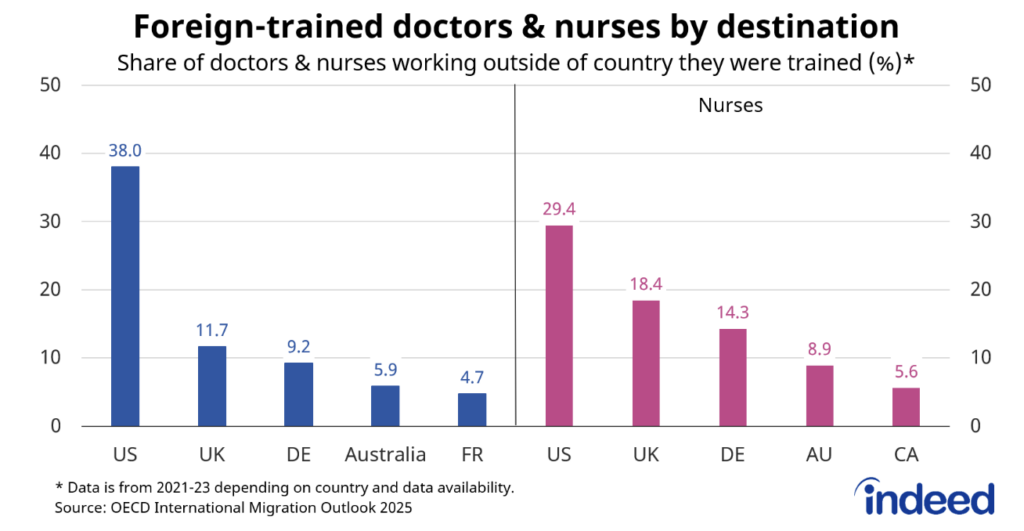
The sheer scale of foreign-trained healthcare professionals working in the United States underscores how dependent the United States’ healthcare system has become on immigration to meet demand. That dependence is especially notable given recent Hiring Lab research showing foreign job seeker interest in US jobs has dropped to a six-year low, even as employer demand for visa-sponsored talent — particularly in healthcare occupations including physicians and therapists — has tripled since the pandemic.
Indeed’s global healthcare dashboard
Inbound job seeker activity — defined as clicks on domestic healthcare jobs by overseas job seekers — varies considerably across countries. This often reflects factors including geographical proximity, language, and historical migration patterns.
Neighboring countries often generate the strongest interest. The United States attracts substantial interest from job seekers in Mexico and Canada, while Australia receives relatively more clicks from Asia and New Zealand. Language and culture can also be important, with high-income, English-speaking countries including the United States, Canada, the United Kingdom, and Australia all showing considerable interest in each other.
Top five sources of inbound clicks:
- United States: India (14.5% of inbound clicks to the United States), Mexico (9.3%), Canada (9.2%), Philippines (9.2%), United Kingdom (4.6%).
- Canada: United States (21.5%), India (14.3%), Nigeria (7.5%), United Kingdom (6.0%), Philippines (4.9%).
- United Kingdom: India (12.0%), United States (9.1%), Nigeria (8.3%), Australia (3.6%), Spain (3.6%).
- Australia: India (14.3%), United Kingdom (12.3%), Philippines (10.6%), United States (7.8%), New Zealand (6.2%).
Patterns differ across many non-English-speaking countries. Morocco is the largest source of inbound healthcare clicks for both Germany (17.6% of total inbound clicks) and France (7.4%). Spain also stands out for its strong ties with Latin America, with almost 20% of inbound clicks coming from Colombia, almost three times higher than any other country.
Interactive choropleth map showing the share of inbound clicks on healthcare job postings in selected countries by job seeker country of origin from July 2025 to June 2026, based on Indeed job seeker click data.
Outbound job seeker activity — defined as domestic job seeker clicks on overseas jobs — is more highly concentrated than inbound clicks. While healthcare professionals from developing economies often consider a broad range of destinations, that isn’t true of workers in high-income countries.
For healthcare job seekers in the United States, more than half of all outbound clicks go to just two countries: Canada (34%) and the United Kingdom (20%). And that pattern holds for other markets:
- Canada: 69% of outbound clicks are for jobs in the United States.
- United Kingdom: 57% of outbound clicks are for jobs in the United States (28.6%), Australia (14.7%), and Canada (14.0%).
- Australia: 73% of outbound clicks are for jobs in the United Kingdom (32.6%), the United States (26.4%), and Canada (14.8%).
Interactive choropleth map showing the share of outbound clicks on healthcare job postings from selected countries by job seeker country of origin from July 2025 to June 2026, based on Indeed job seeker click data.
Foreign interest in healthcare jobs differs by healthcare occupations
In most markets, nursing roles draw considerably more foreign clicks than physician and surgeon roles. But this is primarily driven by the large difference between the total number of job postings for those positions. In all markets studied other than Singapore, the share of foreign clicks on physician & surgeon job postings was greater than for nursing during the 2025-26 period.
The breadth of that interest also varies by occupation across countries. Germany provides the clearest example, with Morocco accounting for just over a third of inbound clicks on nursing postings. Interest in physician jobs is more diversified, with Turkey (the largest foreign source of clicks on German physician roles) accounting for around 1 in 10 clicks. Spain shows the opposite pattern. Physician interest is somewhat more concentrated than nursing interest: Colombia alone supplies almost 30% of physician clicks.
Many of these patterns trace back to policy choices made decades ago. The United States’ reliance on Filipino nurses, for example, has its roots in the American administration of the Philippines in the early 1900s, when English-language nursing schools were established there specifically to supply American hospitals. That pipeline persists, with the EB-3 green card category — which, unlike the H-1B route, does not require a bachelor’s degree — remaining the standard pathway for Filipino nurses. Today, more than 170,000 Filipino-born registered nurses work in the US, a scale that has become self-reinforcing through recruitment agencies, established diaspora networks, and family sponsorship.
Morocco’s prominence as a source country follows a similar legacy. As a former French protectorate, Morocco’s higher education system — including nursing and medical training — still operates largely in French, making France a natural destination for Moroccan candidates, with few language or credential barriers.
Spain’s sourcing patterns are more directly shaped by language and mutual recognition of credentials. Foreign nurses and doctors must have their qualifications formally recognized through Spain’s homologación process. Bilateral agreements with several Spanish-speaking countries — including Colombia, Argentina, and Chile — help streamline the recognition of overseas qualifications. This likely explains why Colombia alone accounts for almost a fifth of inbound healthcare clicks to Spain, roughly three times higher than any other single country.
These occupation-specific patterns also extend to outbound job searches. Nurses generally focus their overseas job search on fewer destinations than physicians do. For example, Canadian nurses direct close to four-fifths of their outbound clicks to the United States, compared with about half for Canadian physicians, who spread their clicks across a broader range of countries.
Inbound and outbound healthcare trends have shifted
Healthcare migration patterns are constantly evolving — the countries driving inbound interest today aren’t always the ones that led four years ago. Comparing 2022-23 with the most recent year highlights how the source of overseas interest has shifted across the United States, Australia, and Europe’s major markets.
Interactive table titled “Trends Over Time of Inbound Clicks on Healthcare Jobs by Source Country,” showing the share of inbound clicks on healthcare jobs from each source country by the July-June period since 2019, with a selectable destination market.
In the United States, the Philippines, and Mexico have both increased their share of inbound clicks since 2022-23, while India has held broadly steady at around 14%.
Australia shows a similar pattern: inbound shares from India and the Philippines each gained around 4 percentage points, solidifying their positions among the top five sources of overseas interest. In comparison, the share from the United States increased by just over two percentage points. Meanwhile, the United Kingdom and New Zealand both edged down slightly but remained in the top five.
Europe’s story is more about realignment than growth. In Germany, Morocco has overtaken Turkey as the largest source of inbound healthcare clicks, with its share nearly tripling since 2022-23 to 17.1%. Turkey has long been a dominant source of migrant flows into Germany, a legacy of 1960s guest-worker migration.
The United Kingdom shows almost the opposite dynamic: Nigeria’s share of inbound clicks has nearly halved, from 16.8% to 8.3%, coinciding with the UK’s 2023 update to its Code of Practice for International Recruitment. That change barred active recruitment from countries on the WHO health workforce support and safeguards list, a roster of nations, including Nigeria, facing acute health worker shortages, and from which the WHO urges other countries not to actively recruit. That gap has been filled by modest increases across a broad range of countries, rather than a single country becoming more dominant.
Meanwhile, France has continued to deepen its reliance on healthcare professionals from Morocco and Algeria. Morocco’s share of inbound clicks rose from 5.5% in the 2022-23 period to 9.9% in the 2025-26 period, while Algeria’s climbed from 4.7% to 6.7% over the same period. Together, the two countries now account for 16.6% of France’s inbound healthcare clicks, up from 10.2% four years ago.
Conclusion
Healthcare recruitment remains a key challenge in many countries. Aging populations continue to increase demand for key healthcare roles, including doctors and nurses, while domestic training systems struggle to keep pace. Skill shortages are widespread and persistent, impacting service delivery and health outcomes globally. Addressing these skill shortages is, quite literally, a life-or-death problem.
As a result, internationally trained healthcare professionals have become an increasingly important source of workforce growth. Indeed’s data show that international interest in healthcare jobs reflects longstanding migration patterns, geographic proximity, and language ties. While lower-income countries remain an important source of healthcare talent, high-income economies also compete with each other for the same pool of skilled professionals.
That competition will only intensify as populations continue to age and demand for healthcare services grows. Countries that can attract and retain internationally trained healthcare workers will be best placed to address workforce shortages over the next decade.
Methodology
We assess inbound and outbound job seeker interest by tracking clicks on Indeed job postings across the 13 countries covered in this analysis. Inbound clicks are defined as clicks on domestic job postings by job seekers with IP addresses outside that country; outbound clicks are defined as clicks by domestic job seekers on postings located in another country. French overseas departments and collectivities, US territories (including Puerto Rico), and the constituent countries of the Netherlands are excluded from the analysis.
Job seekers whose location could not be determined were removed from the analysis. Healthcare postings are grouped into eight occupations — Pharmacy, Medical Technicians, Physicians & Surgeons, Nursing, Health IT, Personal Care, Dental, and Therapy — using Indeed’s normalized occupation categories, alongside an “Overall” category capturing all healthcare postings combined. Unless otherwise noted, current figures reflect the 12 months from July 2025 through June 2026, and historical trends are summarized in the same annual windows dating back to July 2022.