
Key points:
- Business operations skills are mentioned in more than 70% of job postings, by far the most of any skill category.
- In half of all states, healthcare & caregiving skills make up the top skill composition, followed by business operations skills in 20 states.
- While more than half of the skills mentioned in healthcare job postings are concentrated in the healthcare & caregiving skills category, geographical variations in other top skill categories provide important insights into regional workforce needs.
To build a successful career, workers must identify and invest in building skills — not just any skills, but the right skills that pay off in terms of job opportunities, higher wages, and career progression. However, identifying these right skills in a dynamic labor market, where short-term economic uncertainties (from tariffs to geopolitical conflicts) interact with long-term trends (such as demographic change and the rapid advancement of AI that supports or automates entire tasks), becomes increasingly difficult.
So, what do a project manager, a data analyst, and a retail worker have in common? While each role is very different, they all require business operations skills — a near-universal skillset that was required in some form in more than 70% of all US job postings at the end of 2025.
Hiring Lab determined employers’ most desired skills by analyzing more than 3,000 individual skills across 47 broad skill categories and 108 subcategories, extracted from millions of US job postings published on Indeed in Q4 2025. Our analysis shows that learning the simple fundamentals of “doing business” is a worthy investment for virtually all workers, with business operations skills by far the most prevalent skill category nationwide. But the national labor market really is a collection of local markets, and regional economic differences, from clusters of local industries to simple geography, create distinct demands and shape local skills landscapes beyond national trends.
Business Operations skills are ubiquitous in US job postings
Relying on staff who can navigate the functional side of a business is crucial, as reflected in the skills employers are looking for. Business operations skills — including administrative, human resources, business project management, and/or analysis skills — appeared in nearly three-quarters of all US job postings in Q4 2025, significantly more than any other skill category. Other relatively common skill categories, including communication skills and technology skills, each appeared in less than half of all US job postings during that period.
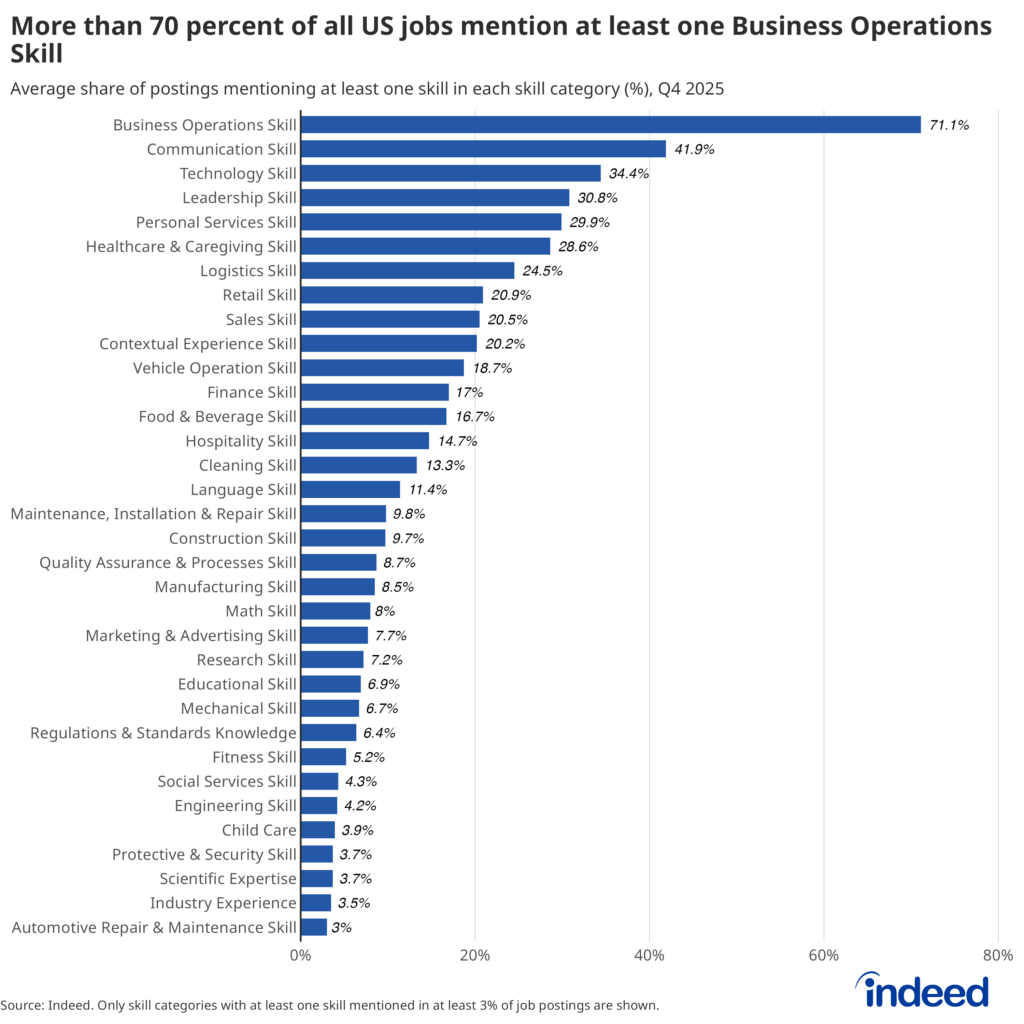
This near-universal relevance sets business operations skills apart and signals that, regardless of the role they’re hiring for, employers expect virtually all their staff to support the broader business in some way. That said, this prevalence is not uniform. Essentially all project management (97.7%), HR (96.3%), and customer service roles (96.1%) required at least one business operations skill at the end of 2025. But they are less frequent in roles that prioritize hands-on, domain-specific expertise. Only about a quarter of job postings for personal care & home health workers (24.1%) and physicians & surgeons (25.8%), for example, required business operations skills.
Table titled “Business Operations Skills are most prevalent in white-collar roles” shows the average share of US job postings mentioning at least one business operations skill, as well as the most common skill (outside of business operations) by sector over the time period October 1, 2025, to December 31, 2025.
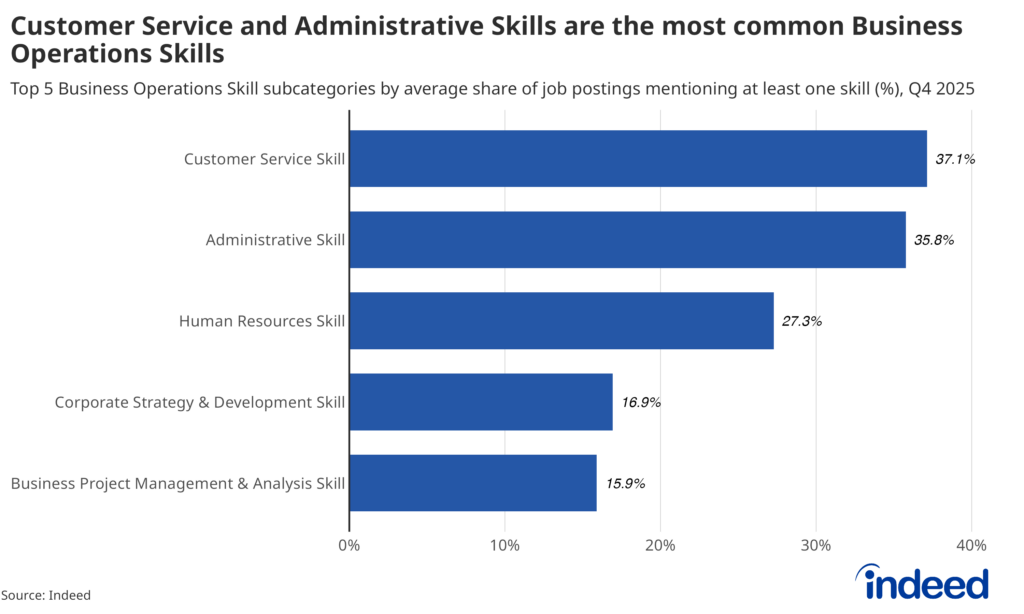
Not all business operations skills are the same, and there are five distinct subcategories within the broader business operations skill family. Customer service (ranging from in-person service to phone or internet-based customer support) and administrative skills (including office management, organizational skills, and calendar management) are the most in-demand subcategories, appearing in 37.1% and 35.8% of all postings, respectively.
Human Resources skills follow, with mentions in 27.3% of job postings. Notably, HR skills such as employee engagement and management often extend far beyond HR departments and are necessary across a broad range of occupations. A majority of job postings in management and more than 20% of administrative assistance job postings feature an HR skill, reflecting the importance of effective people management in helping a business to function smoothly.
For job seekers, the prevalence of business operations skills suggests that developing operational literacy is a high-yield investment across most professions. While technology continues to transform how tasks are performed, the fundamental why of business remains constant. Understanding how a role contributes to an organization’s value chain — from organizational planning to ensuring a product or service is delivered to the customer in the best possible way — and possessing the skills to facilitate that contribution remain critical advantages in the labor market.
National trends, local dynamics
While business operations skills are a through-line across a large majority of jobs nationwide, there is considerable variation locally in which skills are most prevalent in which states. Although it is the most prevalent across all skill categories, business operations skill requirements do not dominate uniformly across states. When measured by compositional share (each skill category’s share of total skill mentions across all job postings), business operations ranks first in 20 states, while vehicle operation skills lead in four states. These four states — Wyoming, Kentucky, West Virginia, and Arkansas — have economies dominated by extractive industries (mining, oil, and gas), agriculture, and logistics, which (literally) drive outsized demand for vehicle operation skills relative to other skill categories. Technology skills top the ranking in Maryland, where proximity to the nation’s capital attracts many IT and intelligence contractors and consultancies that require such skills.
Healthcare & caregiving skills rank first in the remaining 25 states, helped by the fact that healthcare demand is broadly dispersed nationwide — no matter where you live, you need health services. And it is almost certainly driven by the fact that the healthcare sector has consistently had higher job postings levels and has consistently added jobs over the past several years, while hiring in many other sectors stagnated after a post-pandemic boom.
The choropleth map titled “Skill requirements in job postings vary by state” shows the skill composition in job postings (top five categories) in US job postings over the time period October 1, 2025, to December 31, 2025, by state.
And even within states, county-level data reveal a more diverse picture that underscores the specialization present in individual local labor markets. In Virginia, for example, technology skills are more prevalent in both Arlington and Fairfax counties — both located just outside of Washington, D.C., and both major hubs for data centers and tech firms. A similar pattern holds in San Francisco and Santa Clara counties in California, and Travis County, Texas, where the local concentration of software and technology employment pushes technology skills to the top in those counties, despite business operations leading statewide. And there’s still another example in New York: technology skills dominate in New York County (Manhattan), reflecting the city’s concentration of white-collar roles that require tech skills.
Healthcare is a business, too
While healthcare skills may seem to rival business operations skills in terms of broad prevalence in the market, the two skillsets are better seen as complementary rather than in competition with one another. In all 50 states, healthcare and caregiving skills are the most prevalent skill family in healthcare postings, which makes sense; the number one priority of healthcare providers is to provide care. But healthcare is also very big business in the US, and in all but three states (New Mexico, Montana, and Illinois), the top skill required for healthcare workers after healthcare and caregiving skills is business operations. This pattern reinforces our earlier finding that business operations skills serve as a kind of universal language across occupations.
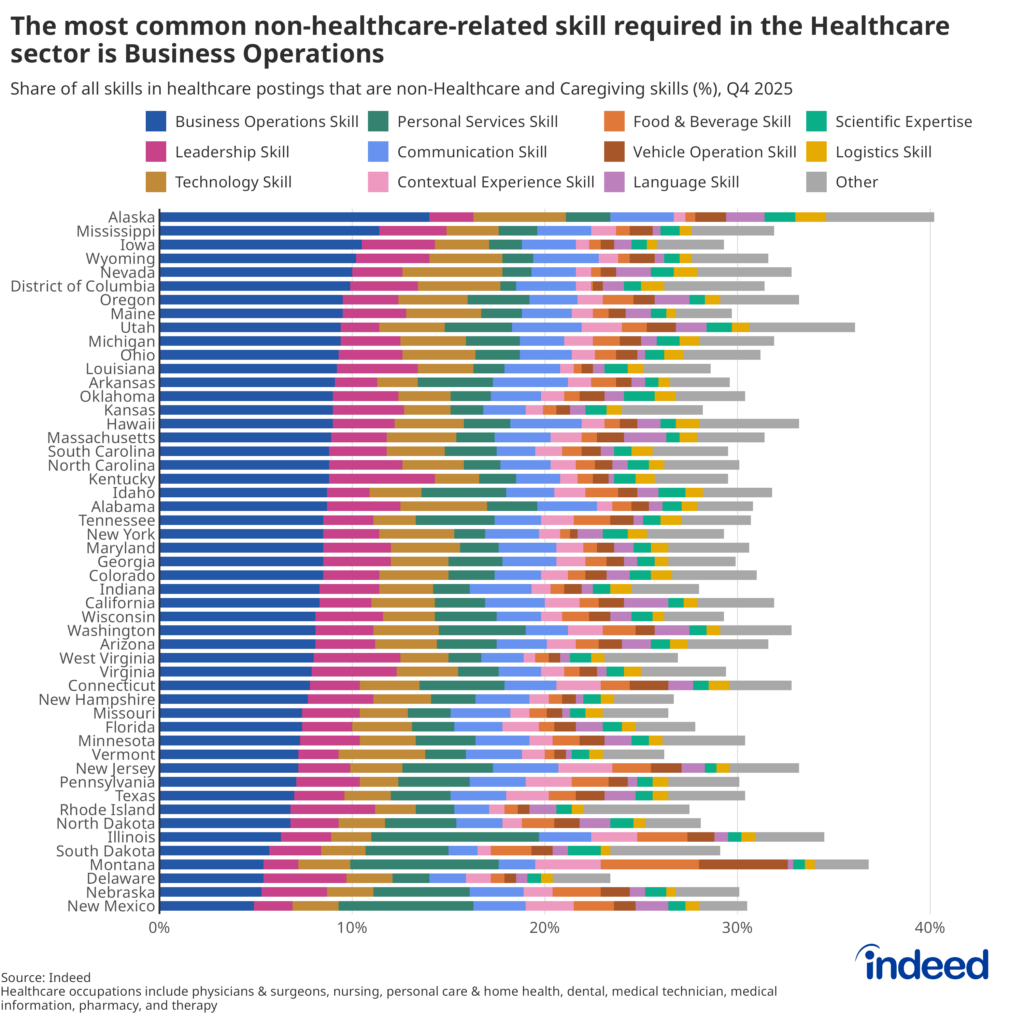
The local variation in the top skills required of healthcare workers outside of the healthcare & caregiving domain also says a lot about the dynamics that shape local labor markets. For example, states with larger immigrant populations (e.g., California, Massachusetts, Washington, and Texas) or greater reliance on immigrant workers within the healthcare sector (e.g., Nevada and North Dakota) tend to show higher demand for language proficiency among would-be healthcare workers. Furthermore, vehicle operation skill makes up a surprisingly large share of all skills in the healthcare sector in Montana, where proficiency in driving and operating perhaps specialized vehicles is seemingly required for roles that may involve reaching patients in remote or rural areas.
Taken together, the skill profile of healthcare job postings reflects a dual structure: a stable clinical core that remains the non-negotiable foundation of the sector across the country, and a variable layer of contextual skills shaped by local labor market conditions. For aspiring job seekers in healthcare, this distinction has practical implications. Developing clinical skills is essential everywhere, but meeting local labor shortages may also require building the contextual skills that vary by place, whether that means language proficiency or vehicle operation skills.
Conclusion
Business operations skills remain the “operational bedrock” of the US labor market, appearing in nearly three-quarters of all postings as a near-universal complement to domain-specific expertise. This prevalence reflects the enduring necessity for coordination and planning within any organization. However, national trends often mask local realities. Below the surface, labor markets diverge, with skill demands dictated by local economic clusters and specific labor shortages. This is a reminder that the right skills investment for a job seeker depends heavily not just on what they do for work, but where they do it. For job seekers navigating an uncertain environment, it’s clear that while fundamental skills persist, local economic conditions dictate which fundamentals matter most.
Methodology
Data used in this analysis are based on the extraction of more than 3,000 skills — across 47 categories and 108 subcategories — from US job postings on Indeed between October 1, 2025, and December 31, 2025 (Q4 2025). For extraction, a deep learning model, along with Indeed’s internal taxonomy and classification systems, was used, shaping how individual terms in job descriptions are grouped, labeled, and counted. Skills are aggregated across multiple hierarchical levels. The highest hierarchical level, i.e., the broadest skills categories, is shown in the bar chart titled “More than 70 percent of all US jobs mention at least one business operations skill”.
Two metrics were analyzed: (i) Skills mentions, i.e., the average daily share of job postings mentioning at least one skill from a certain skill category, and (ii) Skills composition, i.e., the average daily share of a skill or skills category that makes up for the total number of skills mentioned within an occupation.
Indeed’s skill taxonomy continuously evolves through the addition of new skills, refinement of skill categories, and advancement of extraction methods from rule-based keyword matching to model-based extraction using machine learning. While these improvements enhance data quality, they may contribute to differences in results over time alongside genuine labor market trends.
The number of job postings on Indeed.com, whether related to paid or unpaid job solicitations, is not indicative of the potential revenue or earnings of Indeed, which comprises a significant percentage of the HR Technology segment of its parent company, Recruit Holdings Co., Ltd. Job posting numbers are provided for information purposes only and should not be viewed as an indicator of the performance of Indeed or Recruit. Please refer to the Recruit Holdings investor relations website and regulatory filings in Japan for more detailed information on revenue generation by Recruit’s HR Technology segment.