Key Points:
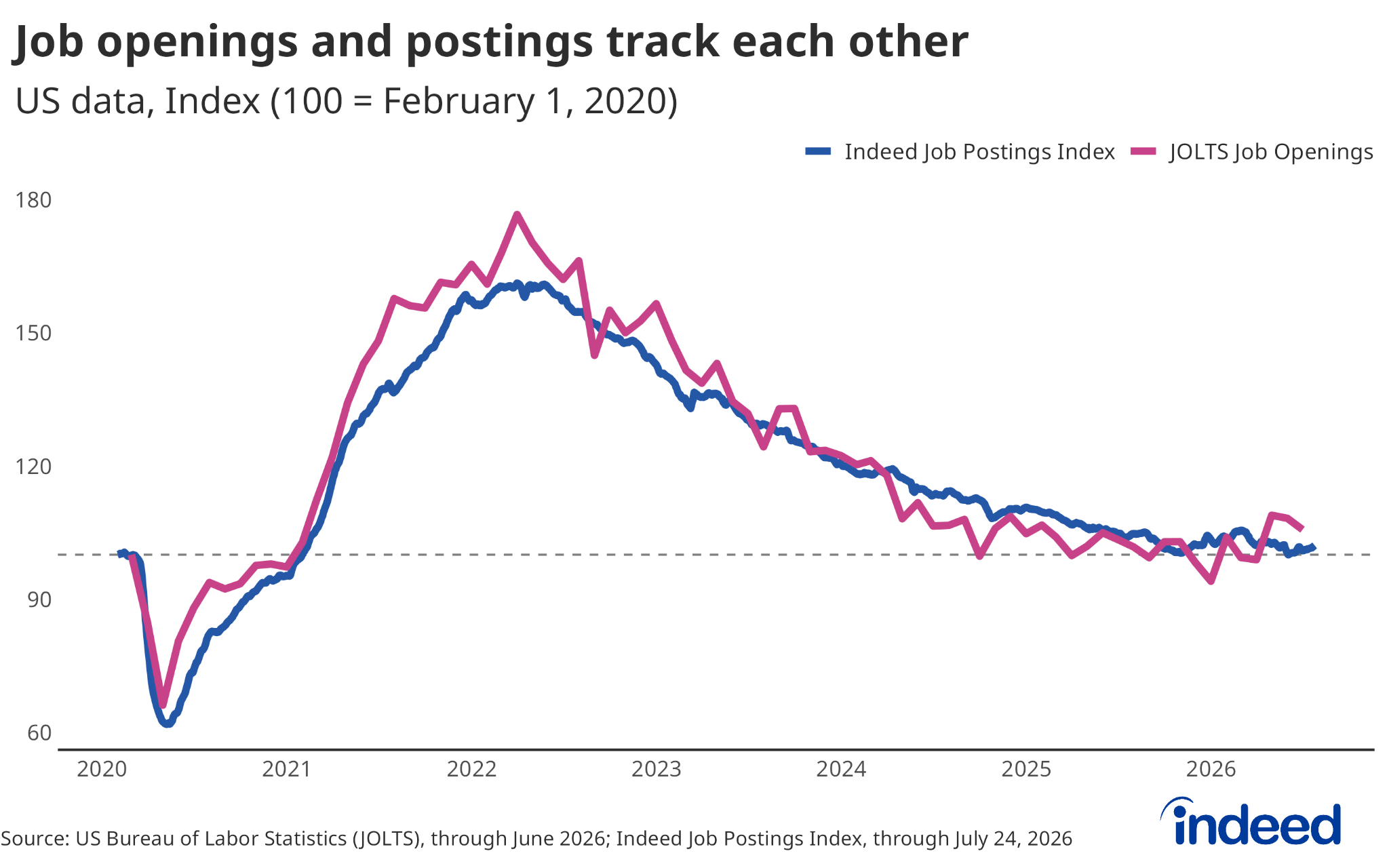
- Job openings were little changed at 7.4 million in June, from a downwardly revised level in May, according to the US Bureau of Labor Statistics.
- The layoffs rate stayed steady at 1.1% in June 2026 and remains well within its recent range.
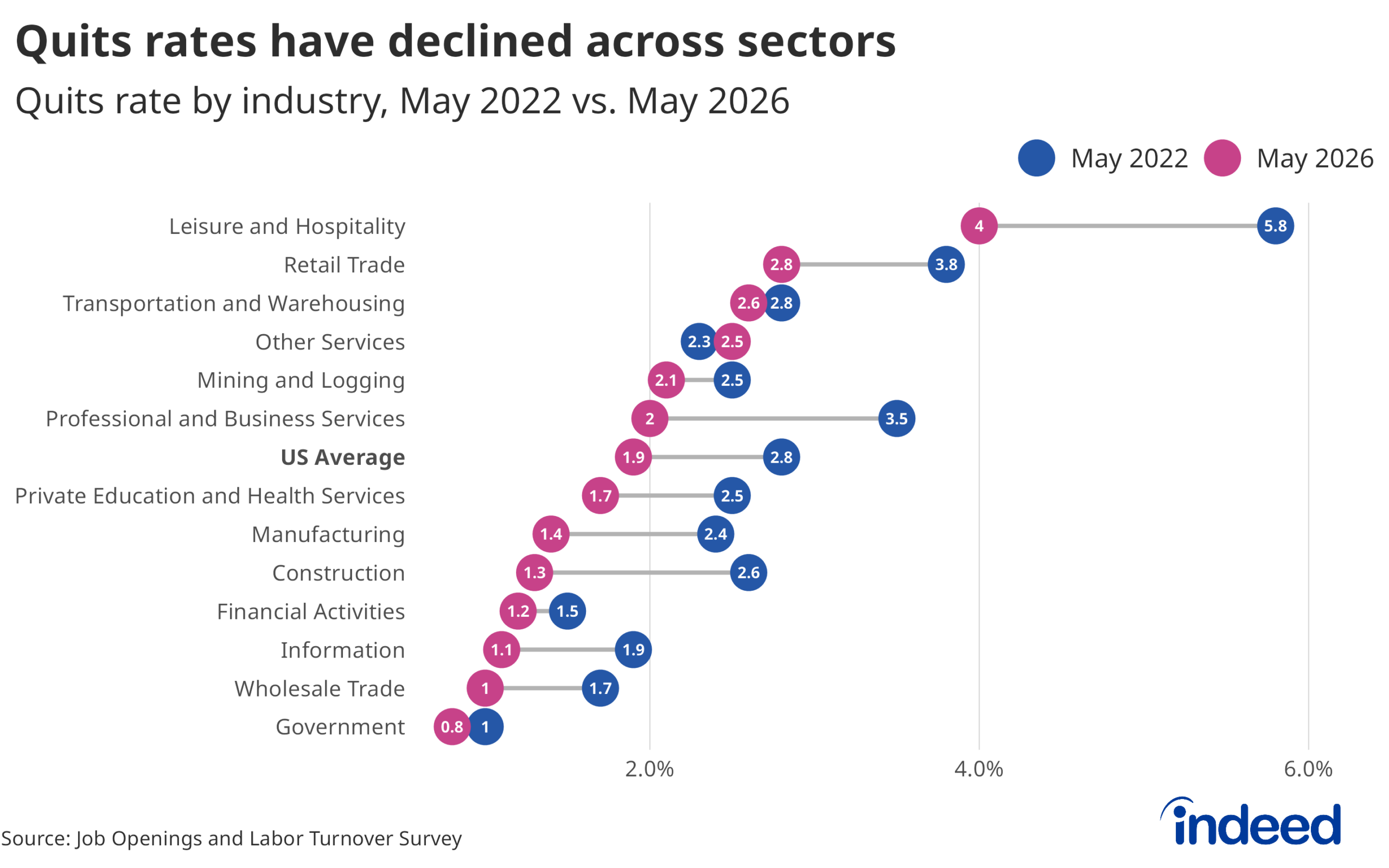
- The quits rate was unchanged at 2%.
Like a duck on a pond, the labor market is calm on the surface but paddling hard just below the water as the market reallocates hiring to outrun a shrinking, greying workforce.
The headline numbers from today’s JOLTS data revealed that job openings were mostly unchanged at 7.4 million in June 2026, and together with the low hiring rate (3.4%), quits rate (2%), and layoffs rate (1.1%), suggest that the labor market is stuck in the low-hire, low-fire environment that’s prevailed since last year. But this may not be purely a labor demand story.
The civilian labor force has declined since the end of 2025, signaling that the labor supply may be driving the decline in hiring in key sectors. The Leisure and Hospitality sector saw the largest decline in hires between May and June 2026, dropping by 87,000, a 0.5 percentage-point drop in the hires rate. Year-over-year, hires dropped by 174,000, substantially more than Construction, which followed with a decline of 27,000 hires year-over-year.
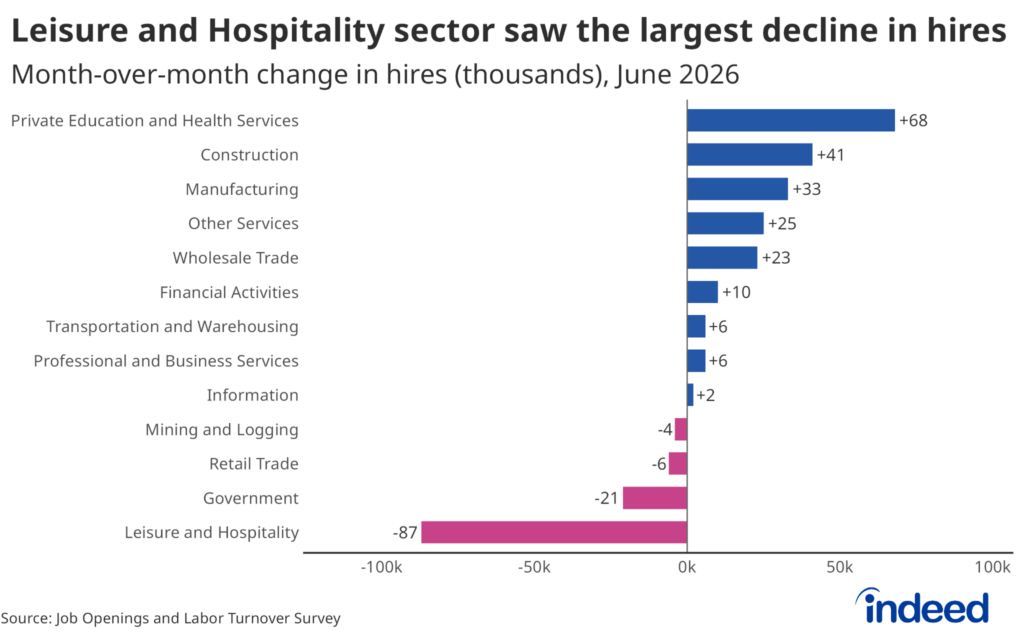
Bar plot titled “Leisure and Hospitality sector saw the largest decline in hires” shows the change in thousands of the level of hires by sector between May 2026 and June 2026. Hires decreased the most in Leisure and Hospitality, and grew the most in Private Education and Health Services.
With job openings steady, quits rates remaining at or below 2%, and layoffs still contained, the labor market shows few signs of cracking, but also continues to be driven by a handful of healthcare sectors. Private Education and Health Services led with 68,000 hires in June 2026, and that continued demand isn’t being met by domestic hiring alone. International recruitment has become a key battleground for the sector, with aging populations driving demand for healthcare professionals that can’t be met domestically due to labor shortages and skill mismatches. With the foreign-born labor force driving the overall decline in the civilian labor force, healthcare’s reliance on international recruitment may be exactly the sector to watch as limited labor supply increasingly shapes hiring in the labor market.
The Indeed Job Postings Index (JPI), which captures postings in near real time and tends to lead the JOLTS headline series by a few weeks, has stabilized at around 1% above the pre-pandemic baseline of February 1, 2020. Other government data similarly signal pressure on labor demand, as last week’s employment cost index further revealed that real earnings growth turned negative in Q2 2026 for the first time since 2022, suggesting that the pressure on current employees as well as job seekers isn’t easing yet.