Key points:
- Job openings rose to 7.6 million in April, from an upwardly revised 6.9 million in March, according to the US Bureau of Labor Statistics.
- The layoff rate edged down to 1.1% from 1.2% in March.
- The quits rate ticked down slightly to 1.9% in April.
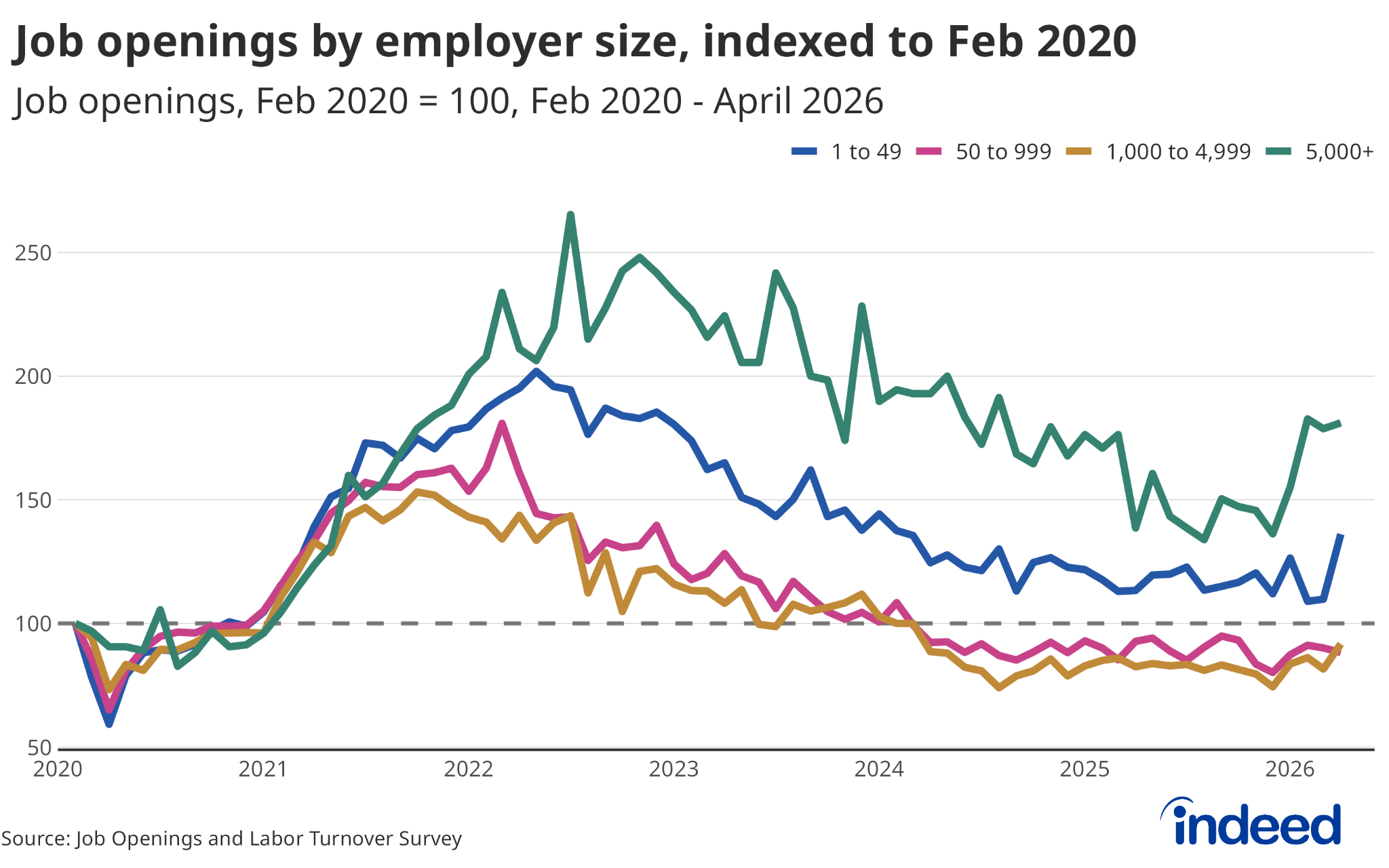
US job openings had an unexpected and generally welcome rebound in April after several months of relative stability, but the spike in openings was not felt evenly across the market. Job openings at establishments with 5,000 or more workers came in 81% above their pre-pandemic level in April — by far the strongest of any size class. But that strength comes with a heavy asterisk: those giant establishments account for less than 5% of all job openings in the JOLTS data. The bulk of demand sits with smaller employers, and the picture there has been relatively stable since mid-2024 — openings at firms with 1 to 49 workers are 36% above their 2020 baseline, while those with 50 to 999 workers, which alone make up roughly 40% of JOLTS openings, remain some 12% below their baseline. Put simply, the giants are posting like it’s a boom, but smaller employers are not.
It is surprising that a near-doubling at the top barely registers in the aggregate. But roughly 90% of job openings are tied to employers with fewer than 1,000 workers. The Indeed Job Postings Index has been relatively stable in 2026, hovering in a narrow range between 2% and 5% above pre-pandemic levels all year. It is accurate to say that openings are stabilizing, but the real story is mostly about small and midsize employers holding steady. The eye-catching rebound at the very top is too small a slice to move the needle on its own. And while a small slice of openings among large employers may not move the headline, it is a slice to watch. The largest employers are typically where signs of structural change emerge first, and in this case, AI adoption is also concentrated among large employers. Indeed data shows nearly all AI-related hiring clustered at a handful of very large companies — about half of the top 1% of firms posting on Indeed have adopted AI, while few smaller firms have. If AI is going to bend the shape of hiring, it will likely show up at the top of the scale well before it reaches the small and midsize firms that do most of the actual hiring. The nation’s employment giants aren’t carrying the market today, but they may be sketching its next chapter.