
Key points:
- Benefits, including health insurance and paid sick leave, are most desired in countries where these are not publicly provided.
- Despite vast differences in mandatory time off, vacation days are universally highly ranked.
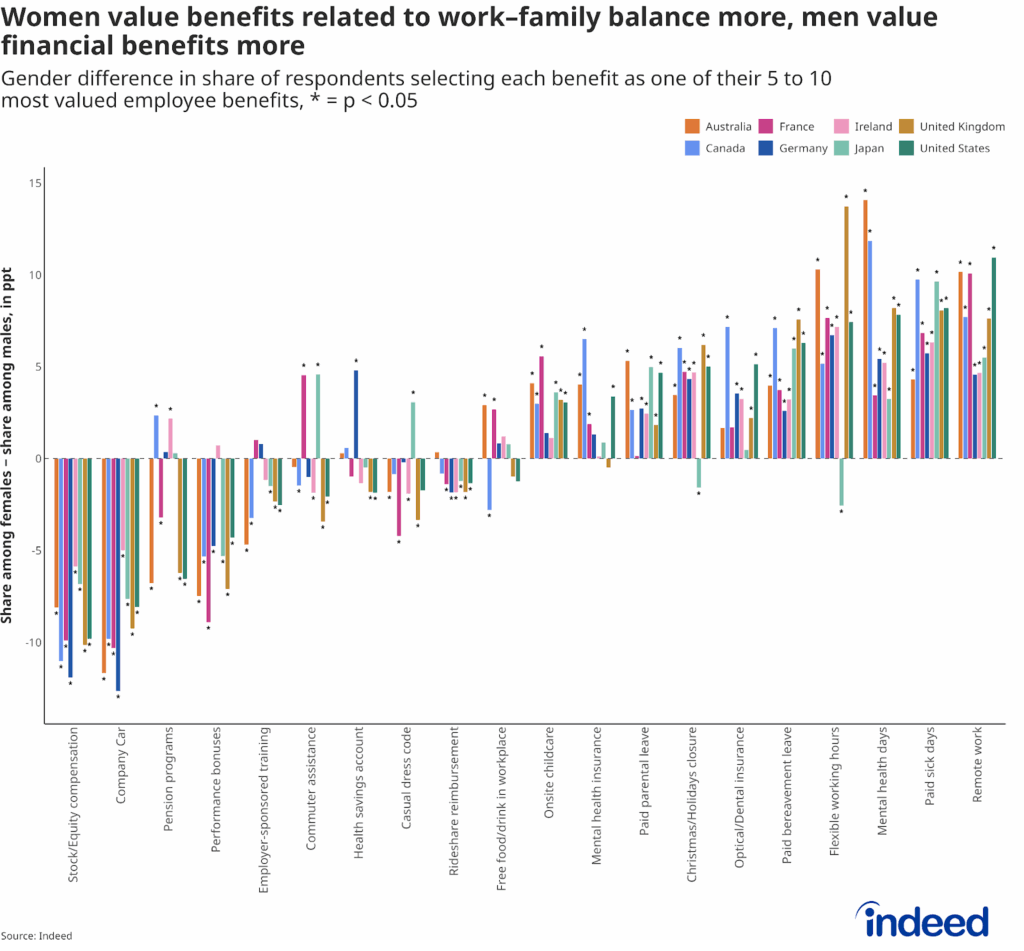
- Gender shapes priorities: Women value benefits that help manage work and family demands, such as flexible working hours, remote work options, and childcare assistance. Men tend to prioritize financial benefits, including stock compensation, company cars, and performance bonuses.
- Flexible work schedules and remote work in job postings have stagnated or even declined in many markets recently. Employers who limit flexibility risk restricting their talent pool and undermining efforts to attract women.
The benefits workers prefer often reflect differences in public services and social insurance in the countries where they work, according to data from Indeed’s 2025 Workforce Insights Survey, a representative survey of more than 80,000 workers across eight countries. Priorities also vary by gender. Women place a greater value on flexible working hours and remote work, yet postings offering these benefits have recently plateaued (or even declined) across markets.
Compensation today extends well beyond wages. Employers stand out by offering benefits including comprehensive health coverage, paid time off, and flexible work arrangements. Workers are willing to trade pay for better non-wage benefits: A recent study shows that 40% of US workers would be willing to give up at least 5% of their salary to keep the option of working from home.
Desired benefits reflect differences in public provision, but can’t be fully explained by them
A lack of government-provided public services, including healthcare and retirement plans, drives the perceived value of certain employer-provided benefits in some countries. When asked to rank their top 5-to-10 most-valued employer benefits, 67% of US respondents chose health insurance. This significant demand reflects the lack of universal public healthcare, which makes employer-provided coverage a critical necessity in the US. In contrast, countries with robust universal public healthcare, including Germany (30%), France (43%), and the UK (44%), see lower value placed on employer-provided health insurance.
Paid sick leave shows a similar pattern. With no federal requirement in the US, 63% of American workers consider it a top benefit. It’s also highly valued in the UK (64%), where Statutory Sick Pay (SSP) replaces only a portion of typical earnings. By contrast, valuation of paid sick leave is lower in Germany (40%) and France (37%), where strong national policies already provide more-robust protections for workers.
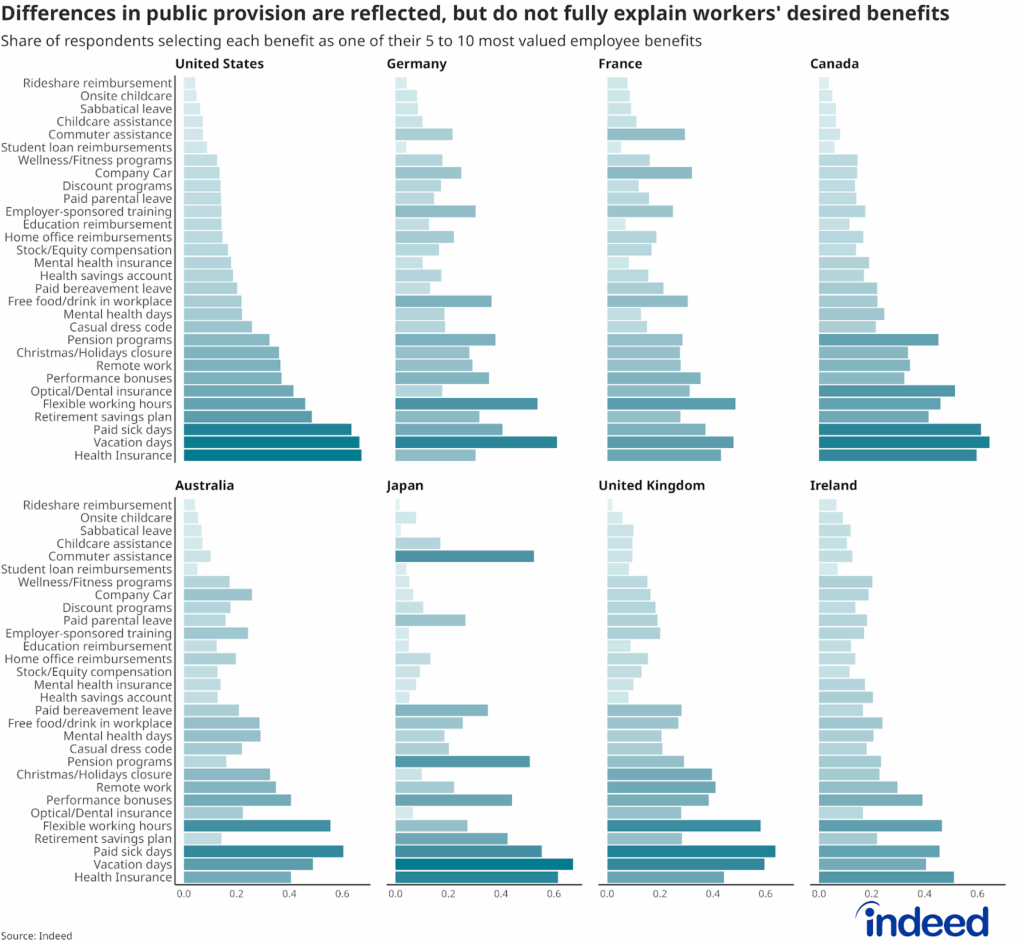
Still, public guarantees don’t fully determine preferences. Vacation days rank among the top three benefits in seven of eight countries — even in those where generous paid time off is mandated (ranging from 0 days in the US to 20 and 25 days in Germany and France, respectively, across the countries surveyed). More than 60% of workers in Japan, the US, Canada, and Germany said they prioritize vacation days, compared to only 40% in Ireland.
And when core needs are met outside of employer-provided benefits, other employer benefits gain traction. Free food and drink is a top choice for 36% of workers in Germany versus 22% in the US. Cultural norms also matter: Commuter assistance is highly valued in Japan (52%), where employers are typically expected to provide it, while company cars are more popular in France (32%), Australia (26%), and Germany (25%) than in the US (14%).
Traditional gender norms shape women’s needs
According to the OECD, women were still the primary caretakers and performed significantly more unpaid labor than men in each of the countries surveyed. This unequal burden of care and domestic responsibilities shapes what benefits women, in particular, look for in a job.
Women place a significantly higher value on benefits that help balance work and family life. The share of US female respondents choosing remote work as one of their top-valued benefits is 11 percentage points (ppt) higher than the corresponding share for male respondents. Women also choose flexible working hours (+7 ppt), parental leave (+5 ppt), and childcare assistance (+3 ppt) significantly more often. They further value mental health benefits, including mental health days and bereavement leave, at higher levels than their male colleagues. This holds across countries investigated.
Men, by contrast, are more likely to prioritize financial rewards aligned with traditional breadwinner expectations, including stock compensation (-10 ppt in the US), company cars (-8 ppt), and performance bonuses (-4 ppt) — a pattern also consistent across countries.
Job postings offering flexible hours or remote work have stagnated
Despite the stronger demand from women for benefits helping to balance work and family life, particularly through flexible working hours and remote work, the availability of these options in job postings has recently stagnated or even declined in many markets.
In the US, the share of postings advertising flexible schedules more than doubled from 7.1% in early 2020 to 14.4% in November 2023. Since then, progress has stalled, standing at 13.7% as of October 2025. A similar plateau is visible in Canada (from 13.3% in December 2024 to 12.5%), while Germany, which historically had the highest share of flexible work postings, recently slipped from 21.3% in August 2023 to 19% as of October 2025. Recent decreases are also observed in France (from 10.5% in September 2023 to 4.6%) and the United Kingdom (from 11.3% in May 2022 to 7.5%), which remain the lowest among the countries surveyed.
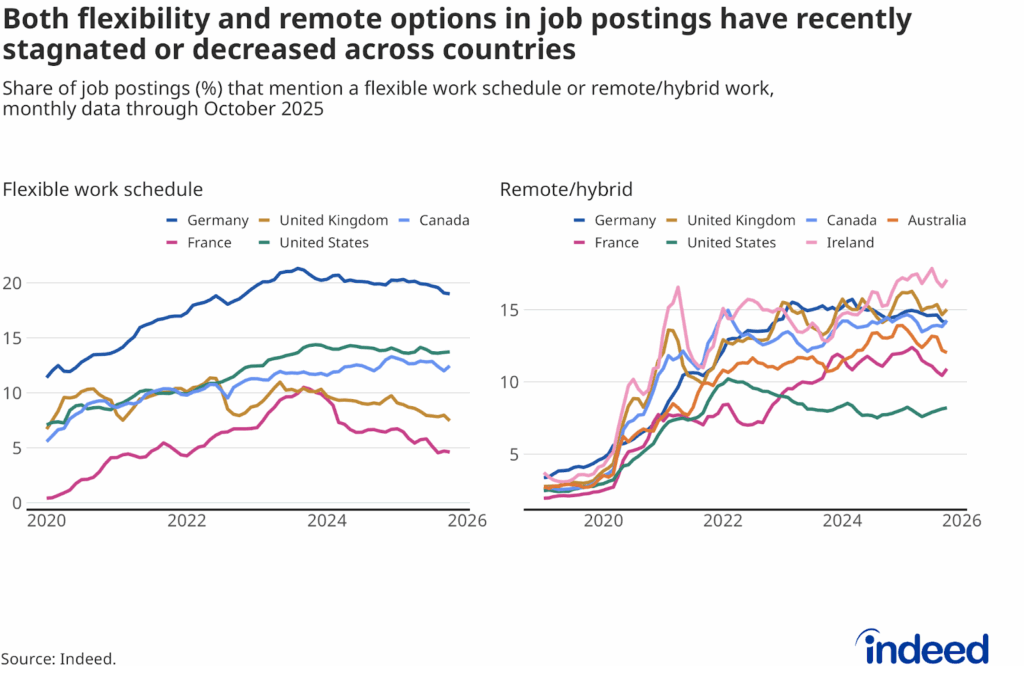
Job postings offering remote or hybrid work tell a similar story. After rapid growth from below 5% in all markets before the pandemic to more than 15% in Canada, Germany, the UK, and Ireland, momentum has flattened since 2024. Recent declines are evident in France (12.4% to 10.9% between March and October 2025), Australia (13.9% in January 2025 to 12%), and Germany (15.7% in March 2024 to 14.1%). The US continues to lag most countries, with remote shares below 10% since 2022.
Workplace flexibility supports both gender equity and labor supply
Desired benefits reflect differences in public provision of services and insurance by country. But culture matters too: Gender norms continue to shape daily responsibilities, and women’s higher demand for flexibility underscores the challenge of balancing work and care. Increasing women’s labor force participation is both a gender equity priority and an economic necessity to address a shrinking workforce in the light of demographic change across all economies analyzed.
To empower women to enter and remain in the workforce, efforts must focus on two fronts. In the long term, policymakers and employers can encourage a more equal split of unpaid labor, for instance, through parental leave that incentivizes men to take over more care work.
In the short term, women’s current life circumstances need to be addressed. Our Workforce Insights Survey reveals that flexible working hours and remote work benefits continue to be a crucial means of supporting women’s retention and advancement in the workforce.
The recent slowdown in flexible schedules and remote offerings is concerning in this respect. Employers who tighten return-to-office policies or reduce flexibility in working hours should be aware of the potential consequences. They risk restricting their talent pool and missing out on skilled workers. Sustaining flexibility isn’t just beneficial for employees; it supports broader workforce participation in the face of growing labor shortages.
Methodology
This analysis on desired benefits utilizes data from the 2025 Indeed Workforce Insights Survey, an online survey conducted for Indeed Hiring Lab by YouGov, of more than 80,000 adults from the US, the UK, Germany, France, Japan, Ireland, Australia, and Canada. Sampling was random and representative by age, gender, education, and region in all markets, and by race, aligned to the U.S. Census Bureau, American Community Survey, 2022. Fieldwork was conducted during the months of May and June 2025, with a total of n = 80,936 interviews globally, and a minimum of n = 10,000 interviews per market. This sample size provides a margin of error of ±1% at the 95% confidence level within each market.
Job postings offering a flexible work schedule are identified using a list of language-specific keywords by country. For postings offering remote or hybrid work, we use the Indeed Remote Tracker data, which also relies on a keyword-based approach.