
Key points:
- The World Cup champions are bucking the wider trend of labour demand deterioration in Europe — The Spanish Indeed Job Posting Index stood at 145 as of July 17, far above the Euro Area JPI of just 105.
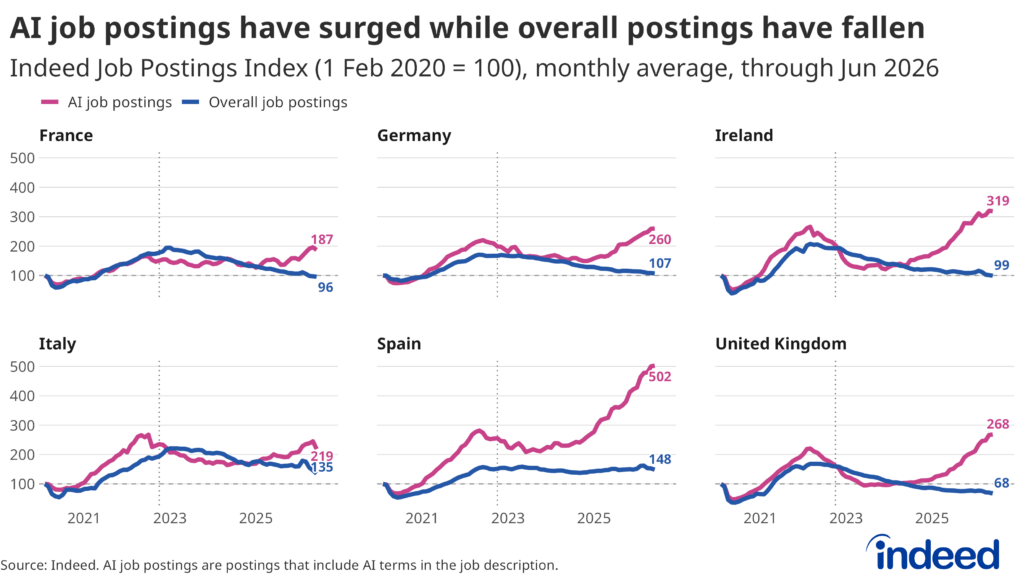
- AI-related job postings are on an upward trajectory, contrasting with a broader cooling in hiring demand.
See our full European Labour Market Overview chartbook for a more comprehensive view of the European labour market.
The stabilisation in labour demand we saw in late 2025 is now a distant memory in Europe. As of July 17, the Indeed JPI stood at 105 — almost 10% lower than where it started the year. The loss of momentum is relatively broad, and more than half of the occupational categories we track have fallen below the pre-pandemic baseline within Germany, Ireland, Belgium, France and the UK.
However, amidst an overall gloomy economic picture and uncertain geopolitical backdrop, there are bright spots. For one, the World Cup champions are also top of the table in European labour demand: Spanish job postings remain 45% above February 2020 levels. The elevated labour demand is broad-based across occupational categories, spanning cyclical sectors like construction as well as healthcare fields like therapy, nursing and physicians & surgeons, where hiring demand is structurally high. Nevertheless, increased hiring demand does not necessarily mean the labour market is overall tighter. Spain still faces some of the highest unemployment rates in Europe, at 10% for the general population and 24% for youth.
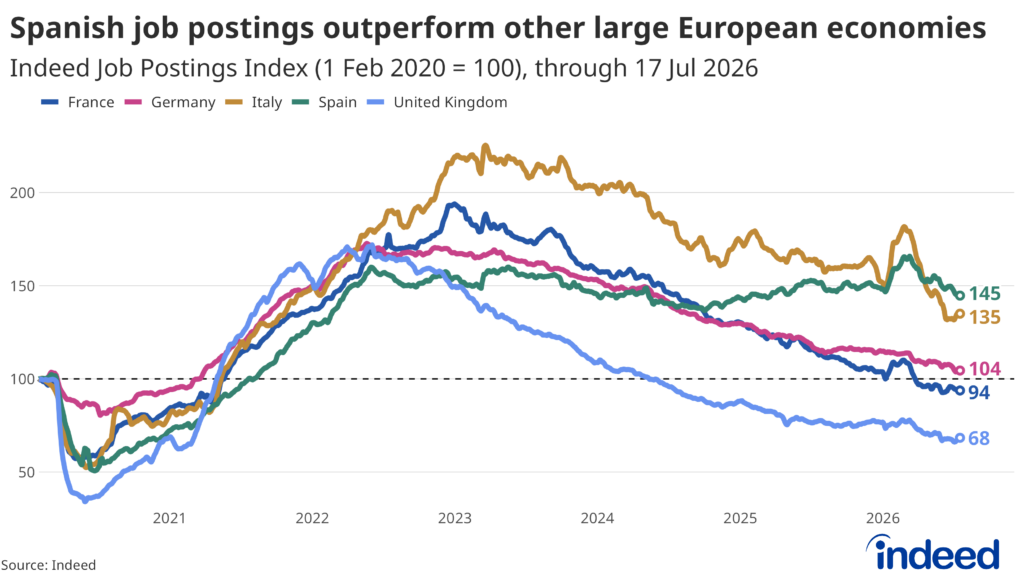
Line chart titled “Spanish job postings outperform other large European economies” shows the indexed level of job postings on Indeed from 1 February 2020 to July 17, 2026, where 1 February 2020=100, for Europe’s largest economies. Job postings are below 100 in France and the UK and modestly above baseline in Germany. Meanwhile, Italy and Spain continue to see hiring demand far above the pre-pandemic baseline.
AI is a clear standout as a job growth engine. According to the Indeed AI Tracker, the share of job postings mentioning AI continues to climb, led by Ireland (15%), Spain (13%), and the UK (9%). Our recent research also highlights a rise in “AI-touched” roles, with employers explicitly integrating AI into job titles across a broadening spectrum of occupations. In fact, AI now appears more frequently in non-tech job titles than in tech roles across Germany, the Netherlands, France, and the UK. Demand is rising for candidates who can effectively demonstrate and articulate how they apply AI in their daily work across a range of sectors.
While low unemployment (6.2%) and pockets of hiring strength are keeping the European labour market fundamentally stable, the overall trajectory continues to point downward. Risks include a deterioration in US-Iran relations and associated global energy price increases, monetary policymakers at the European Central Bank on the verge of increasing interest rates further, while in the UK a new prime minister spells a period of policy flux, complicating broad improvement in the European labour market.
See our full European Labour Market Overview chartbook for a more comprehensive view of the European labour market. Other data, including the Indeed Wage Tracker, is regularly updated and can be accessed on our data portal.