Key points:
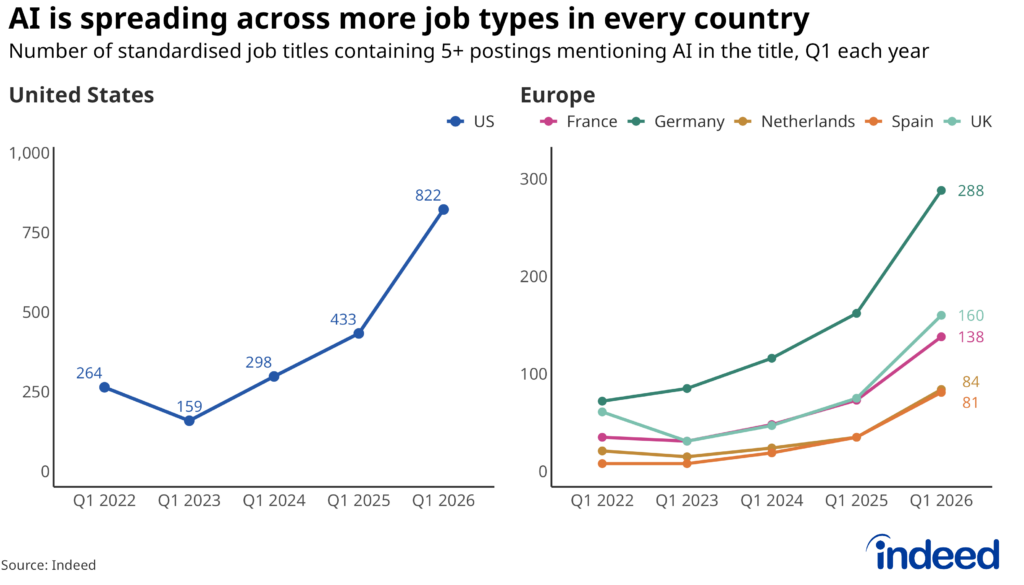
- The number of occupational categories where job postings have started mentioning “AI” in the title has risen sharply across the US and five large European markets – more than tripling in the US since 2022.
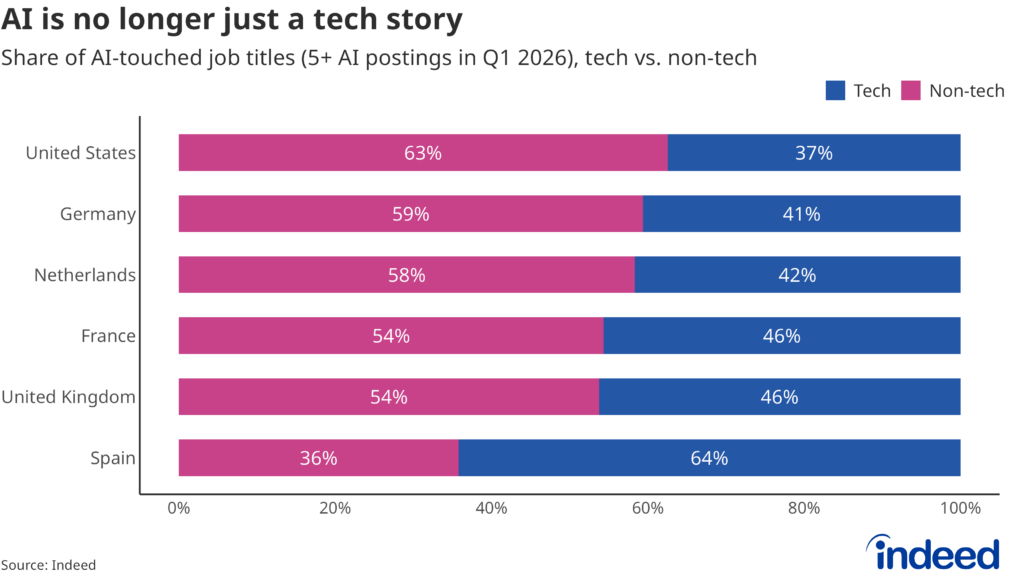
- AI in job titles is now more prevalent outside tech than in tech in five of the six markets we examined.
- Newly AI-labelled roles span sales, HR, customer service, legal, administrative, teaching and even skilled trades.
- The US leads both in the number of AI-touched titles and in the non-tech share, but Europe is catching up.
The adoption of AI tools has accelerated rapidly across European workplaces since 2022, and employers are increasingly weaving AI into job titles across a wider range of occupations. While this trend was initially concentrated in software and data roles, AI now appears in job titles in many other categories, such as sales, HR, legal services, customer support and administrative assistance, suggesting that AI-related skills, tasks and tools are becoming mainstream in the labour market.
In this post, we analyse normalised job titles, that is, Indeed’s detailed occupations that group very similar postings under a common label. For instance, postings for an “AI Engineer (Autonomous Agents)”, “Applied AI Engineer” and “AI Engineer – Urgently Needed” all fall under one label of “AI Engineer”, defined consistently across countries and over time. This is similar to, but more granular than, the standard occupational classifications used by statistical agencies.
We classify a normalised job title as “AI-touched” when at least five postings under that label have AI in the employer’s raw job title in a given calendar quarter. The five-posting threshold filters out one-off mentions, so we can consider job titles where AI language has become part of how employers define roles. We focus on job titles rather than full job description text because the main body of a posting can mention AI in many different contexts that aren’t necessarily related to the role itself. In contrast, including AI in the job title is a deliberate choice that likely means the employer considers AI as central to the role.
“AI-touched” job titles are multiplying
The number of AI-touched job titles has risen across every market we track. In the US, where AI hiring was highest even before the launch of generative AI, the count dipped from 264 in 2022 (or 2.6% of all titles with at least 5 postings) to 159 in 2023 before climbing steeply to 822 distinct AI-touched titles by the first quarter of 2026 (8.3% of all titles or about 1 in 12 in January-March). Europe has followed the same trajectory on a smaller scale. After a similar dip in 2023 in some countries, all five European markets we track have risen sharply. Germany leads with 288 AI-touched job titles in Q1 2026 (4.2% of all titles), ahead of the UK (160, 2.7%), France (138, 3.3%), the Netherlands (84, 2.2%) and Spain (81, 2.3%).
Postings with AI in the title are widely present outside tech
In five of the six countries we examine, more than half of all AI-touched job titles are now outside tech occupations. The US leads in non-tech share at 63%, consistent with its position as an early adopter, while Europe is close behind. In Germany, 59% of AI-touched titles are outside tech; in the Netherlands, it’s 58%; and in France and the UK, 54%. Spain is the exception: 64% of AI-touched job titles remain tech roles, reflecting a market where AI-related hiring is still concentrated in software and other tech job categories.
Familiar jobs, new language
One pattern that stands out is that many of the roles with AI in the title are jobs that have existed for decades. Employers are not only hiring AI specialists, but they are also adding AI to the titles of jobs where the use of AI tools is required – an indication of how AI is already reshaping jobs. In the US, recent postings include an “AI Autonomous Truck Test Driver”, a “Physical Therapist (AI Documentation)” and a “Real Estate Agent – AI Lead System Included”. There is a similar pattern in Europe. In Germany, an HR manager posting asks for someone who can use “AI in HR to increase efficiency.” In France, salespeople are sought to sell AI products and solutions, while in the Netherlands, we find postings for marketing and advertising specialists who use AI. These are familiar occupations, newly described in the language of AI.
Interactive table titled “AI is reaching new job types” showing curated examples of non-tech job titles that contain at least five postings mentioning AI in the job title in Q1 2026 but had none in Q1 2023, for France, Germany, the Netherlands, Spain, the UK and the US.
Three clusters appear across countries. The first is AI enablement and consulting: roles where candidates are expected to advise on AI strategy, manage AI adoption or oversee process changes, including account managers, operations managers and business development specialists. The second is AI training and content creation: language specialists, voice-recording contractors and subject-matter experts recruited explicitly to generate or review training data for AI models, as well as designers and marketers who use AI to create content. The third is AI instruction: coaches, tutors, lecturers and corporate trainers are increasingly hired to teach colleagues, clients and students how to use AI tools.
Conclusion
A posting with AI in its title likely signals that the employer considers AI as central to the role in terms of tasks or skill requirements. It may also reflect competitive signalling if candidates associate such mentions with positive characteristics of the employer, such as innovation. Either way, Indeed’s AI tracker and survey-based measures of AI adoption both suggest the diffusion of AI tools in the workplace continues to grow. The spread of AI into how roles are named points to a redefinition of jobs across the US and Europe that extends well beyond software and data teams.
For jobseekers, the implication is that AI is becoming part of the expected toolkit across a growing range of roles. A truck driver, a physical therapist or an HR manager looking for work today is increasingly likely to encounter postings that demand familiarity with AI. This does not necessarily mean deep technical knowledge, as the examples above span tasks like using AI-assisted software, or advising on how to implement AI in a business. Workers who can demonstrate familiarity and articulate how they use AI in their work are likely to be better positioned as employers make that expectation increasingly explicit.
Methodology
This post analyses Indeed job postings from Q1 2022 to Q1 2026, covering the US and five large European economies: France, Germany, the Netherlands, Spain and the UK. Italy is excluded because “ai” is a common prepositional contraction in Italian, equivalent to “to the” or “at the”, that appears in many job titles with no relation to artificial intelligence, making a clean filter impractical.
A normalised job title is defined as “AI-touched” in a given quarter when at least five postings under that label include “AI”, “GenAI”, “AGI” or “artificial intelligence” (or the relevant versions of these terms in other languages) in the employer’s raw job title.
Indeed’s normalised job titles group very similar postings under a single, consistently defined occupational level, making them comparable across countries and over time. They are more granular than standard occupational classifications used by statistical agencies. The UK’s Standard Occupational Classification (SOC 2020), for instance, has 412 unit groups at its most detailed level, while Indeed ‘s data for the UK includes around 6,000 normalised job titles with at least five postings in a given quarter. The picture is similar in other countries.