
Key points:
- With the June 2026 deadline for implementing the EU’s pay transparency directive only weeks away, most large member states are likely to miss it.
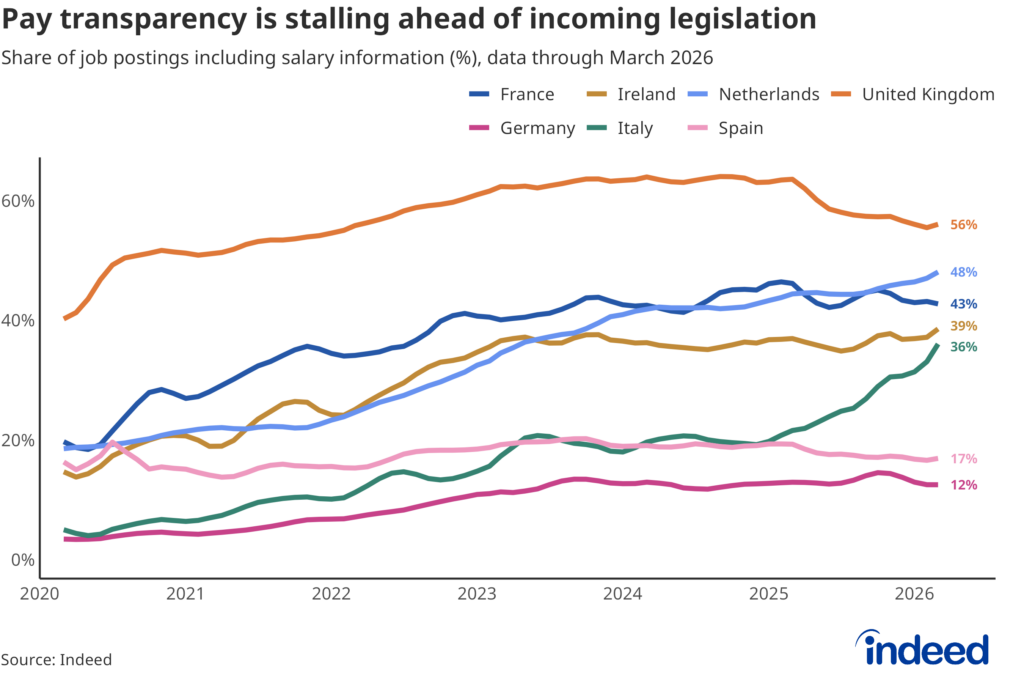
- The gap in salary disclosure between Europe’s best and worst performers is wide: over half of UK job postings include salary information, while only 1 in 8 do in Germany.
- Even as some EU countries have started to implement salary transparency laws, the share of postings with pay has not changed much in Europe’s largest economies over the past year – Italy’s rise from 22% to 36% within 12 months is a notable exception.
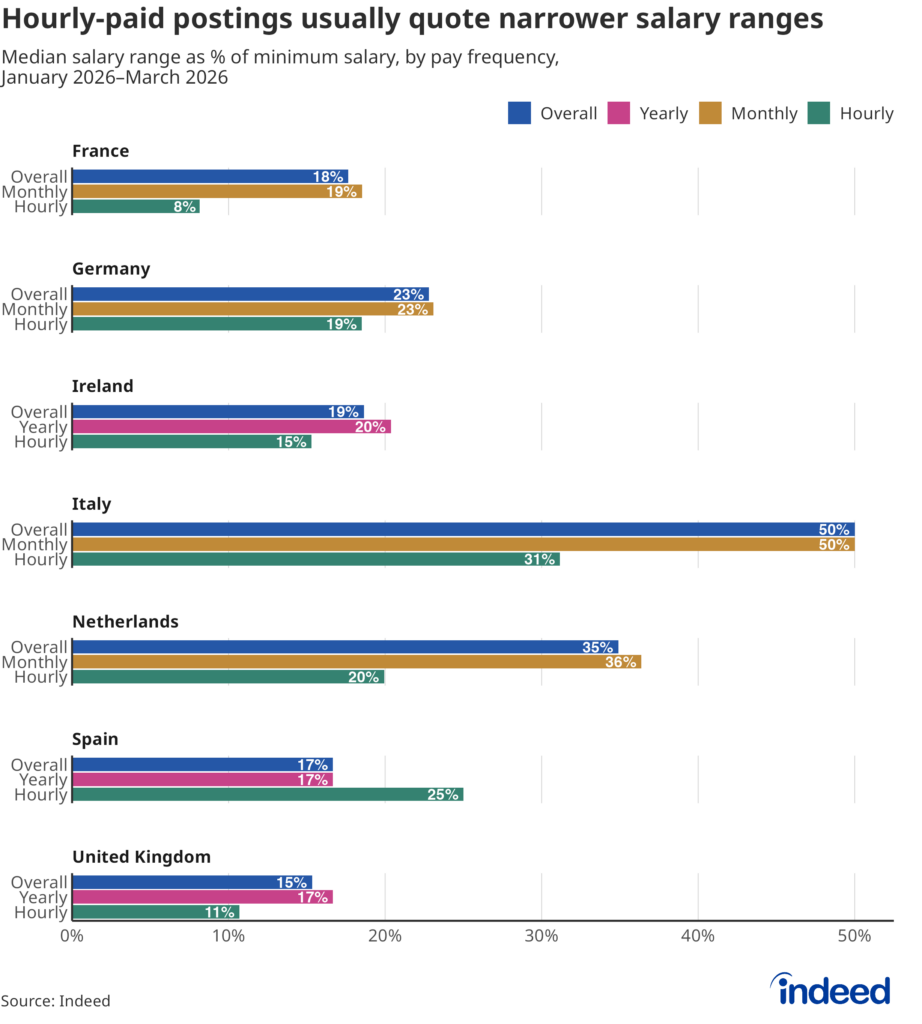
- When pay ranges do appear, their size and usefulness vary across countries and pay types: UK postings typically advertise hourly ranges just 11% wide (e.g., £15–£16.65/hr), while Italian postings show median ranges of 31% above the lower bound (e.g., €10-€13,10/hr).
- Postings for hourly-wage jobs are typically the most informative – they are most likely to quote an exact figure, and when a range is given, it tends to be narrower than for monthly or annual pay.
The Hiring Lab publishes its Pay Transparency Tracker, updated monthly, on the Hiring Lab Data Portal.
In many countries, pay is the number one reason people look for a new job. But in most of Europe, it is also a piece of information very likely to be missing from job postings, despite a yearslong EU-driven policy push to increase salary transparency.
Withholding pay information from candidates has real consequences. Navigating information asymmetries and negotiating under uncertainty do not carry the same consequences for all workers. Instead, research has linked both to the persistence of the gender pay gap.
Upfront disclosure of pay – one of the most decision-relevant characteristics of a job – improves matching by giving candidates the opportunity to self-select based on realistic information. Yet, Indeed Hiring Lab data shows that postings in most large European economies remain largely opaque, and progress on salary transparency has stalled.
Three years after the EU adopted the pay transparency directive in 2023, most large member states, including Germany and France, are still legislating and will likely miss the EU’s June 2026 deadline. France’s parliamentary calendar makes adoption before June unlikely, the Netherlands has pushed implementation to 2027, and Germany has yet to introduce a bill, despite an expert commission publishing implementation recommendations in October 2025.
Italy and Ireland, on the other hand, have both drafted laws that go beyond the EU directive requirements, mandating that pay information be shared in the job posting. Specifically, on pre-hire pay disclosure, the directive requires only that employers share information on pay with candidates before an interview, not necessarily publish it in the posting. This distinction matters because a salary in a posting is visible to all candidates before they invest time in applying. Tracking what actually appears in postings is therefore the right measure of how much transparency jobseekers actually experience at the job search stage.
Pay transparency in European job postings is low and has stalled despite legislative focus
In most large European economies, the majority of job postings are silent on pay. Only 12% of German postings and 17% of Spanish postings disclose salaries. At the other end of the spectrum, the UK reaches 56%, followed by the Netherlands (48%), France (43%), Ireland (39%), and Italy (36%). While it is encouraging that the long-term trend since 2019 is positive in most countries, data from the past two years shows a flat trend. Italy stands out as the only country to have experienced a sustained rise in recent months, from around 20% at the start of 2025 to 36% in March 2026. In contrast, the United Kingdom, although still the most transparent large European market, has seen its share of postings with salary drop recently from almost two-thirds to just over one-half. It remains to be seen whether the EU directive and national legislation have any positive spillover effects on British employers, especially those with a cross-border presence.
Stagnation in transparency mirrors cooling labour markets
Indeed Hiring Lab analyses of pay transparency laws in Canada and the United States found that employer behaviour changed primarily when specific disclosure laws took effect, not in anticipation of them. The pattern in Europe appears similar so far. With most large EU member states yet to pass national legislation, many employers do not appear willing to change their job posting practices. Against this backdrop, the June 2026 EU deadline is less a hard trigger than a starting point for legislative processes that will play out across most member states over the coming months. Individual countries may go further than the directive and mandate upfront disclosure, but until they do so, the directive allows postings to omit pay.
The stagnation in salary transparency has also occurred in the context of slowing job posting growth in most large European markets, including France, Ireland, the Netherlands, and the UK. To that end, greater employer bargaining power may be behind the plateauing or decline in transparency. With neither tight labour markets nor specific national disclosure legislation, the broad intent of the EU directive alone appears insufficient to drive further adoption.
Italy and Spain have been notable exceptions to the cooling labour market trend, with postings significantly above the pre-pandemic baseline. In Spain, salary transparency has remained low, perhaps because the overall ratio of job vacancies to unemployment is still low by EU standards. Italy has recently released a draft law requiring employers to publish salaries in postings, and part of the rise in salary transparency in Italy was likely also driven by the addition of prompts encouraging employers to include salary information when publishing a job posting on Indeed.
The cross-country differences in transparency also reflect underlying wage-setting institutions. In the UK, pay is predominantly market-based and determined at the firm level, whereas in much of continental Europe, wages are set through sector- or industry-level collective bargaining. In practice, that means that pay can often be derived from publicly available salary grids. Germany’s particularly low transparency share is consistent with this observation; with pay largely governed by collective agreements, individual employers have little incentive to disclose salary ranges in postings, and the EU directive accommodates this, explicitly allowing pay information to be made available through social partners such as unions.
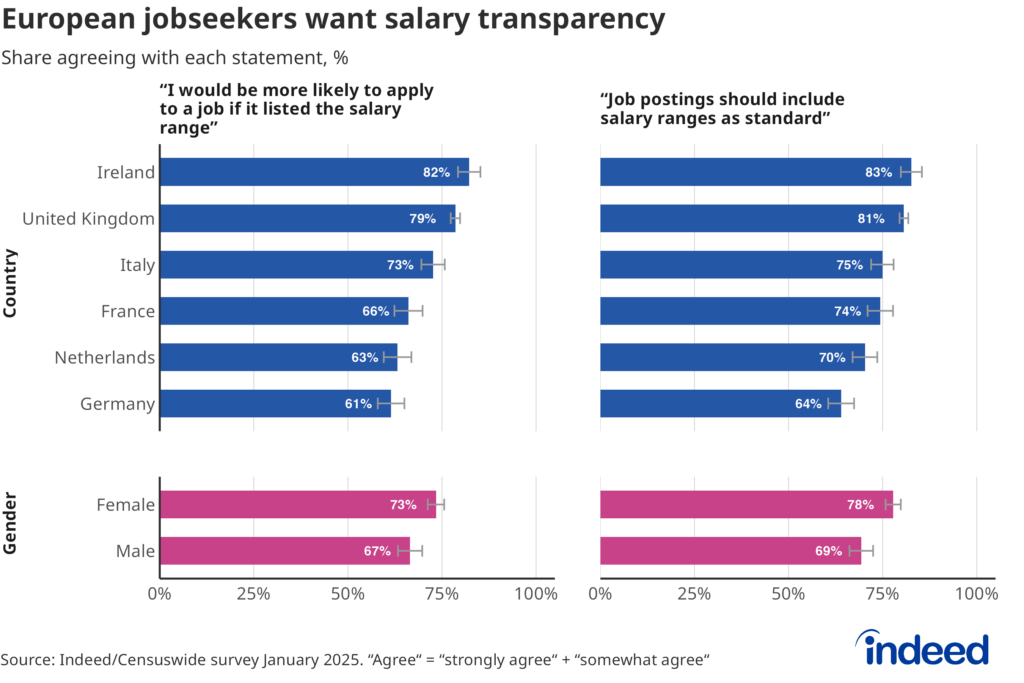
Meanwhile, pay transparency in job postings is a stated preference among European jobseekers and workers, according to an Indeed survey of 6011 workers in 6 countries. A vast majority of respondents across all observed countries (ranging from 61% in Germany to 82% in Ireland) said they would be more likely to apply to a posting with a salary range. An even higher percentage (64% to 83%) said they believe job postings should include salary ranges as standard. Crucially, around three in four women said they agreed with each statement, compared to roughly two in three men, underpinning the argument that transparency could help reduce gender disparities in application behaviour and negotiation under uncertainty.
Lower-paid jobs tend to be more transparent
Transparency rates vary widely across occupations. The most transparent categories are typically composed of lower-paid, standardised roles, including cleaning and sanitation in Germany, driving in Spain and Italy, personal care and home health in the United Kingdom and France, childcare in Ireland, and community and social service in the Netherlands. These jobs are characterised by high turnover, greater labour substitutability, and fewer non-pay benefits – making salary one of the main features employers compete on. In Austria, where pay information in job postings has been mandatory since 2011, low-skill jobs show higher compliance rates, consistent with this pattern.
Select a country to display salary transparency rates of job postings by occupational category:
In most countries, occupational categories where hourly pay is the norm – often, low-wage, non-permanent roles – tend to have higher transparency rates than categories where annual salaries dominate. This pattern holds in the UK, Germany, France, and, to a lesser extent, Italy. The Netherlands, however, is an exception. Postings there are predominantly quoted in monthly terms, and occupational categories with a high share of hourly pay quotes are not correspondingly more transparent.
Precise numbers are the exception; salary ranges are the rule
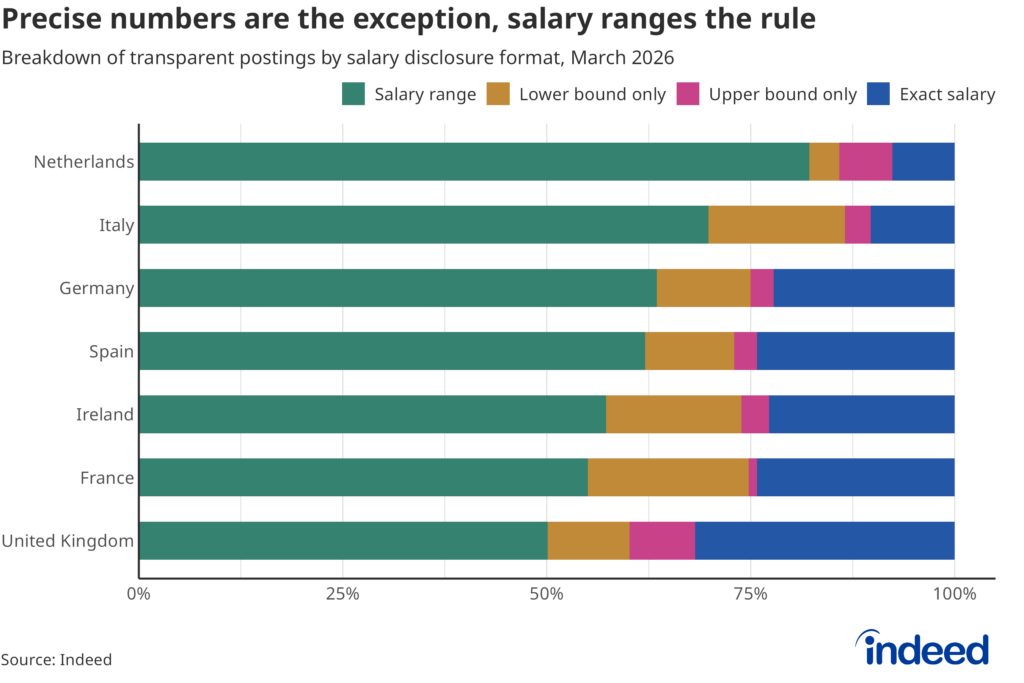
Only a small proportion of postings providing a salary quote a precise figure. The vast majority state either a range or a single (upper or lower) bound. Precise figures are most common in the United Kingdom, with 32% of postings quoting exact pay, followed by Spain and France (both 24%). Job postings with salary data are least likely to provide a single figure in Italy (10%) and the Netherlands (8%).
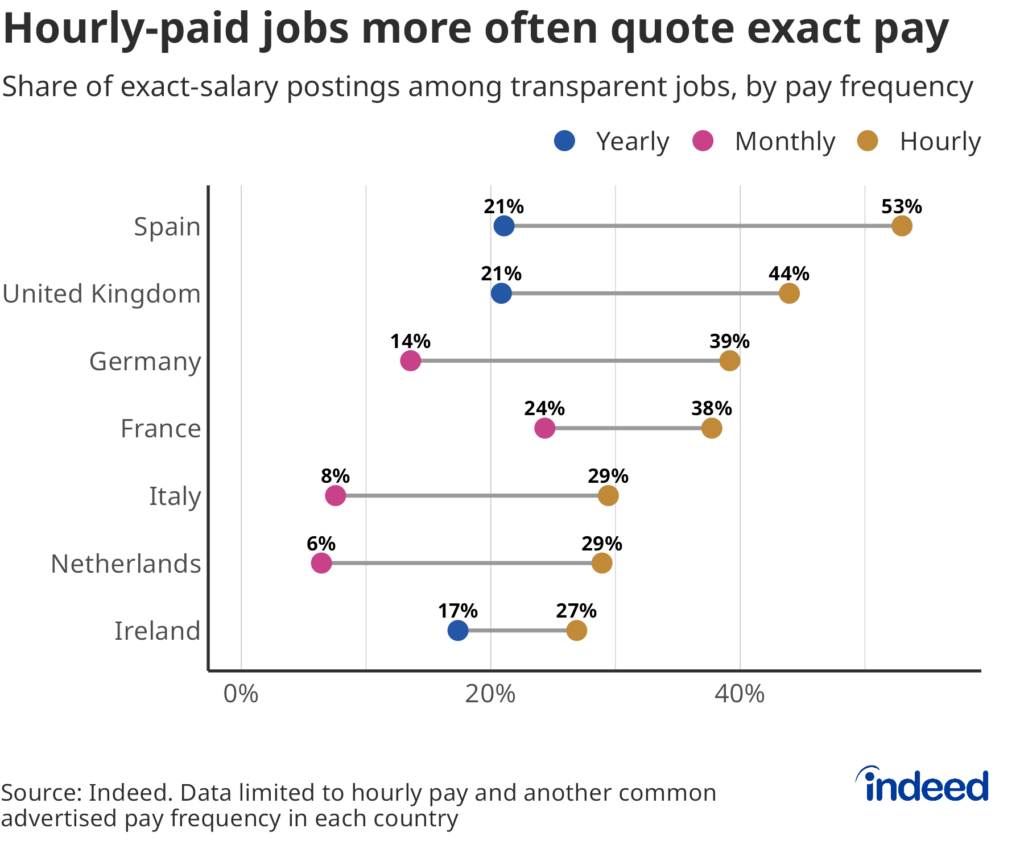
Precision also depends on the type of pay offered. Hourly pay is more likely to be quoted as an exact figure and, when a range is given, it tends to be narrower. In Spain, for instance, 53% of hourly pay postings quote an exact figure, against only 21% of postings advertising annual salaries. In the UK, 44% of hourly rate postings do the same, compared to 21% of annual salary postings. The same pattern holds across all countries studied, though the size of the gap between pay types varies.
As the typical salary-transparent posting advertises a range rather than a fixed figure, the final wage is determined by experience, skills, and some negotiation between employer and candidate. That said, not all ranges are equally informative – a narrow band gives jobseekers a much clearer sense of likely pay than a wide one. Median ranges show strong variation across countries and pay types. In the UK, for instance, the median hourly range is 11% of the lower bound (equivalent, for example, to a posting paying £15-£16.65 per hour), while annual salary ranges are wider at 17% (corresponding to something like £30,000-£35,100). Hourly ranges are consistently narrower than the most common longer-interval pay type in all countries except Spain, where hourly wages are quoted in slightly less precise terms. Italy stands out at the other extreme: salary ranges there are the widest of any country in our sample, with a median of 50% of the lower bound (a posting advertising €3,000 per month, for instance, would typically top out at €4,500).
Conclusion
Until the introduction of a legal obligation, European employers will likely remain reluctant to adjust their job posting practices. Even then, the quality of disclosure is not guaranteed – some employers may respond by posting ranges wide enough to satisfy the letter of the law while revealing little about actual pay. Either way, the current data shows how little European jobseekers know about pay in the jobs they apply to today. As national laws are implemented, the current baseline presented in this analysis will be a reference point against which future progress in salary transparency can be assessed.
Methodology
We calculate pay transparency in job postings by dividing the number of unique job postings with a salary by the total count of unique advertisements in a given month. Pay information is extracted from postings published or indexed by employers on Indeed. Some postings reference publicly available benchmarks such as the minimum wage or collective bargaining wage tables rather than listing figures explicitly; including these cases as transparent does not meaningfully change the salary transparency shares or trends.
The Indeed/Censuswide survey on pay transparency preferences was conducted in January 2025 across 6011 workers and jobseekers aged 18 or older in the UK, Netherlands, France, Italy, Germany, and Ireland.