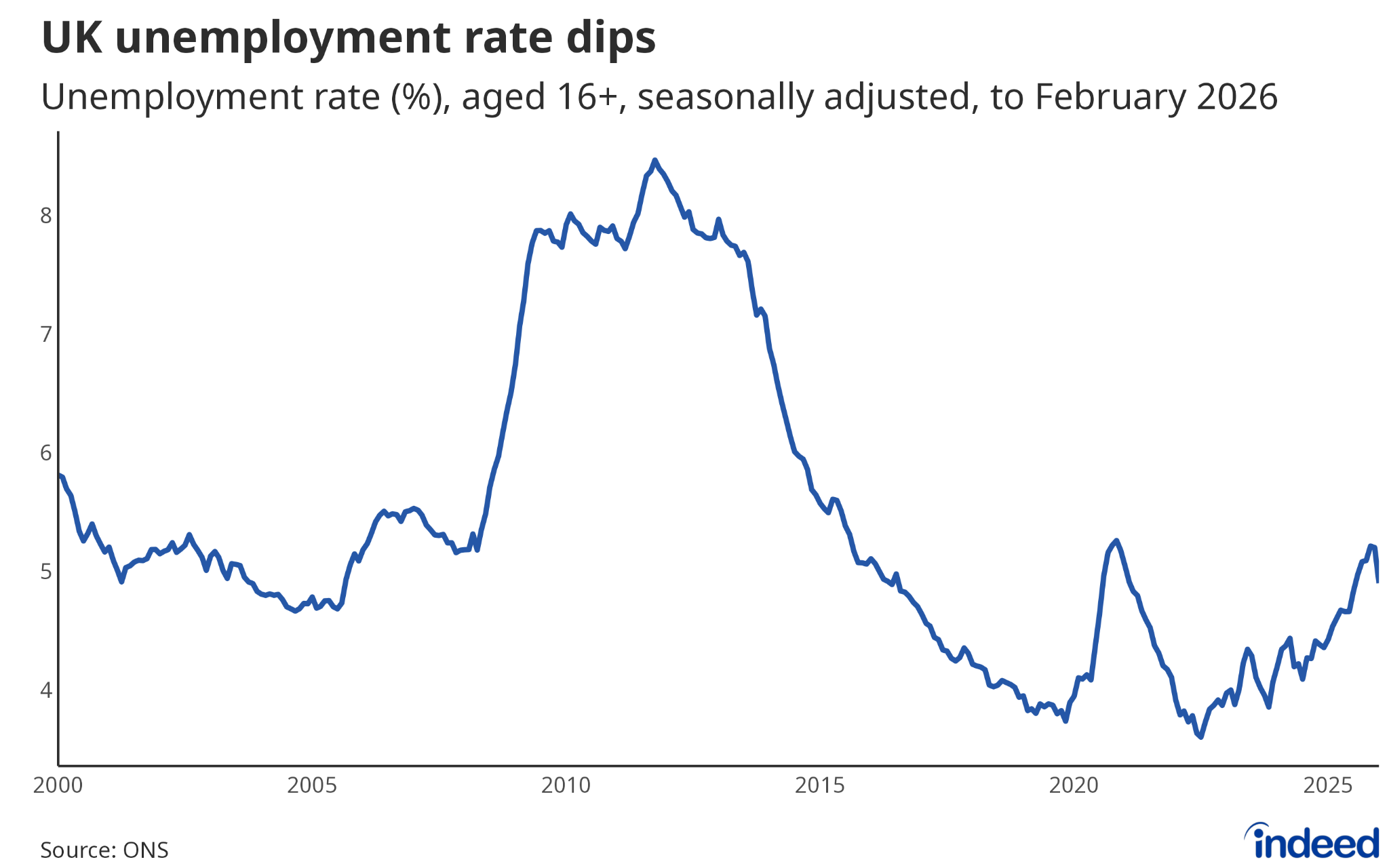
Key points:
- UK job postings have fallen around 8% since the outbreak of the Iran conflict in late February, and now stand 29% below their pre-pandemic baseline.
- The drag is most visible in energy-exposed sectors such as construction, installation & maintenance and production & manufacturing –though consumer-facing and professional occupations have shown greater resilience.
- The softening labour market complicates the Bank of England’s task as it weighs rising inflation against downside growth risks from the conflict.
Our Labour Market Updates examine important trends using Indeed and other labour market data. Our European Labour Market Overview chartbook provides a more comprehensive view of the European labour market. Other data, including the Indeed Wage Tracker, is regularly updated and can be accessed on our data portal.
UK hiring demand has shown signs of further softening in recent weeks amid a global energy price shock, with job postings falling by around 8% since the start of the war in Iran. However, recent performance is uneven across job categories, with some experiencing larger declines, while others show modest falls or even growth.
A weakening labour market remains a key consideration for policymakers at the Bank of England as they weigh competing risks to the UK economy from rising inflation and downside growth prospects stemming from the conflict. The Bank’s Monetary Policy Committee (MPC) held its policy rate steady at 3.75% in April, while setting out its thinking as to possible future rate increases under different scenarios, from shorter to more prolonged energy market disruptions.
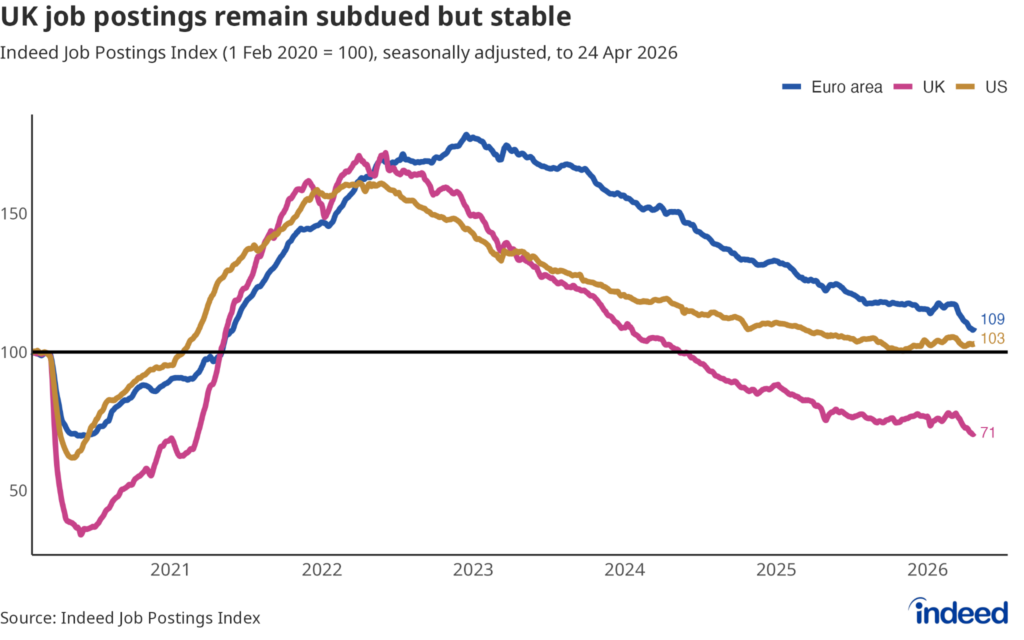
Job postings have fallen in recent weeks
UK job postings are down about 8% since the outbreak of the conflict in Iran in late February. They now stand 29% below their pre-pandemic baseline, in contrast to other major advanced economies like the euro area and the US, where postings remain above baseline.
That said, euro area postings show a similar recent downward trajectory to the UK (down 7% since the start of the conflict). That could be a reflection of the estimated greater exposure of European economies to the energy price shock relative to the US economy (where postings are down just 2%).
Some occupational sectors are showing resilience
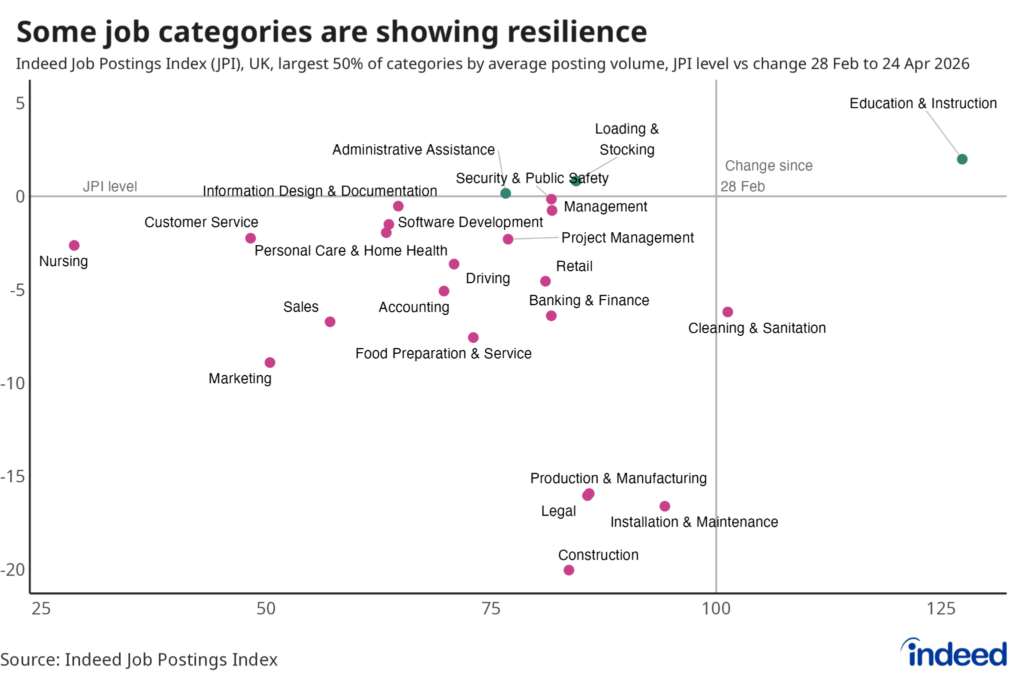
Recent performance is uneven across job categories. Construction, installation & maintenance and production & manufacturing – all relatively highly exposed to energy prices – show among the biggest declines since late February.
But many categories have seen only modest declines over the period, including consumer-facing sectors such as retail and food preparation & service, as well as most professional occupations like accounting, banking & finance and management. Education & instruction, meanwhile, continues to see robust hiring demand, with momentum building in recent weeks.
Conclusion
The latest data paint a labour market under pressure – but not one in freefall. Occupational categories more exposed to energy prices appear to be bearing the initial brunt (as might be expected), while much of the services economy is holding up. But with global energy prices remaining elevated and business confidence fragile, the risk is that today’s softness in hiring demand becomes tomorrow’s acceleration in job cutting.
The Bank of England faces a dilemma: inflation pressures from the energy shock pull in one direction, while a weakening jobs market (and the threat to growth) pulls in the other. The MPC is in wait-and-see mode for now. Still, a prolonged conflict raises the risk of more substantial monetary policy tightening, which would place further strain on the economy, household finances and the labour market.
Hiring Lab Data
Job postings data is available on our Data Portal. We also host the underlying job-postings chart data on GitHub as downloadable CSV files. Typically, it will be updated with the latest data one day after this blog post is published.
Methodology
Data on seasonally adjusted Indeed job postings is an index of the number of seasonally adjusted job postings on a given day, using a seven-day trailing average. Feb. 1, 2020, is our pre-pandemic baseline, so the index is set to 100 on that day.
To calculate the average rate of wage growth, we follow an approach similar to the Atlanta Fed US Wage Growth Tracker, but we track jobs, not individuals. We begin by calculating the median posted wage for each country, month, job title, region and salary type (hourly, monthly or annual). Within each country, we then calculate year-on-year wage growth for each job title-region-salary type combination, generating a monthly distribution. Our monthly measure of wage growth for the country is the median of that distribution.
The number of job postings on Indeed.com, whether related to paid or unpaid job solicitations, is not indicative of potential revenue or earnings of Indeed, which comprises a significant percentage of the HR Technology segment of its parent company, Recruit Holdings Co., Ltd. Job posting numbers are provided for information purposes only and should not be viewed as an indicator of performance of Indeed or Recruit. Please refer to the Recruit Holdings investor relations website and regulatory filings in Japan for more detailed information on revenue generation by Recruit’s HR Technology segment.