
Key points:
- The share of Ontario job postings mentioning AI-related terms jumped from 9% to 28% after new rules requiring disclosure of the use of the technology in hiring came into force at the start of 2026, making the province a global outlier.
- The presence of AI-terms in postings soared across nearly all occupations, with a few exceptions in fields including beauty and wellness, dental and veterinary services.
- The widespread reaction to the new rule demonstrates how common the use of AI is in current hiring processes, which brings both benefits and risks.
- It’s difficult to pinpoint whether the rise of AI is reducing demand for recruiters and other HR professionals. Recruiter job postings have been weak since 2023, but their decline mainly preceded the public rollout of Chat GPT, and they’ve held steady more recently.
At the start of 2026, the Ontario government instituted a range of new disclosure requirements for job postings originated by employers with at least 25 employees. Some of the changes, such as posted salary transparency requirements, resemble rules in other provinces (including B.C.) and countries. But Ontario is unique in now requiring employers to disclose when artificial intelligence (AI) is used in the candidate recruiting or screening process. The response in job postings was immediate.
AI mentions raced ahead of their earlier trend in anticipation of the new disclosure requirement, and soared once it came into force. The share of job descriptions in Ontario that included AI-related terms more than tripled, from 9% in October 2025 to 28% in May 2026, according to data from the Indeed Hiring Lab’s AI tracker, which tracks mentions of AI and AI-related terms in job postings. The rapid rise in AI mentions has turned Ontario, and the rest of Canada with it, into a global outlier.
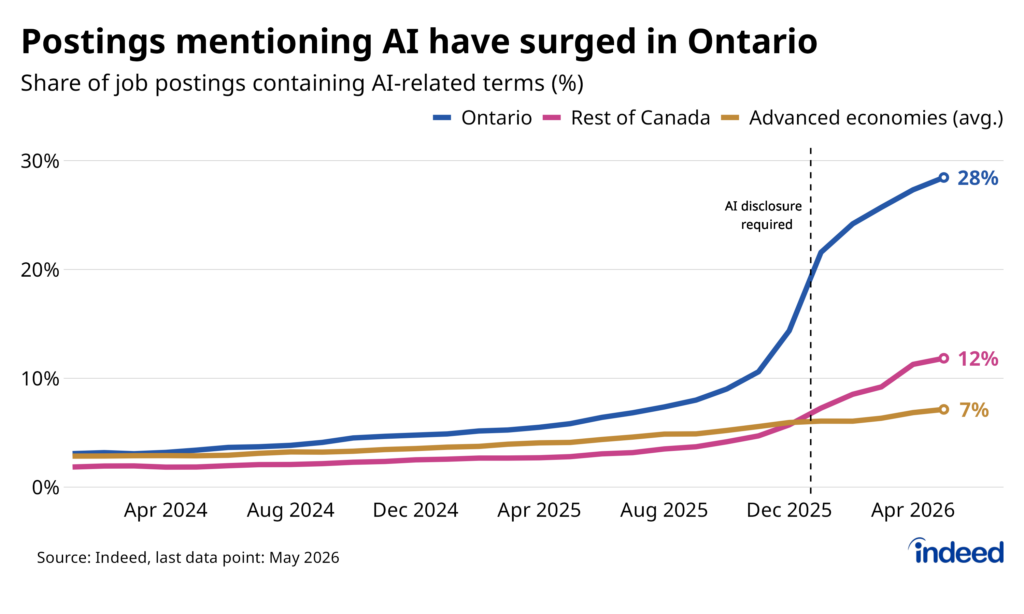
As recently as mid-2025, the highest AI share recorded among advanced economies was in Spain, at 9%. Canada was the only nation in which AI mentions are up by more than 4 percentage points since October, with clear signs that Ontario’s policy decision has spilled over into the rest of the nation. The share of postings in the rest of the country jumped from 4% to 12% over this period. On average across other advanced economies analyzed, the AI share stood at 7% in May, and has been rising only gradually.
Only a few sectors failed to show large jumps in AI mentions
The surge in Ontario AI mentions was broad-based across different job types. AI mentions rose between October and May in every one of the 48 occupations tracked, and 40 of those sectors rose by 10 percentage points or more. Across sectors, the median increase between October 2025 and May 2026 was 18 percentage points.
There wasn’t a particularly tight correlation between initial levels of AI postings in mid-2025 and the subsequent increases thereafter. Instead, fields that initially rarely mentioned AI were represented in both the largest and smallest jumps after the policy change. Postings in beauty and wellness, as well as dental and veterinary services, showed little movement, while sectors including pharmacy, retail and personal care and home health saw outsized increases. Meanwhile, areas where AI postings were already common, such as tech, rose similarly to the economy-wide average.
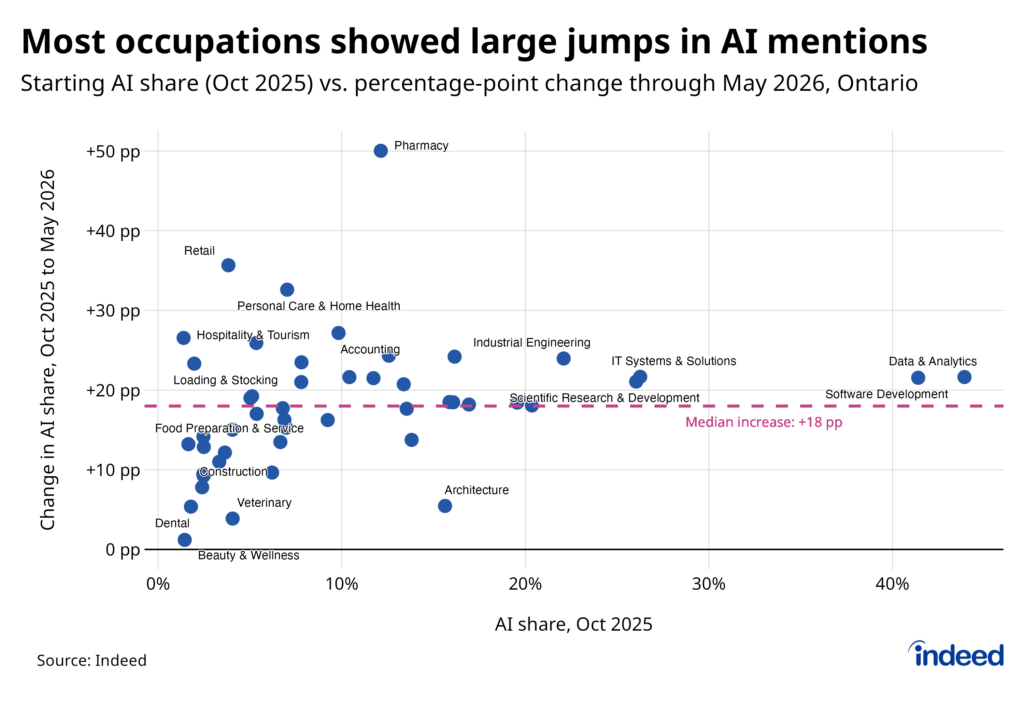
Employer size likely played a role in determining how much AI mentions changed across different occupations following the new disclosure requirements. Not only are businesses with fewer than 25 employees exempt from the new rules, but the smaller scale of their operations could mean less urgency to systematize their recruiting processes using tools like AI. For example, while most postings at local-level hair salons and dental offices weren’t affected by the policy change, big-box retailers employing cashiers, stockers, and pharmacists not only complied with the law in Ontario, but also started including AI disclosures in their postings in other provinces, too.
AI is now widely incorporated in hiring processes
The message from our AI tracker in Ontario – and by extension, Canada – has morphed: no longer does the presence of AI-related terms in job descriptions just capture demand for AI-related skills. It’s now primarily a metric capturing the use of AI by employers for recruitment. The elevated level today highlights how common the application of AI is in hiring processes, and is probably an understatement, given both exemptions to the new rules and incomplete compliance.
The rise of AI in the recruiting process raises questions, both over how the technology will impact the way hiring is done throughout the economy and its implications for the future of employment in recruitment and human resources fields themselves.
Ontario job seekers haven’t seemed especially put off by (or haven’t noticed) the jump in mentions of AI in job descriptions. Outside of the tech sector, daily applications per posting in 2026 have been similar between posts mentioning AI and those that don’t. Moreover, many job postings that include AI disclosures also emphasize that human decision-makers have the final say in ultimate hiring decisions. Still, it’s incumbent upon employers to ensure the technology doesn’t degrade the candidate experience or introduce new biases into the recruitment process.
It’s also difficult to pinpoint the impact of AI on demand for recruiters and other HR professionals. Recruiter job postings in Canada have been weak since plunging from extreme heights reached at the peak of the post-pandemic job labour market. However, the dropoff was steepest throughout 2022, before the public release of ChatGPT in November 2022, and postings have been flat since early 2024, while rebounding somewhat in 2026 to 7% below their pre-pandemic level as of late May. Postings for other HR-related jobs also experienced an outsized boom before cooling off, and have evolved similarly to the rest of the economy since 2023. The evolution of demand for recruiters resembles the tech sector, where postings are weak compared to pre-pandemic levels, but have evolved like less AI-exposed occupations more recently.
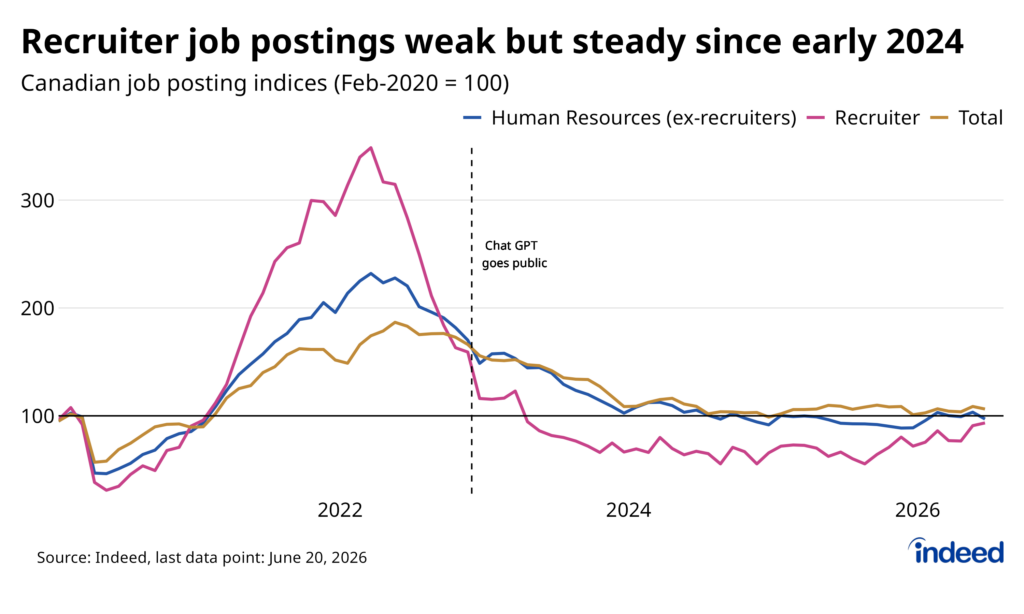
The fact that recruiter job postings haven’t continued to decline as AI’s agentic capabilities have advanced suggests that so far, the application of AI has focused on optimizing smaller tasks rather than fully transforming whole jobs. Like with other white-collar occupations, how the roles of recruiters and other HR professionals evolve as the technology advances will depend on the interaction between AI’s capabilities and human oversight and judgment in accomplishing different organizations’ workforce goals.
Methodology
This post utilizes data from Indeed’s AI posting tracker, which flags posts as mentioning AI if key terms such as “Machine Learning”, “Data Science” and “Artificial Intelligence” are included in the posting title or job description. All data presented are monthly average daily shares. Other advanced economies tracked include the US, UK, Australia, Germany, France, Ireland, Italy, Spain, and the Netherlands.
The number of job postings on Indeed, whether related to paid or unpaid job solicitations, is not indicative of potential revenue or earnings of Indeed, which comprises a significant percentage of the HR Technology segment of its parent company, Recruit Holdings Co., Ltd. Job posting numbers are provided for information purposes only and should not be viewed as an indicator of performance of Indeed or Recruit. Please refer to the Recruit Holdings investor relations website and regulatory filings in Japan for more detailed information on revenue generation by Recruit’s HR Technology segment.