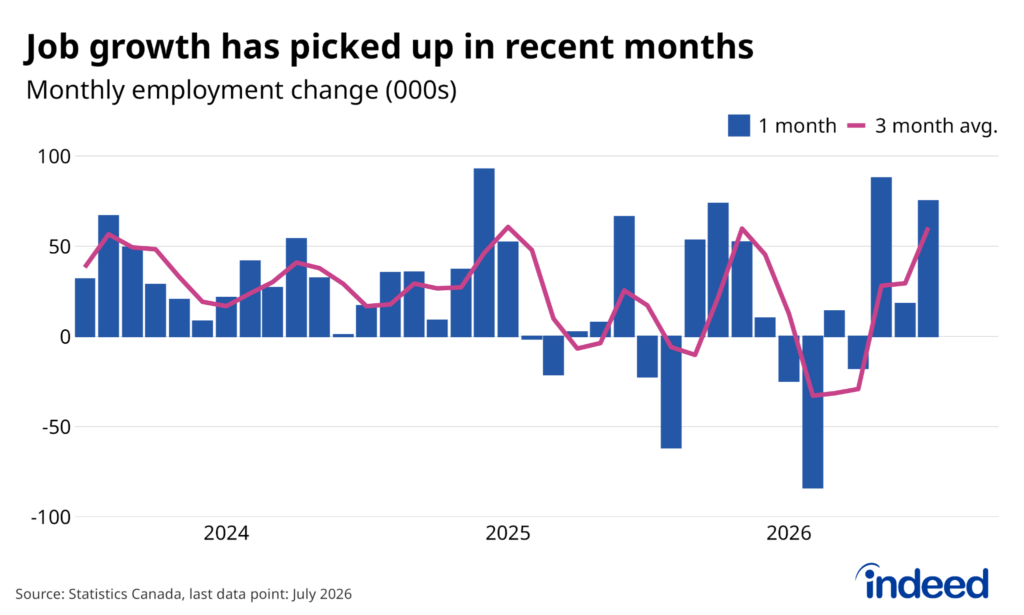
Last month, we called June’s report momentum without a turning point. July data makes the turn harder to dismiss. Employment rose by 75,000, far above the consensus of 15,000, the unemployment rate ticked down to 6.4% — its lowest level in two years — and the employment rate edged up to 60.9%. What matters isn’t the single month of data; it’s the consecutive strength. Since April, jobs in Canada have increased by 181,000 and the unemployment rate has declined by half a percentage point, declining for three consecutive months. One month of positive data can be noise, but three months in a row starts to look more like a trend.
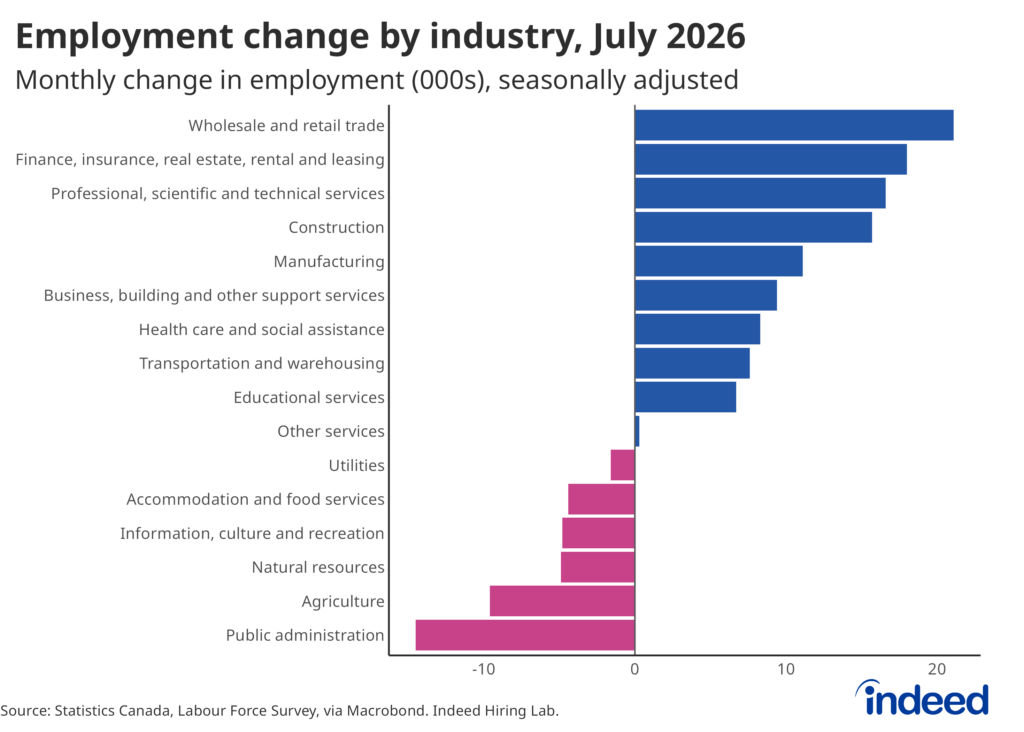
The broad-based nature of the gains is also impressive. While the private sector led the way (+58,000 jobs), self-employment also showed strength, adding 44,000 jobs. Gains in July were split between full-time and part-time positions, another positive development after part-time led the way earlier this summer. Employment increased across a broad array of sectors, including Wholesale and Retail Trade, Finance and Real Estate, Professional and Technical Services, and Construction. Declines were seen in six sectors, but only Public Administration saw losses greater than 10,000, and many of the declines were only small give-backs from early-summer strength. Core-aged women were the real standout: their unemployment rate fell to 5.2% and their employment rate climbed to 81.2%, now more than 2 points above its pre-pandemic norm.
Job growth in Ontario has been the driving force over the past four months, adding 52,000 jobs in July and a net gain of 119,000 over the four-month period. The unemployment rate in Ontario declined 0.2 percentage points to 6.8 in July, its lowest level since July 2024. Employment in British Columbia has increased each month since May, albeit at lower levels, adding 18,000 jobs in July. Nova Scotia saw an increase of 4,600, and Quebec and Alberta were little changed in July.
We’ve focused frequently on the story of youth unemployment in Canada over the years, and July’s report showed improvements worth noting. Youth unemployment ticked down to 12.6% in July, and while virtually flat compared to June, this is two points lower than a year ago. The summer job market is an important part of this story. Returning students posted a 15.1% unemployment rate, down more than 2 points from last summer, and for those aged 20 to 24, the rate fell to 6.3%, its lowest July rate since 2018. For younger Canadians, the labour market looks a little brighter in 2026.
While July’s report is overwhelmingly positive, the overall trend still looks a lot more like stabilization from last year’s softness rather than true acceleration. But three straight months moving in the right direction is exactly how turning points begin — and if the breadth we saw in July holds into the fall, stabilization could quietly become the momentum Canada has been waiting for.