
Key Points:
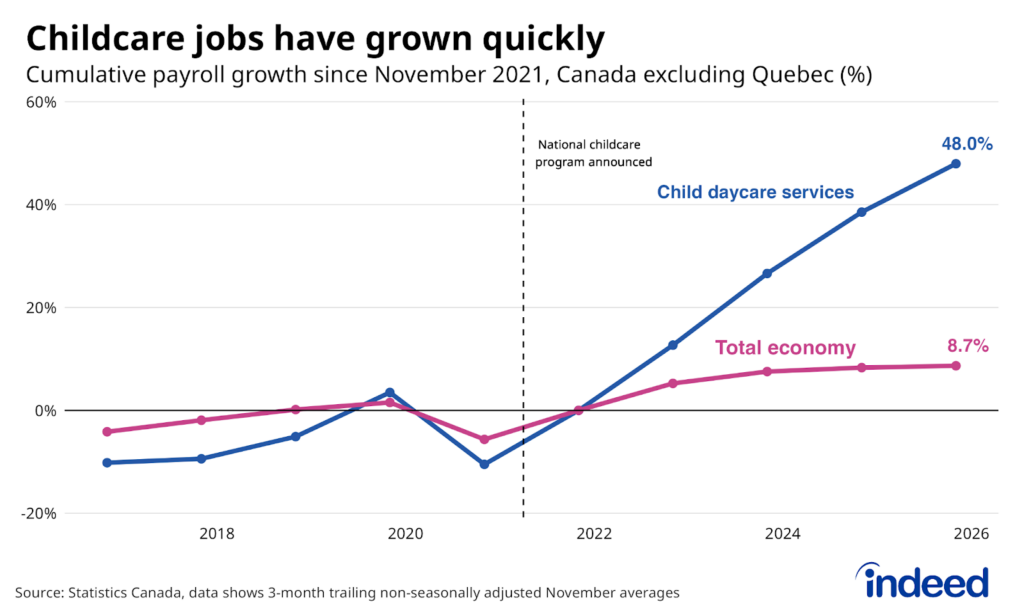
- As of late 2025, payroll employment in Canada’s formal child care industry (excluding Quebec) was up 48% from its 2021 level, after the federal government announced its national child care program.
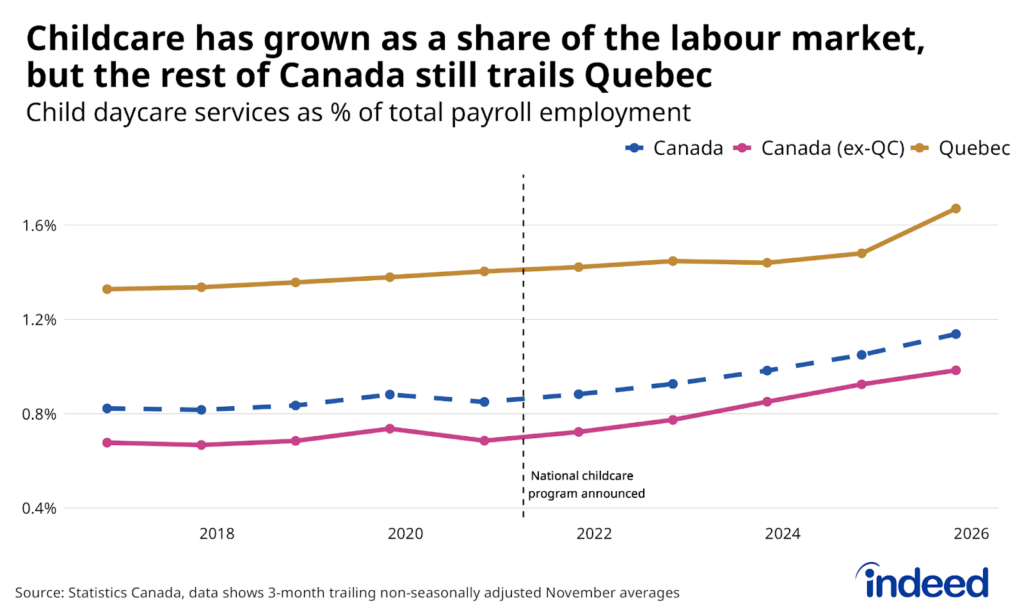
- Outside Quebec, the sector represents 1.0% of total payroll employment, up from 0.7% before the 2021 policy changes. However, that share remains lower than Quebec’s 1.7% (where a similar policy has been in place for over two decades), suggesting further job growth is needed for the system to meet demand.
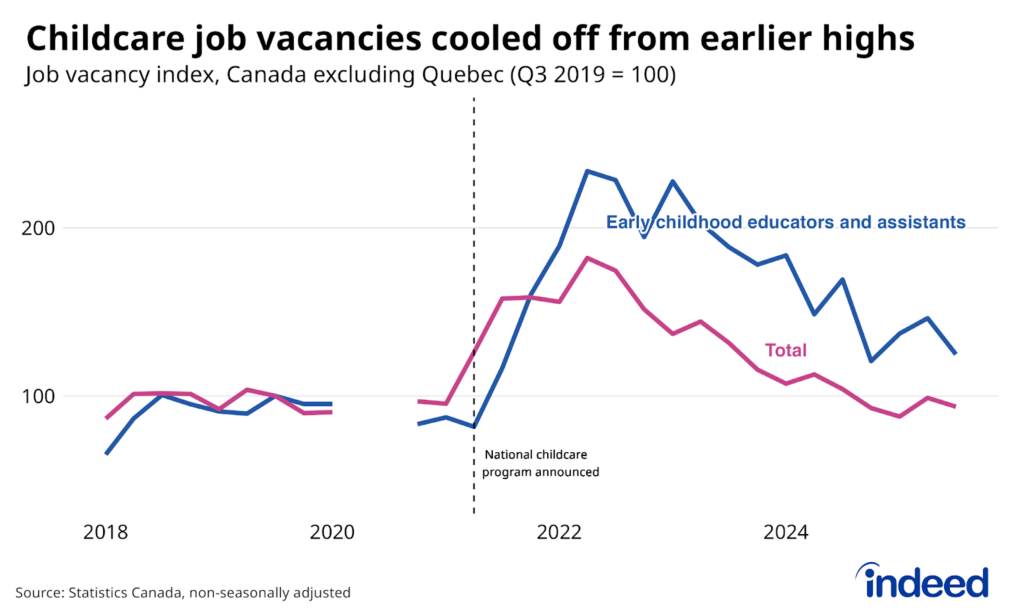
- Job vacancies for early childhood educators more than doubled in the year after the federal policy was announced, but most of that increase has since reversed. Though weekly earnings of employees in the industry are still nearly a third lower than the economy-wide average, outside of Quebec, they grew at a strong 6.7% average annual rate between 2021 and 2025, likely helping attract and retain workers.
- Even as the staffing bottleneck has eased, waitlists of families seeking childcare persist, highlighting the need for further growth in the raw number and size of childcare establishments to ease the shortage.
In Budget 2021, the Canadian government introduced its Canada-wide Early Learning and Child Care program. Inspired by Quebec’s system since the late 1990s, the most prominent plank of the policy was to implement subsidies that have dramatically reduced the out-of-pocket costs families face for daycare. Demand for regulated childcare services soon surged, but the supply of spaces hasn’t kept pace, and many families have reported challenges accessing services.
Job growth in the formal childcare industry responded quickly to the policy change. According to Statistics Canada’s Survey of Payrolls and Hours (SEPH), between 2021 and late 2025, payroll employment in child daycare services (outside of Quebec) jumped 48%, far outpacing 8.7% overall job growth. This data doesn’t capture employment trends across the entire childcare sector (e.g., it misses some informal homecare providers), but nonetheless highlights a striking shift.
At the same time, the relatively small level of formal childcare employment in most of Canada compared to Quebec helps explain ongoing challenges in accessing services in the new system. Outside of Quebec, over the three months through November 2025, the sector employed 1.0% of all workers, a notable increase from 0.7% four years earlier. However, in Quebec, child daycare services stood at 1.4% of total employment in late 2021, jumping to 1.7% at the end of 2025, likely reflecting the impacts of the federal policy change in Quebec. At the current growth rate of the past four years, it would take more than six years for the childcare industry in the rest of Canada to match Quebec’s 2021 share of employment.
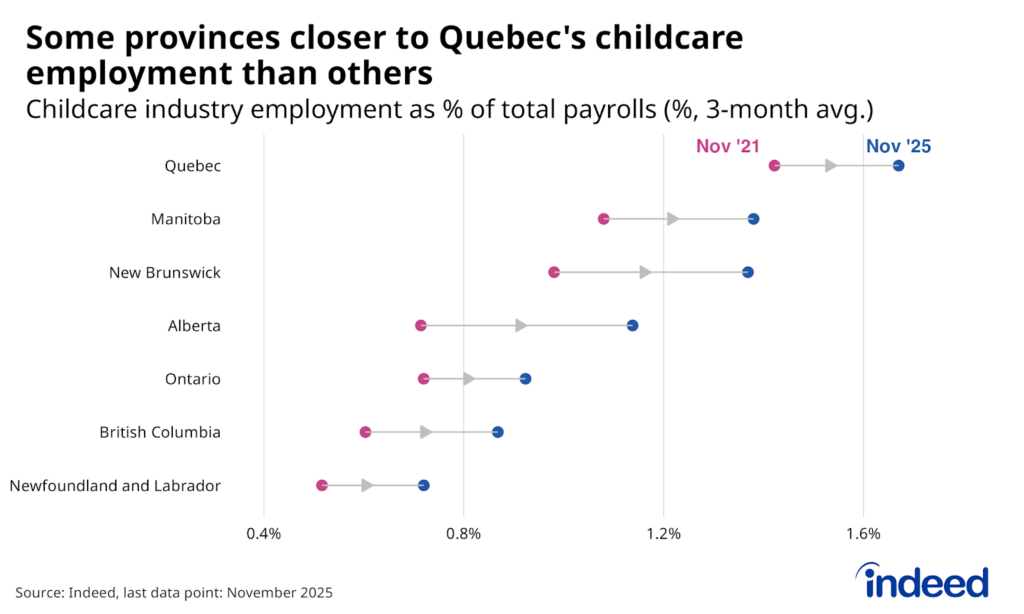
That said, the distance to the Quebec benchmark varies across individual provinces. Employment in the sector is already fairly elevated as a share of total jobs in Manitoba and New Brunswick. Alberta is further behind, but grew rapidly between 2021 and 2025. Meanwhile, the sector has remained smaller and grown more slowly in Ontario, B.C., and Newfoundland.
Childcare job vacancies remain elevated but have eased as wages have increased
Job vacancies for early childcare educators and assistants outside of Quebec more than doubled in the year after the national program was announced in 2021. This jump in vacancies coincided with both the removal of pandemic-era restrictions and a broader economy-wide surge in hiring appetite. And even as openings in most of the economy started to falter in mid-2022, childcare vacancies remained elevated as the industry continued to ramp up. However, vacancies have cooled substantially since, reversing more than half of their earlier increase. As of Q3 2025, childcare job openings were up a more modest 25% from the same point in 2019, though still stronger than the 6% decline in overall vacancies over the same period.
Declining child care job openings amid ongoing strong employment growth suggests that employers are finding it easier to attract and retain workers, and higher wages in the sector are a likely reason. Excluding Quebec, average weekly earnings among childcare employees were up 30% in August 2025 (the most recent date for which complete data is available) from four years earlier (an average pace of 6.7% per year), compared to 15% growth for employees overall.
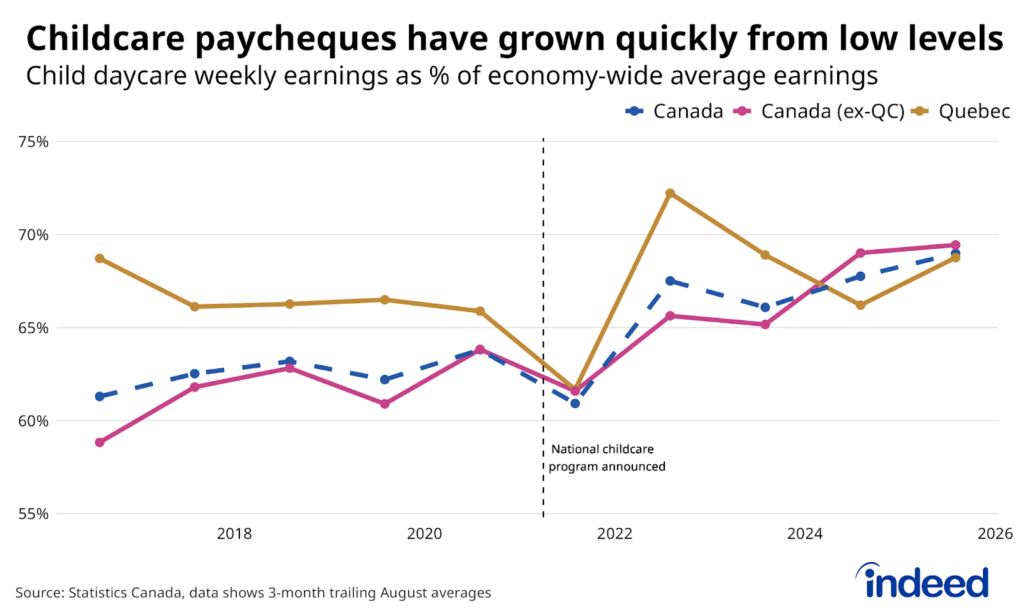
Even with these recent wage gains, childcare remains a relatively low-paying sector. As of August 2025, the typical childcare worker earned 31% less per week than the average employee economy-wide, reflecting both lower hourly wages and fewer hours worked per week. Nonetheless, the shortfall has narrowed from a 38% gap in 2021, and is now roughly equal with the gap in Quebec, where pay in the sector had been relatively higher throughout the 2010s. These improvements suggest the industry’s relatively low pay is likely a less significant barrier to attracting and retaining workers than it used to be.
Waiting game
Despite strong job growth, ongoing waitlists highlight the continued shortage of Canadian childcare spaces at their new, lower price. The cool-off in job openings suggests that staffing issues themselves have become less of a bottleneck in service provision. Instead, hiring will now depend on further growth in the number and size of childcare establishments themselves. However, the relatively large size of Quebec’s sector compared to the rest of Canada suggests many provinces have a ways to go. In the meantime, many parents who’d otherwise utilize subsidized childcare in the formal sector will have to rely on the informal or unsubsidized operators, family help, or cut back on their own work hours, to provide care themselves.
Methodology
This post primarily relies on non-seasonally adjusted data from Statistics Canada’s Survey of Employment, Payrolls, and Hours (SEPH). The childcare industry specifically refers to NAICS 62441 – Child Daycare Services. SEPH data are presented in their 3-month trailing average form. Due to missing provincial data in late 2024, we use August 2025 as our most recent datapoint on weekly earnings, to present a continuous timeseries.