
Key points:
- Workers worldwide say skills development is essential, but many also say they feel employers treat it as less of a priority than they do.
- Employer-sponsored training is less common for workers without a university degree and/or in less stable jobs.
- Evidence from a recent labor market reform in Spain shows that a policy incentivizing permanent contracts led firms to offer more training.
Training is one of the key ways for firms to invest in their employees. Training boosts productivity, supports career progression, and helps workers and businesses adapt to technological change and new skill requirements. But it has an upfront cost, while the payoff comes over time. As a result, some employers are reluctant to invest in training, especially when workers are not expected to stay with the firm very long. This tension is especially relevant in Europe, where many countries have high shares of workers on temporary contracts. The result can be a vicious cycle: high worker turnover leads to less training, which in turn limits workers’ opportunities for advancement.
Data from Indeed’s Workforce Insights Survey, conducted across eight countries, show that this is not just a theoretical concern. Workers consistently prioritize skill development, but many believe that their employers do not share that sense of priority. Access to employer-provided training is also highly unequal, with workers without a university degree less likely to receive it.
A new working paper, published jointly by economists from the Hiring Lab, WZB Berlin Social Science Center, and Universidad Complutense de Madrid, shows that policy can make a difference. The data show that Spain’s 2022 labor market reform, which sharply restricted temporary contracts, led to an increase in permanent contracts and firm-provided training in the occupations most affected by the reform.
Workers prioritize learning more than they think employers do
Across countries, most workers said they view developing new skills as a personal priority, but far fewer said their employer feels the same way. In the United States, for example, 67% of employees said skill development was a personal priority, but only 48% said they believe it is a priority for their employer — a gap of 19 percentage points. The pattern is similar in many other advanced economies.
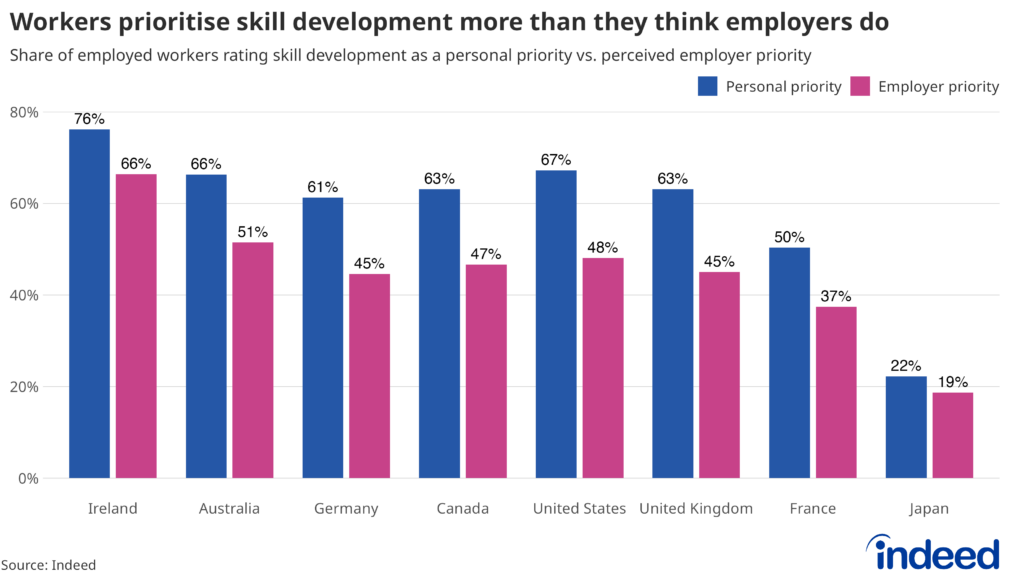
Japan stands out with the lowest share of workers rating skill development as a personal priority (22%). Such low focus on learning may reflect Japan’s tradition of employer-led, on-the-job training specific to the firm, where skill development is embedded in the structure of work rather than something workers feel they need to focus on themselves. Even so, a gap exists with perceived employer priority — one that may become more pronounced with the rise of AI, as many Japanese workers report a need for specific AI training.
If workers feel their employer is not focused on their development, this can undermine retention. As documented in previous Hiring Lab research, growth opportunities and access to training are among the reasons workers commonly cite for looking for a new job. Firms that underinvest in training not only forgo productivity benefits but also risk losing workers who may feel their skills are stagnating.
Access to training is unequally distributed
The training gap is not only about perceptions. It is also reflected in the training that workers actually receive. Across all countries surveyed, workers without a bachelor’s degree were substantially less likely to report receiving employer-provided training than their more educated counterparts.
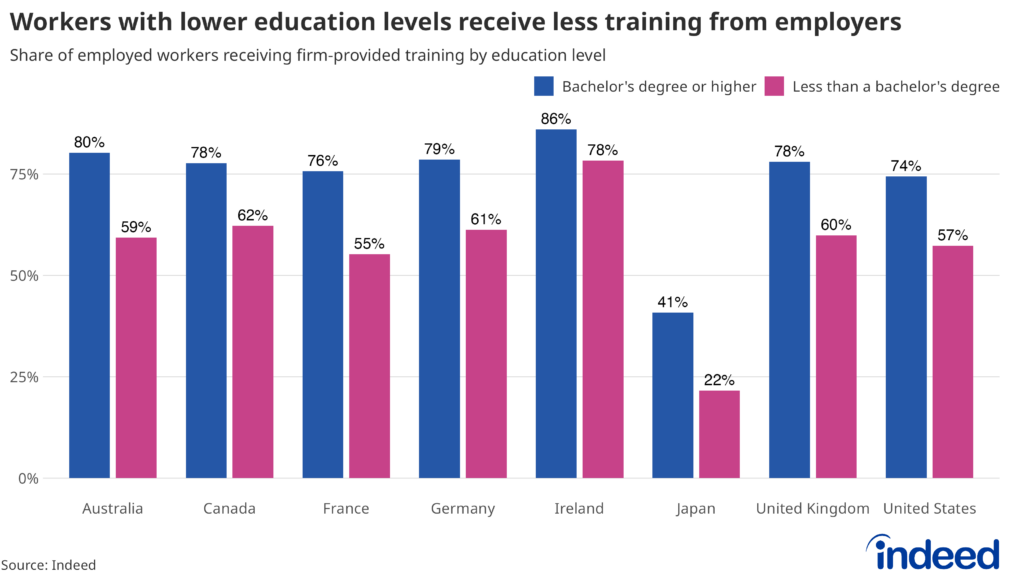
In Ireland, the country with the most training, 86% of bachelor’s degree holders reported receiving some form of firm-provided training, compared to only 78% of those without a degree, a gap of 8 percentage points. In other countries, the education gap in training is much larger: 21 percentage points in Australia and France, 19 points in Japan, 18 points in Germany and the UK, 17 points in the US, and 16 points in Canada.
These patterns suggest that employer-provided training may be reinforcing, rather than narrowing, existing gaps in the labor market. Workers who already hold high qualifications are more likely to receive additional training from employers, while those who might benefit most from training are less likely to receive it.
Policy can incentivize firms to offer training
When firms decide whether to provide training, one relevant factor is how long they expect workers to stay. Training is an investment with an upfront cost that generates returns over time through higher worker productivity. But when jobs are temporary, or worker turnover is high for other reasons, firms have less time to recoup that investment and have weaker incentives to offer training in the first place.
This logic is borne out by the data. We analyzed how employers’ training offers changed after Spain’s labor market reform in early 2022, which sharply restricted the use of temporary contracts. Before the reform, temporary work was much more prevalent in Spain than in most other European countries. The reform abolished the most widely used type of temporary contract and tightened restrictions on others, making open-ended, permanent contracts the default. Importantly, the reform did not affect all occupations equally, as some relied heavily on temporary contracts before the reform, while others did not. This created a natural experiment, enabling us to compare job postings in occupations with high and low prior temporary contract shares to isolate the causal effect of greater contractual stability on firms’ training offers.
Using these data, we grouped occupations into three categories based on their pre-reform reliance on temporary contracts. After the reform, occupations previously most dependent on temporary contracts saw a large shift from temporary to permanent hiring, consistent with the reform’s stated objectives. Crucially, this led to large increases in training offers, providing direct evidence that firms invest more in workers they expect to keep.
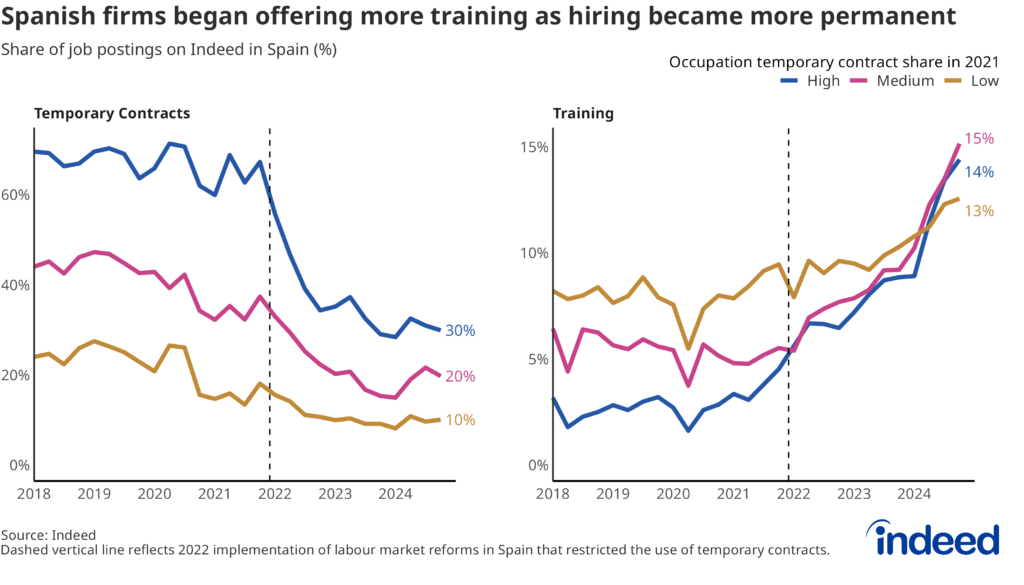
While training offers increased across all three job categories, the rise was largest among occupations previously most reliant on temporary contracts. Before the reform, those occupations were less than half as likely to offer training as those in the group with the lowest temporary contract use (3% vs. 8%). By 2024, training in previously high-temporary-employment occupations had increased enough to eliminate the pre-reform gap entirely.
Importantly, the increase in training was not driven by other changes in the labor market. The reform did not coincide with other major policy shifts, growth in other job amenities (including pension plans or flexible schedules), or tighter labor markets in the affected occupations. Applying the same research design to job postings in France, Germany, the Netherlands, and the UK also showed no comparable increase in training, confirming the effect was specific to Spain’s reform rather than a broader European HR trend. Moreover, the effect was not concentrated in a single occupation but was observed across a wide range of occupations that experienced the shift from temporary to permanent postings. Together, these checks increase our confidence that the observed rise in training offers was a direct consequence of the reform. We also found an increase in formal training participation in Labor Force Survey data, suggesting that the increased training intentions documented in job postings have begun to translate into realized training outcomes.
Part of the increase came from individual firms changing their behavior, and another part resulted from the reform shifting the composition of hiring towards firms that were already more inclined to invest in worker training. Both channels are consistent with economic logic: when employment relationships are expected to last longer, firms have stronger incentives to invest in workers’ skills and to hire more, given the greater expected value of the match.
Implications for policymakers and employers
The survey data show a gap between the training that workers say they want and what employers provide. The research evidence helps explain why. When employment relationships are expected to be short-lived, firms have weaker incentives to invest in training. In contrast, when jobs become permanent, incentives to train workers rise.
The findings from the Spanish reform have implications well beyond Spain. Many European countries continue to have a significant share of their workforce on temporary contracts. Our research suggests that policy reforms aimed at reducing excessive reliance on temporary employment can have the positive side effect of encouraging firms to invest more in training. At a time when rapid technological change — including the rise of AI — is reshaping skill requirements across occupations, that is a benefit worth considering.
Methodology
The first part of this analysis uses data collected from an online survey conducted for Indeed Hiring Lab by YouGov across eight countries: Australia, Canada, France, Germany, Ireland, Japan, the United Kingdom, and the United States. Fieldwork was conducted in May and June of 2025, with a total of n=80,936 interviews globally, and a minimum of n=10,000 interviews per market. Sampling was random and representative, with all responses weighted based on age, gender, education, and region in all markets, and by ethnic background in the US, aligned to the US Census Bureau, American Community Survey, 2022. This analysis is based on employees aged 25 and above for a total sample size of n=39,767, with a minimum of n=4,375 observations per country. All within-country differences shown in the charts are statistically significant.
The analysis of the Spanish labor market reform is based on Adrjan, Jessen, and Victoria Lanzón (2026), “Restricting Temporary Contracts Increases Firm-Provided Training: Evidence from Spain,” which uses data from 3.1 million job postings on Indeed between 2018 and 2024.