Key points:
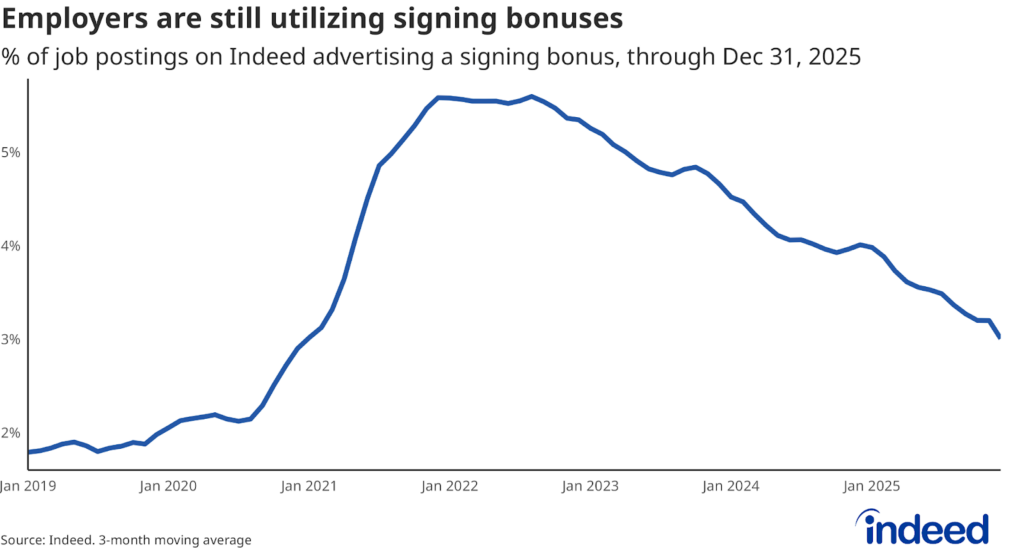
- About 3% of US job postings offered a signing bonus in December 2025, down from almost 6% in 2022 but still above the 2019 average of 1.8%.
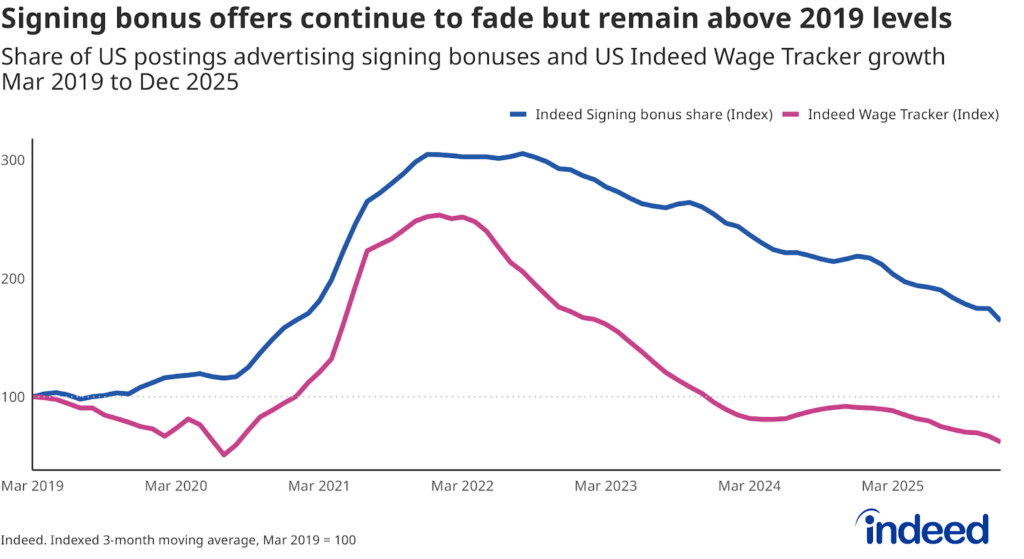
- Even after recent declines, signing bonuses have proven more resilient than wage growth, remaining far above their 2019 levels.
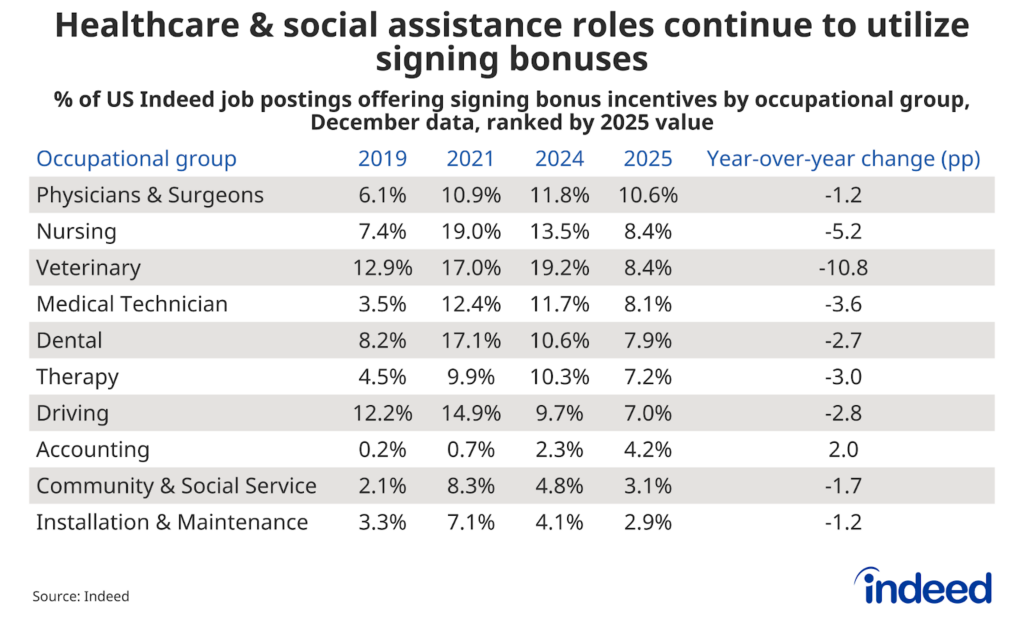
- Healthcare occupations continue to drive signing bonus usage, with physicians & surgeons and nursing among the roles most likely to offer pay upon hire.
Despite a years-long (and widespread) cooldown in hiring demand, a Hiring Lab analysis of the relative popularity of signing bonuses shows that some employers — particularly in certain healthcare segments — are still feeling pressure to attract workers.
In December 2025, about 3% of all US job postings on Indeed offered a signing bonus, down from a recent high of 5.6% in August 2022 but still above the 2019 average of 1.8%. And while the overall popularity of signing bonuses has risen and fallen alongside wage growth and hiring trends in recent years, signing bonus usage has held up slightly better. This suggests that some employers may have shifted recruiting strategies and are now favoring one-time bonuses over raises and across-the-board wage hikes, particularly in sectors (like healthcare) where hiring remains relatively strong.
Data from the Indeed Wage Tracker shows that the annual growth in advertised pay in job postings has been slowing consistently since 2022. Year-over-year posted wage growth peaked at 9.5% in January 2022, a period marked by extremely tight labor markets and rising inflation. But pay gains have slowed dramatically since, and by December 2025, annual posted wage growth clocked in at just 2.1%, well below both the 2019 average of 3.2% and the January 2025 reading of 3.4%. The usage of signing bonuses also peaked in 2022 and has since fallen, but the decline has been less pronounced. At the end of 2025, an indexed version of the Indeed Wage Tracker was 37% below its March 2019 rate, while signing bonuses were up 64% over the same period.
Continued demand for healthcare and social assistance workers — historically the jobs most likely to offer signing bonuses — is a key driver behind the ongoing broad popularity of signing bonuses. Seven of the top ten occupations most likely to utilize signing bonuses in December 2025 fell into the healthcare & social assistance category. Postings for physicians & surgeons topped the list with the highest share of jobs offering signing bonuses at 10.6%, down from 11.8% in December 2024. Nursing jobs were next on the list, but they took a sizable step back in bonus mentions in the last year, falling from 13.5% of jobs offering pay upon hire to 8.4% between December 2024 and December 2025. Posted wage growth for nurses has also slowed considerably, falling from 2.3% to 1% over the same period.
In line with the story of widespread cooling seen in broader economic data, Indeed data does show a clear pullback in both wage growth and signing bonus offers, even in stronger pockets of the job market. But the resilience of signing bonuses suggests that competition for critical workers hasn’t entirely disappeared, particularly in healthcare occupations. In an uncertain economic environment, signing bonuses may offer a short-term incentive to attract workers without committing to long-term pay increases. Whether this continues in 2026 will depend on the continued strength of healthcare hiring and on the supply of workers willing and available to work in high-demand fields.
Methodology
We track signing bonus offerings by tallying US job postings on Indeed that mention a signing bonus in the job description. Data is not adjusted for seasonality or changes in job mix, but a 3-month moving average is used. Data are subject to revision from prior publications due to proactive changes to extraction tools and definitions.
To calculate the average rate of wage growth in the Indeed Wage Tracker, we follow an approach similar to the Atlanta Fed US Wage Growth Tracker, but we track job postings, not individuals. We begin by calculating the median posted wage for a given country, month, job title, region, and salary type (hourly, monthly, or annual). Within each country, we then calculate year-on-year wage growth for each job title-region-salary type combination, generating a monthly distribution. Our monthly measure of wage growth for the country is the median of that distribution. Alternative methodologies, such as the regression-based approaches in Marinescu & Wolthoff (2020)and Haefke et al. (2013), produce similar trends.
More information about the data and methodology is available in a research paper by Pawel Adrjan and Reamonn Lydon titled What Do Wages in Online Job Postings Tell Us about Wage Growth?
The number of job postings on Indeed.com, whether related to paid or unpaid job solicitations, is not indicative of potential revenue or earnings of Indeed, which comprises a significant percentage of the HR Technology segment of its parent company, Recruit Holdings Co., Ltd. Job posting numbers are provided for information purposes only and should not be viewed as an indicator of the performance of Indeed or Recruit. Please refer to the Recruit Holdings investor relations website and regulatory filings in Japan for more detailed information on revenue generation by Recruit’s HR Technology segment.