
Key points:
- Job searches on Indeed were up to 31% higher in January 2026, compared to the early-December 2025 average.
- While seasonal and blue-collar sectors saw posting declines in January, relative to early December, a range of professional fields posted modest gains exceeding 5% — a welcome signal after a soft 2025 for white-collar employment.
- Market leverage in the labor market has shifted to employers, with job openings per unemployed persons now below 1.0, and time-to-hire lengthening as companies can afford to be selective in hiring.
Our monthly Labor Market Update examines significant trends using Indeed and other labor market data. Our US Labor Market Overview chartbook provides a more comprehensive view of the US labor market. Data from our Job Postings Index and the Indeed Wage Tracker (including sector-level data) are regularly updated and can be accessed on our data portal.
Every January brings with it a surge of ambition. New goals are set, gym memberships are purchased, and yes, people search for jobs. Even in today’s low-hire, low-fire labor market, jobseekers’ renewed New Year push to find new roles has persisted into 2026. In fact, job searches on Indeed were up to 31% higher in January 2026 compared to the early-December 2025 average.
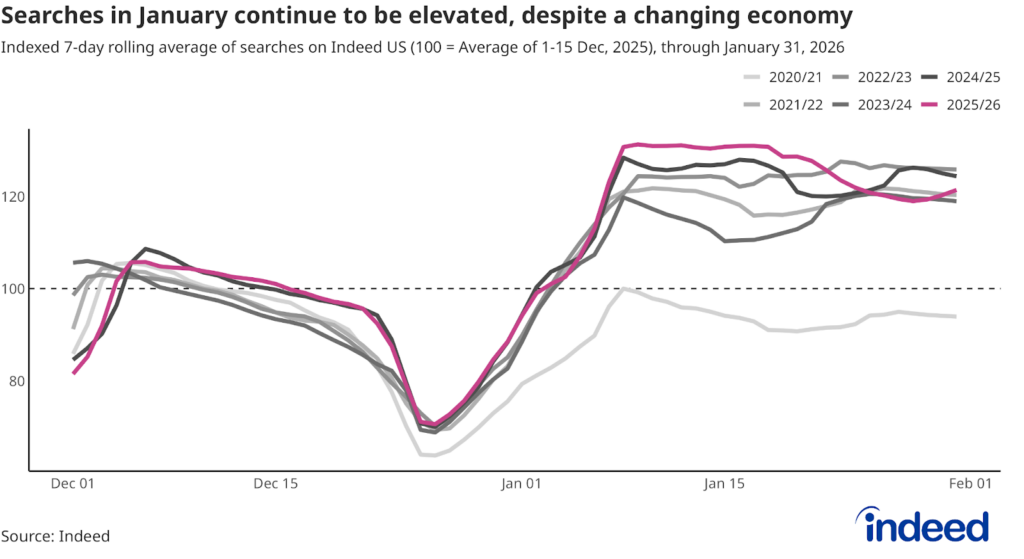
Despite markedly different labor market conditions since 2020 — ranging from a pandemic to a surging labor market to broad-based stagnation — the seasonal spike in job searches in January has remained remarkably consistent. This year’s surge is not an anomaly; it mirrors the pattern observed annually (with the exception of January 2021, a period highly disrupted by the pandemic). Workers pause their job searches during the holidays, then return in force at the start of the new year.
What is notable, however, is the context. In previous years, strong job search momentum often aligned with robust hiring demand. In early 2026, that alignment is weaker. While workers’ appetite for change remains high, opportunities in most sectors are comparatively more limited.
Searches surge as postings creep along
While job searching increased considerably in January compared to early December 2025, job postings tell a different story. Job postings in January remained roughly the same as in late 2025. In fact, postings never rose above their early‑December 2025 level at any point in January 2026. Postings momentum looked almost identical this year and in the year prior. This dynamic fits squarely within the low-hire, low-fire environment that has persisted now for well over a year.
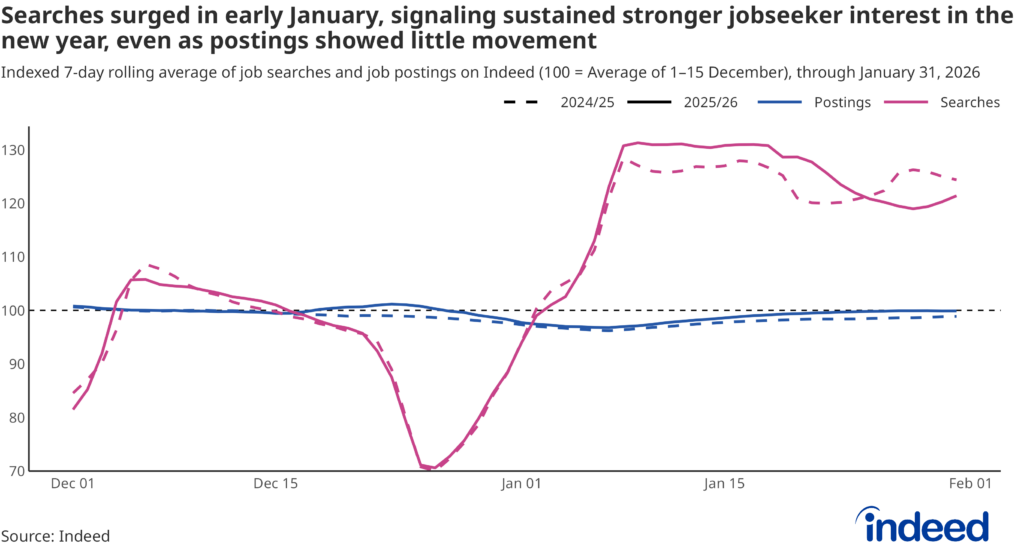
Job seekers’ search activity started stronger this January than a year ago. However, search activity in the first half of January 2026 fell off a bit in the second half of the month, potentially showing a lack of sustained job search energy, which aligns with much of the data we are seeing around consumer sentiment currently.
Different sectors, different stories
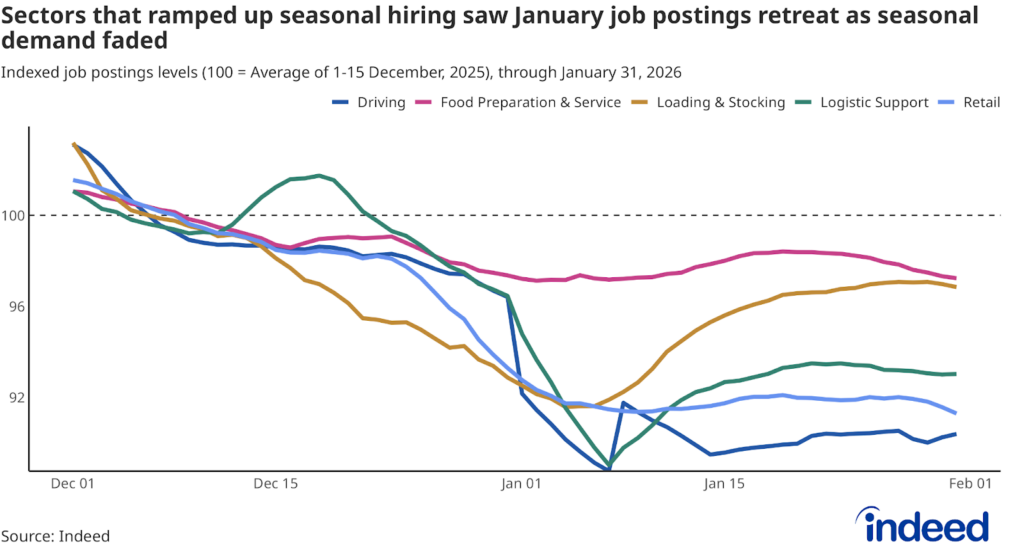
Sectors that typically see strong seasonal hiring toward the end of the year — including retail, driving, and logistic support — experienced some of the steepest job posting declines in January, when compared to early December 2025.
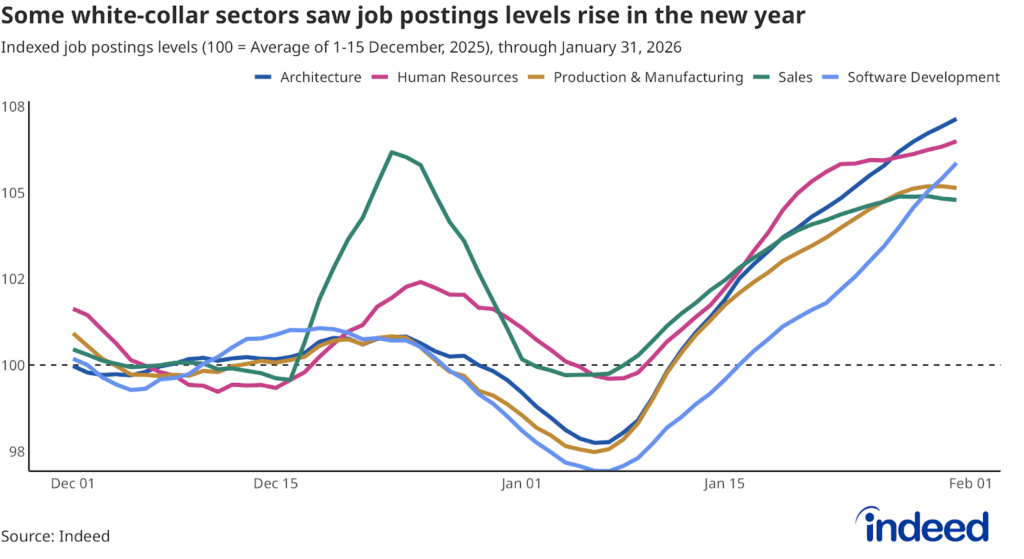
The story is quite different in many white-collar sectors, a pattern that might bring some relief, given the softness observed in white-collar employment in 2025. Relative to early December 2025, a broad range of sectors saw increases in job postings that exceeded 5%. These gains are modest but meaningful, and for job seekers in professional fields, this offers pockets of opportunity.
Market leverage shifts to employers
The discrepancy between job seekers’ interest in new roles and job openings can also be observed in the Bureau of Labor Statistics’s share of job openings per unemployed person. This rate has been trending downwards since 2022, reaching a post-pandemic low — the lowest level since mid-2017 outside of the pandemic — of 0.9 in December 2025. This is a significant shift from the peak labor tightness of the 2021-22 hiring boom, when job openings far exceeded the number of available workers. In that era, employers had to compete aggressively for talent, leading to strong wage growth and frequent job switches.
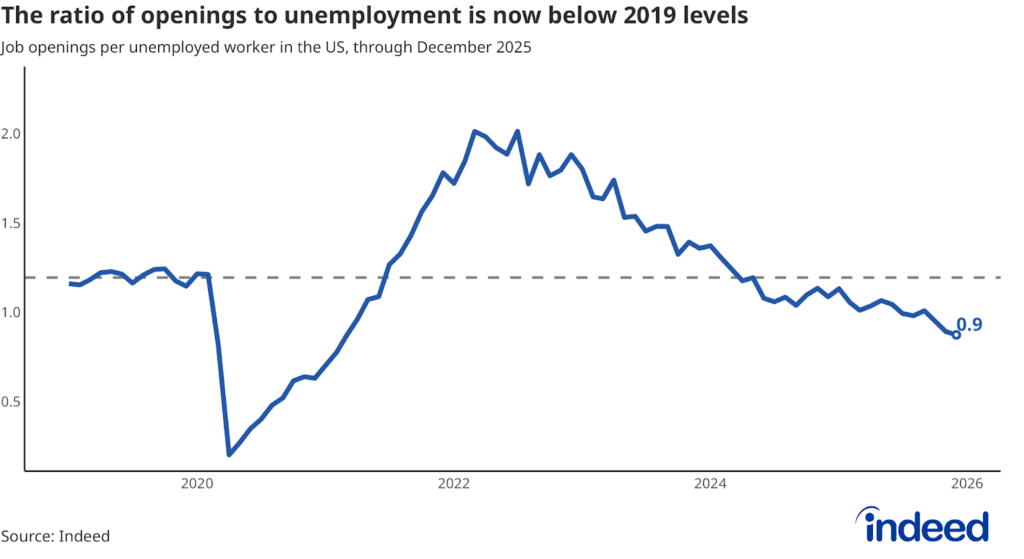
Today’s ratio reflects a rebalancing. Worker scarcity does not define the labor market in 2026; the balance is now tilted towards employers. Job searching remains robust, even as job openings have steadily declined. Wage growth is now subdued, and employers can be more selective in when — and who — they hire.
Employer leverage is also reflected in the average time it takes to hire a candidate, measured as the number of days between a job’s creation date and the reported first-hire date. Earlier in the post-pandemic recovery, hiring moved quickly. Elevated job switching and the war for available talent meant employers had to backfill roles rapidly.
Today, fewer workers are voluntarily quitting their jobs. Previous analysis has shown a negative correlation between quits rates and time to hire, suggesting that as more workers quit and employers backfill roles, hiring tends to move faster. On the other hand, as quits rates have currently declined to levels not observed since early 2018 (outside of the pandemic), the time to hire has been rising as employers don’t need to rush to fill roles vacated by voluntary departures by employees, but in fact have the flexibility to wait for the most suitable candidate. Furthermore, fewer job openings than unemployed people could also lead to higher job applications received for each role, adding to screening time and further slowing the recruitment process.
Conclusion
The labor market in early 2026 brings with it clear tension. Job seeker energy jumped in very normal, expected ways in January, while employer demand is steady but restrained. The reality facing those seeking jobs in 2026 is that openings per unemployed person have declined, and hiring timelines are lengthening. While some sectors continue to see elevated levels of postings, the macro environment remains in the low-hire, low-fire stagnation of 2025. For employers, this likely means increased interest in postings and stronger candidate quality for open roles.
Whether 2026 evolves into a year of renewed employment expansion or continued stagnation will depend on the numerous macro trends impacting the market. For now, the pattern is clear. Workers have started the year with the same resolutions they always do — to find something better or more aligned with their goals and priorities. The difference in 2026 is that finding a new position may require more patience and persistence than in the recent past.
Methodology
US searches on Indeed included queries on both the desktop and mobile versions of Indeed.
Data on non-seasonally adjusted Indeed job postings are an index of the number of job postings on a given day, using a seven-day trailing average. The index is normalized so that 100 equals the average level of postings between December 1st and 15th in each season. Data for several dates in 2021 and 2022 are missing and were interpolated.
The number of job postings on Indeed.com, whether related to paid or unpaid job solicitations, is not indicative of potential revenue or earnings of Indeed, which comprises a significant percentage of the HR Technology segment of its parent company, Recruit Holdings Co., Ltd. Job posting numbers are provided for information purposes only and should not be viewed as an indicator of performance of Indeed or Recruit. Please refer to the Recruit Holdings investor relations website and regulatory filings in Japan for more detailed information on revenue generation by Recruit’s HR Technology segment.