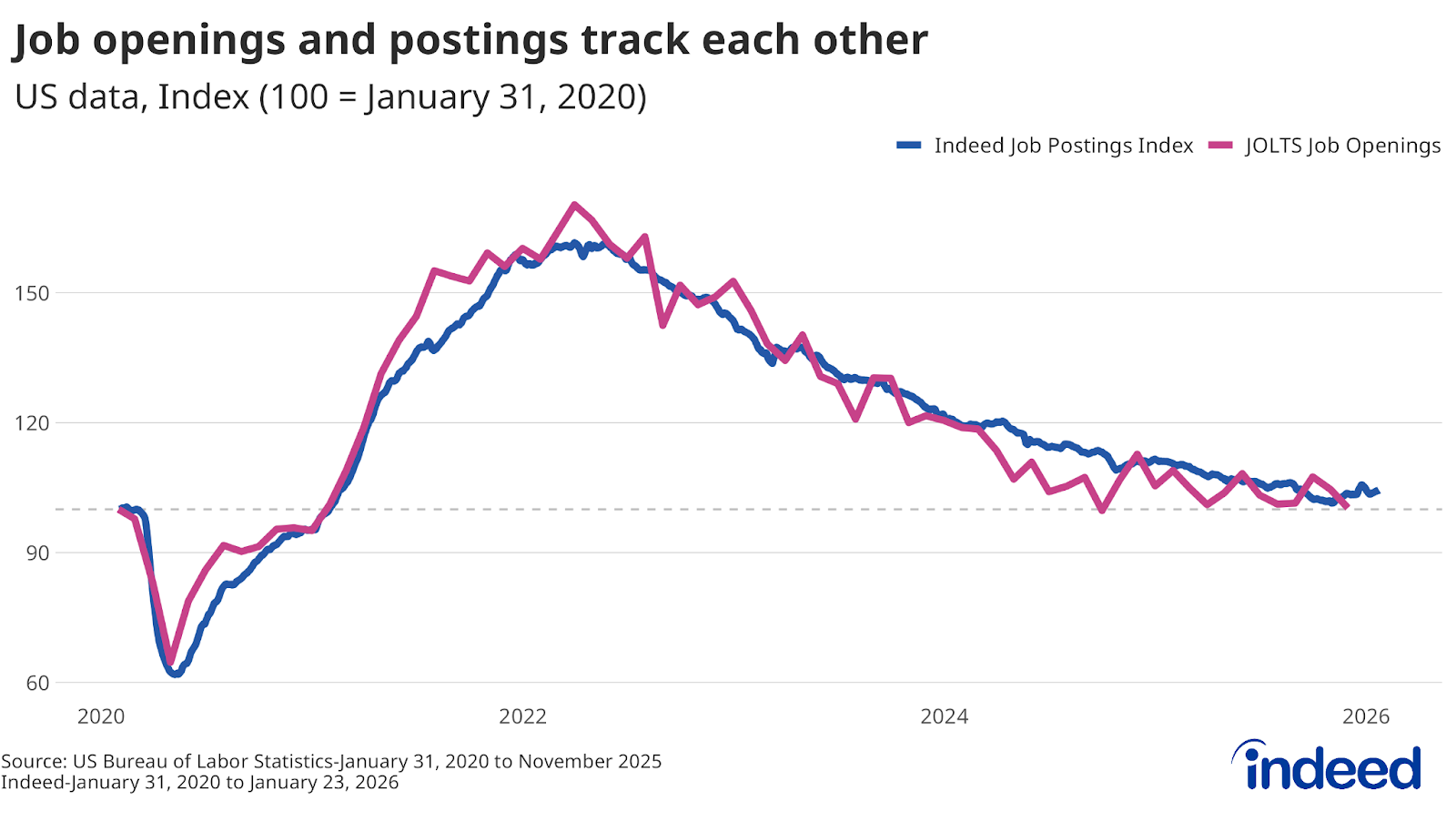
Key points:
- The partial government shutdown delayed the release of the December Job Openings and Labor Turnover (JOLTS) and January Jobs Report data releases from the Bureau of Labor Statistics. Annual revisions and updated methods included in the January jobs report, when it is released, will offer a fresh look at overarching labor market trends.
- Real-time data from the Indeed Job Posting Index (JPI) shows the labor market cooled in 2025, with job postings starting the year some 11.5% above pre-pandemic levels, and ending the year just 4.7% above those levels.
- JPI was essentially flat through the first three weeks of January, reflecting a continuation of the low-hire and low-fire environment that marked much of 2025.
The partial (and hopefully short-lived) government shutdown has delayed a pivotal jobs report. In addition to key monthly indicators, including unemployment and the number of jobs added/lost, the January Jobs Report is also expected to contain revisions to key data from the past year. When released, it will also include much-anticipated methodological updates to the Bureau of Labor Statistics’ birth-death model, accounting for recently opened and closed businesses. Some, including Jerome Powell, have estimated that previous issues with the model may have led to significant over-estimation of employment growth in 2025. Year-end, December 2025 data from the Job Openings and Labor Turnover Survey (JOLTS) has also been delayed. Collectively, these changes and updates, when published, will offer an updated view of the health of the US labor market and may provide a sharper picture of where it is heading in 2026.
Government and real-time private sector data both suggest that the labor market continued to slow in 2025. A cooling labor market has been weighing on workers’ confidence in their ability to find new or different work easily, and they aren’t changing jobs right now. If job gains last year had kept pace with 2024, an estimated 1.4 million more jobs would have been created in 2025. The Indeed Job Postings Index, a real-time measure of millions of job postings, also shows that the hiring demand slowed over the course of the year, from 11.5% above pre-pandemic levels on January 1 to just 4.7% on December 31. Nothing in our Hiring Lab data indicates that the story changed in the first month of 2026 — JPI has been largely flat since the start of the year. A cooler labor market is also evident in the pullback in the Indeed Wage Tracker, sourced from advertised salaries in job postings, showing that posted wage growth fell from 3.4% to 2.1% over the course of 2025.
Looking ahead, employers and job seekers alike will continue to find ways to move forward despite some challenging dynamics and a cloudy outlook. As wage growth slows, total compensation, including benefits packages and flexibility, is likely to remain both a powerful recruiting and retention tool. AI still has enormous potential to help boost productivity, but many workers remain disengaged, and employer encouragement and training remain key to helping workers maximize the tools’ potential. Hiring Lab will continue to monitor how these — and many more — rapidly changing dynamics are impacting the labor market. In the meantime, trends in Indeed’s real-time data, including the Indeed Job Posting Index and Indeed Wage Tracker, can provide insight into the current state of the US labor market.