
Key points:
- Hiring activity remains subdued, and job postings are flat or declining in many occupations.
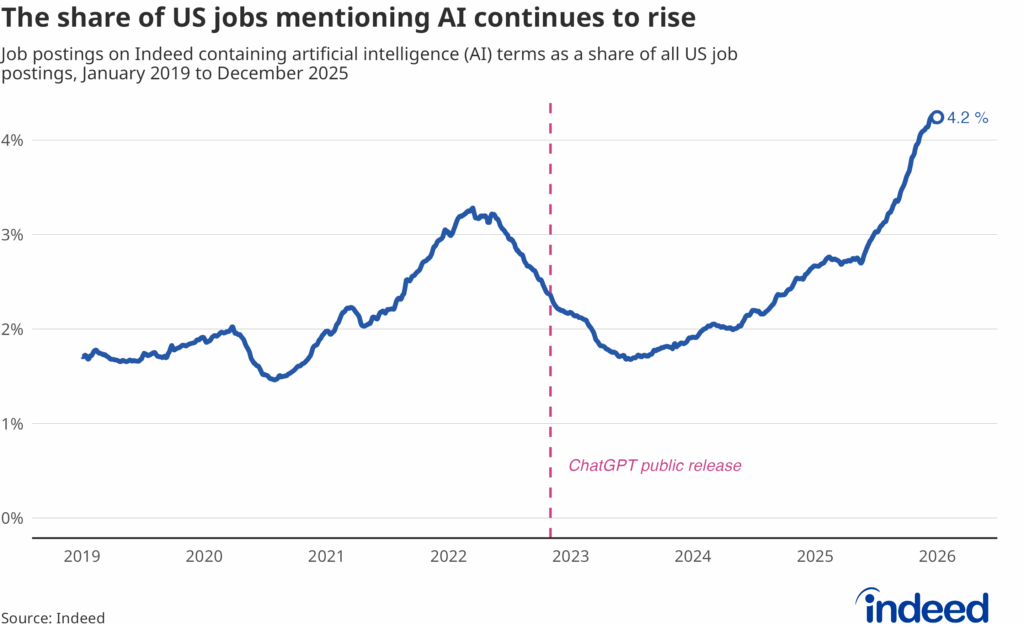
- However, jobs with AI mentions are bucking the overall trend and are growing across many knowledge work occupations. The Indeed AI Tracker reached a high of 4.2% in December 2025.
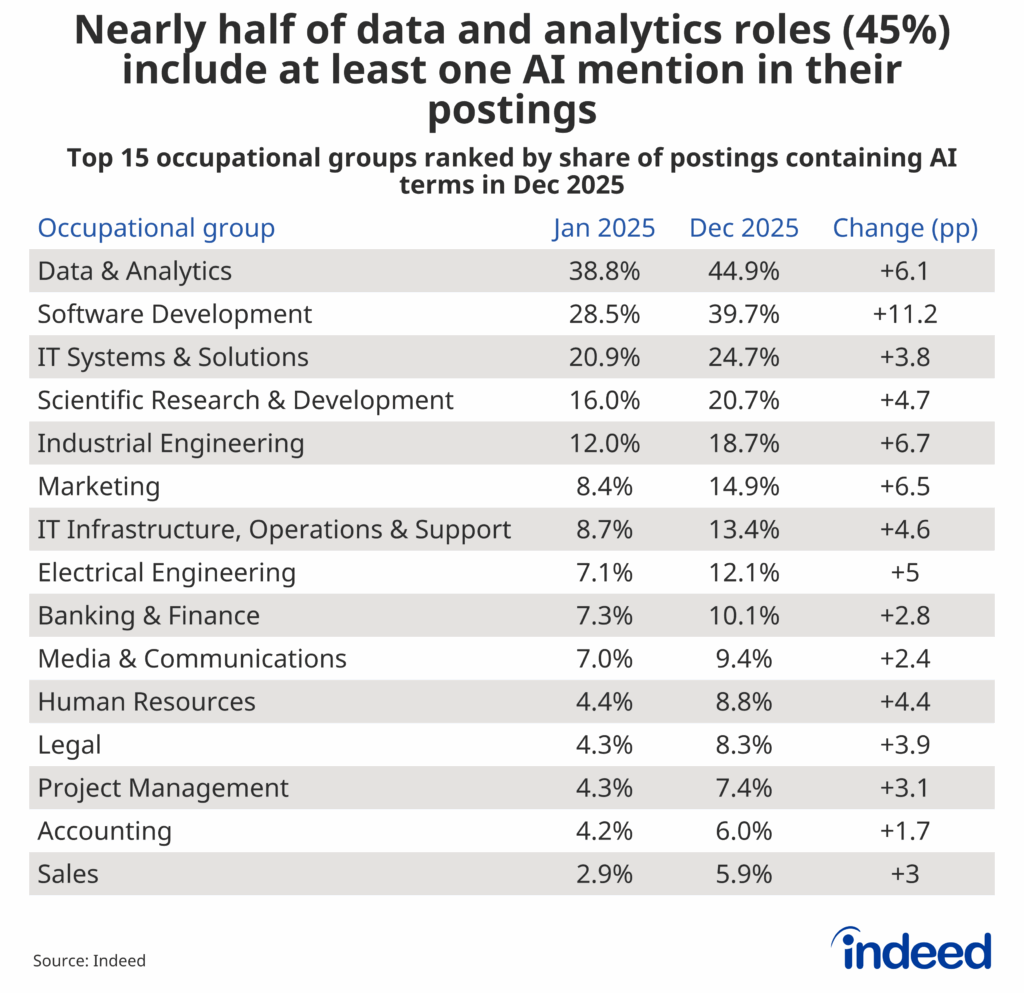
- Nearly 45% of data & analytics postings now contain AI-related terms, compared with about 15% in marketing and 9% in human resources.
Our monthly Labor Market Update examines significant trends using Indeed and other labor market data. Our US Labor Market Overview chartbook provides a more comprehensive view of the US labor market. Data from our Job Postings Index — which stood 6% above its Feb 1, 2020 baseline as of December 31, 2025 — and the Indeed Wage Tracker (including sector-level data) are regularly updated and can be accessed on our data portal.
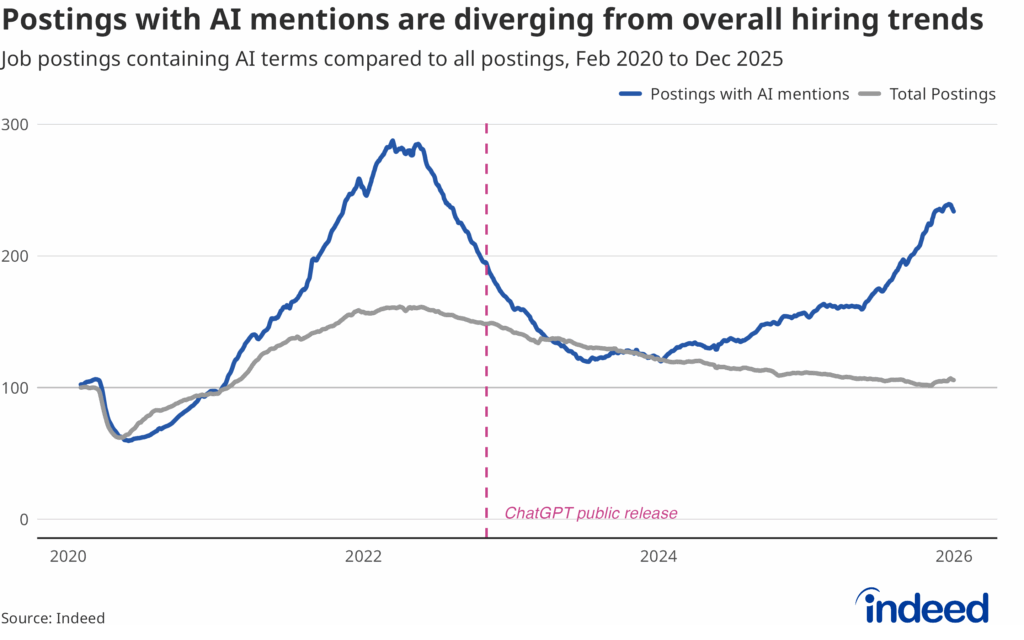
The total number of US job postings on Indeed at the end of 2025 was only about 6% above baseline, pre-pandemic levels, reflecting the weak overall hiring environment that has characterized much of the past few years. But over the same period, the number of job postings that mention AI or AI-related terms surged by more than 130%, pointing to a clear shift in the types of skills employers are seeking when they do hire.
Job gains remained strong enough in 2025 to keep the overall unemployment rate relatively stable, and layoffs remained low as employers hung on to existing workers. Even so, the total number of jobs added last year was more than 1.4 million fewer than what it would have been if the pace of job growth had stayed consistent with 2024. Hiring activity has slowed to rates last seen between 2010 and 2013 (excluding a pandemic-induced dip in April 2020), and the lack of movement between jobs suggests that job seekers are not confident they can easily find new work. Weak hiring has been especially pronounced for some tech and knowledge-work roles, including marketing and human resources. But beneath the surface, a clear divide is emerging between hiring trends for jobs that mention AI and those that do not.
Job postings with AI mentions are diverging from general hiring trends
The Indeed AI Tracker — which monitors changes in the share of job postings on Indeed that mention artificial intelligence or any of a basket of AI-related keywords — reached a high of 4.2% at the end of 2025. From mid-2020 to early 2022, growth in AI mentions was driven by more “traditional” AI applications, including machine learning and modeling techniques common in data and computer science roles. After peaking in early 2022, hiring for those roles began declining, and the AI tracker fell in tandem. That trend reversed following the widespread introduction of ChatGPT and other large language models (LLMs) in late 2022, and a subsequent growth in demand for newer generative AI skills began to push the overall share of postings mentioning AI back up again, starting in mid-2023.
While part of the story here is the growing demand for AI and GenAI skills, it also reflects a shifting landscape amid a consistently cooling labor market. From February 2020 through March 2022, the total number (not share) of job postings mentioning AI almost tripled, then peaked and rapidly declined, returning to a level in line with overall postings. But beginning in late 2023, the two trends diverged, with postings including AI terms bouncing back and surging even as overall postings continued to steadily decline.
At the end of 2025, the number of postings mentioning AI measured 134% above February 2020 levels despite remaining below their early 2022 peak. In contrast, total job postings finished the year just 6% above their 2020 baseline. Weak overall hiring, paired with a rebound in AI demand, has shifted the types of jobs available. As a result, the share of postings that mention AI has reached new heights, even as growth in the total pool of jobs stagnates.
Knowledge work hiring is muted, but AI-mentioning jobs are increasing
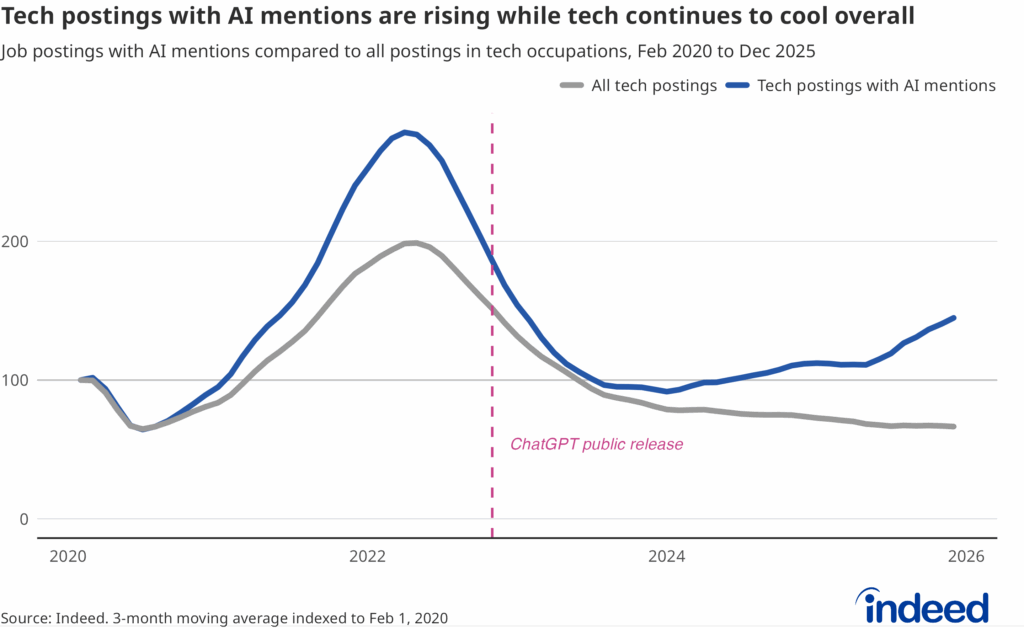
This same pattern can be seen in occupational sector data. In the years following the pandemic, postings with AI mentions in tech moved in the same direction as overall tech postings. But by early 2024, roughly a year after the release of ChatGPT and other LLMs, hiring for tech roles that mentioned AI began to diverge from general tech hiring trends, and the two series continue to move in opposite directions. By the end of 2025, the number of tech postings that mentioned AI was about 45% higher than in February 2020, while total tech postings were 34% below pre-pandemic levels.
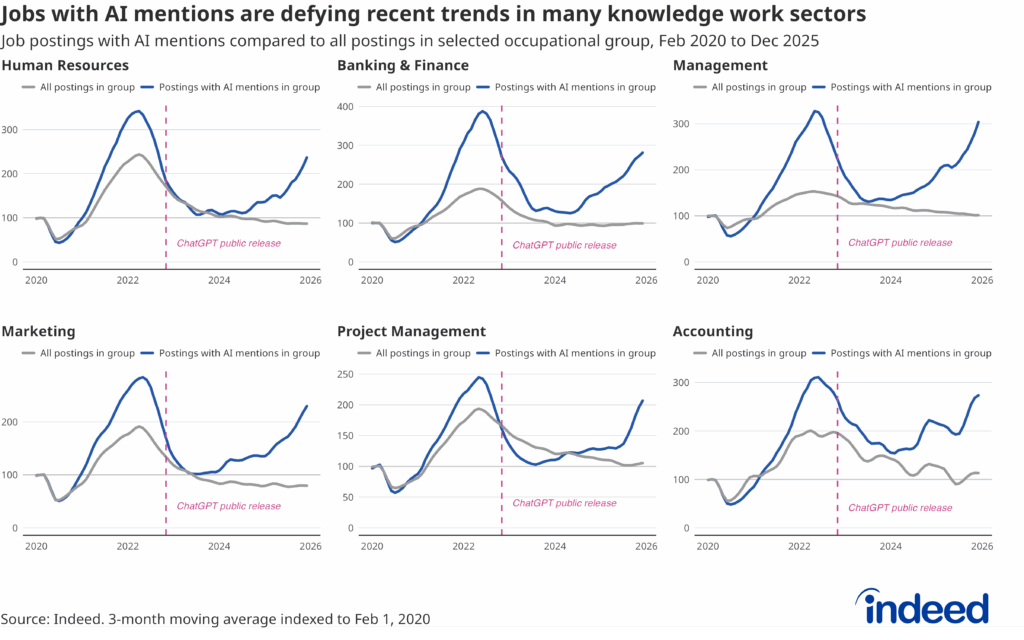
This isn’t just a story about coders; similar patterns are emerging across many other knowledge work occupations. Human resources, banking & finance, management, marketing, project management, and accounting are also experiencing a divergence between postings that mention AI and those that do not. While AI itself is more likely to be mentioned in certain roles than in others (only 6% of accounting jobs mention AI, for instance), this supports previous Hiring Lab research that found AI and GenAI are rewiring the DNA of jobs as employers shift their hiring priorities.
AI mentions are most common in tech, but other knowledge work sectors are catching up
The divergence between job postings overall and those that explicitly mention AI is stark, and the recent rise in AI jobs is impressive. But neither has led to a notable increase in the Indeed Job Postings Index, which was down 5.2% year-over-year as of December 31. This decline is partly because the occupational sectors most prone to adopt AI and GenAI tools, including data & analytics and software development, account for a relatively small share of all job postings. And even within those groups, the majority of postings still do not mention AI. As of December 2025, 45% of data & analytics job postings mentioned AI, the highest among all sectors analyzed, but still a minority of all data & analytics postings. Several tech-adjacent occupational groups also showed solid rates of AI integration. Job postings in software development, IT systems & solutions, and scientific research & development each mentioned AI 20% or more of the time.
Other knowledge work occupations increased their frequency of AI mentions in 2025, but many still account for only a small share of all postings within their sector. This includes marketing, where AI mentions in job postings grew from 8.4% at the start of the year to 14.9% by the end of December, and human resources, which doubled its share from 4.4% at the start of the year to 8.8% in December.
Conclusion
All recent data suggest that the same kind of “low-hire, low-fire” environment that defined much of 2025 looks likely to continue into 2026. Overall, job postings are flat or declining, but small pockets of growth are emerging as employers concentrate their limited hiring on roles and skills tied to AI. For workers, this suggests that developing and highlighting relevant AI skills may be the key to landing a job in 2026, particularly in occupations with otherwise muted hiring activity. These trends are also an invitation for employers to think now about how AI will play a role in their efforts to build a productive, competitive workforce. Either way, growth in AI-related jobs will need to correspond with growth in overall worker exposure to, and comfort with, AI tools. Only about 43% of US workers reported regularly using AI at work last year, and roughly 40% said they were actively disengaged with AI, according to a recent Hiring Lab survey. As AI becomes a more routine and expected part of work, expanding both access and engagement will be necessary.
Methodology
The number of job postings on Indeed.com, whether related to paid or unpaid job solicitations, is not indicative of the potential revenue or earnings of Indeed, which comprises a significant percentage of the HR Technology segment of its parent company, Recruit Holdings Co., Ltd. Job posting numbers are provided for information purposes only and should not be viewed as an indicator of the performance of Indeed or Recruit. Please refer to the Recruit Holdings investor relations website and regulatory filings in Japan for more detailed information on revenue generation by Recruit’s HR Technology segment.
The Indeed AI Tracker measures the share of AI (and generative AI) job postings, as a percentage of overall job postings, using a seven-day trailing average. We calculate the aggregate share of job postings in a specific sector that included keywords associated specifically with: AI (e.g., “Machine Learning”, “Data Science”, and “Artificial Intelligence”) or Generative AI (e.g., “Generative AI”, “Large Language Models,” and “Chat GPT”).