
Key points:
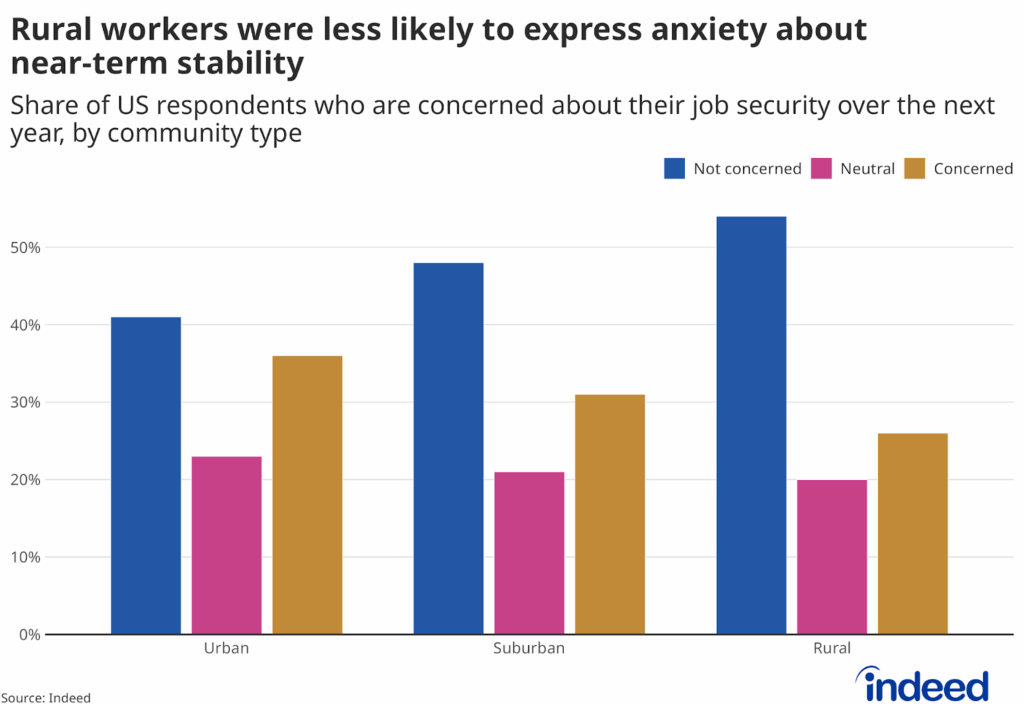
- More than half of rural workers (54%) say they’re “not at all” or “not really” concerned about losing their jobs in the next year, compared to just 41% of urban workers.
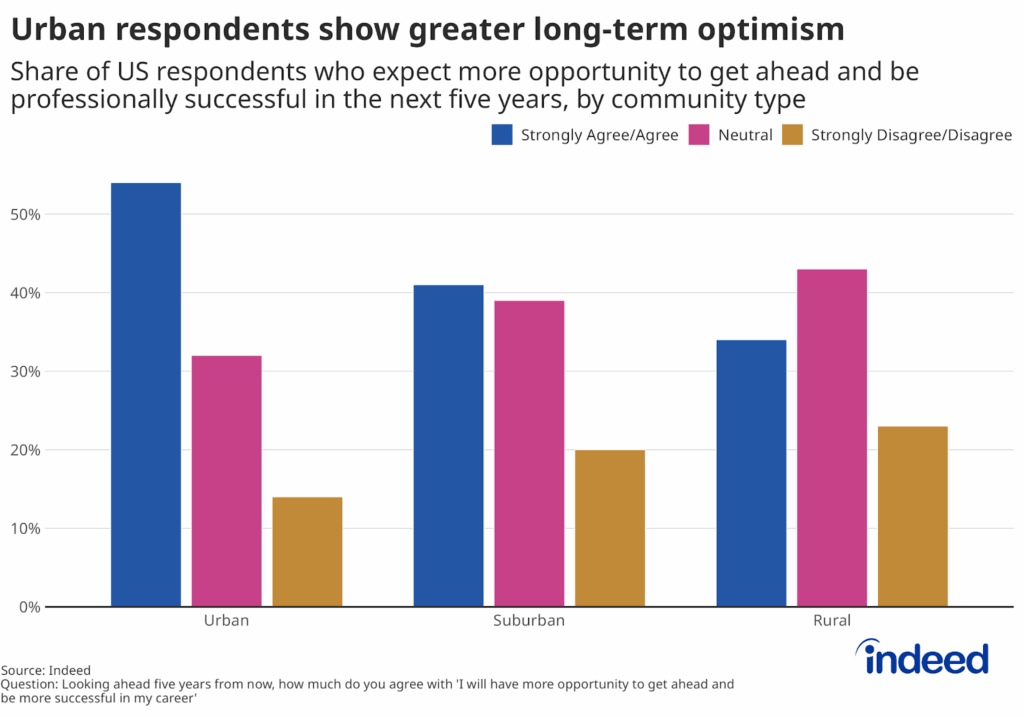
- While 54% of urban respondents say they agree or strongly agree that they will have more opportunities to advance and be more successful in their careers over the next five years, only 34% of rural respondents share the same level of confidence.
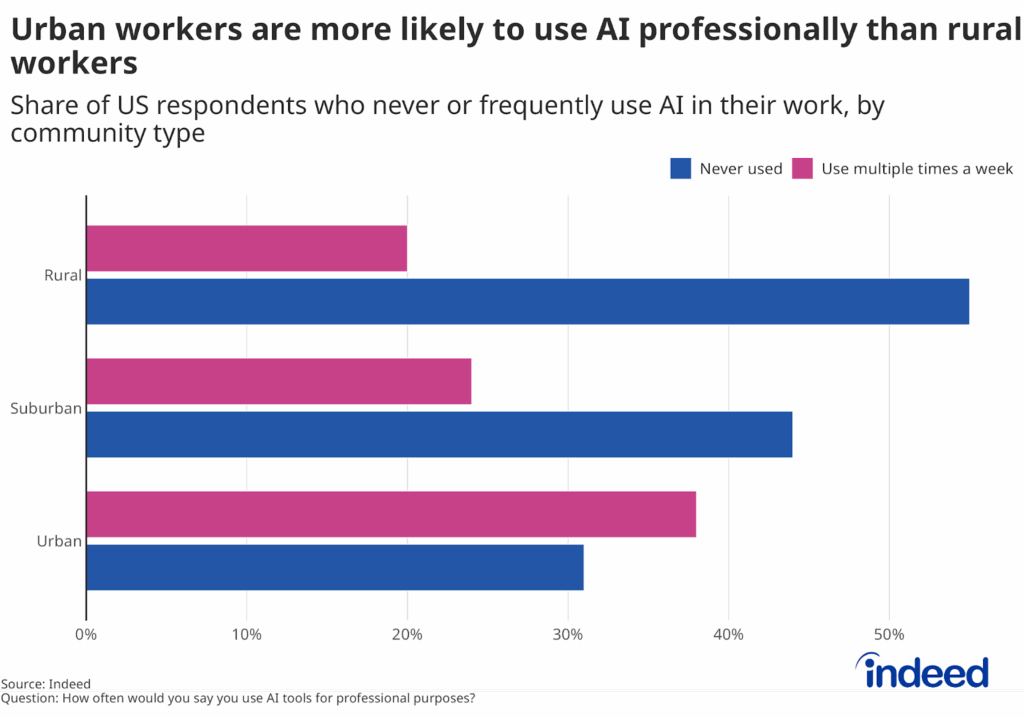
- Over 50% of rural workers indicated that they had never used AI professionally, which is far greater than the 31% of urban workers who reported the same.
For as long as there have been cities and countryside, there have been differences in how people see the world and their place in it. The two settings offer different trade-offs and cultivate different opportunities. But what does that mean for how those in each setting feel about the future of work?
According to Indeed’s Workforce Insights Survey, the urban/rural divide is alive and well when it comes to workers’ sense of possibility. While rural respondents feel confident about maintaining their current position, they also express pessimism about their career prospects over the next five years.
How much of it is about infrastructure, education, industry, or simply the kinds of jobs available? And what role does technology play in widening or narrowing that gap? The answers offer a glimpse into not just what people believe about their own careers, but what they think about the economy itself — and who it really works for.
Future outlook: Shakier today, but more room to climb in the city
When it comes to job security, rural workers actually feel steadier than their urban counterparts, at least in the short term. More than half of rural workers (54%) say they’re “not at all” or “not really” concerned about losing their jobs in the next year, compared to just 41% of urban workers. Urban workers are far more likely to express concern, with 36% of them reporting that they are indeed worried about losing their jobs in the next 12 months, compared to just 26% of rural respondents.
Urban workers might have anxiety about near-term stability, but they also report being more likely to see long-term opportunities. While 54% of urban respondents say they agree or strongly agree that they will have more opportunities to advance and be more successful in their careers over the next five years, only 34% of rural respondents share the same level of confidence. Suburban workers fall exactly between the two, with 41% reporting confidence in their 5-year career outlook.
Urban respondents consistently report a stronger sense of longer-term optimism and possibility across multiple dimensions. More than half of city dwellers (51%) expect to advance into new roles and increase their income within the next five years, compared to just 31% of rural workers. Even work-life balance feels brighter in the city, with nearly 6 in 10 urban workers saying they see improvement ahead, compared to just 42% of rural workers.
The potential role of technology
Part of the explanation may lie in technology. Artificial intelligence concerns loom larger in cities, where workers report higher daily use and more employer encouragement to experiment with AI. Rural workers appear to feel safer in their current roles, but less connected to the emerging tools and skills that are shaping the future. Urban workers, meanwhile, live closer to the frontier, feeling both more exposed and more prepared as technology reshapes the workplace.
While 38% of urban respondents reported using AI multiple times a week professionally, suburban and rural respondents reported levels of just 24% and 20%, respectively. Over 50% of rural workers indicated that they had never used AI professionally, which is far greater than the 31% of urban workers who reported the same. Interestingly, the gap between urban and rural use of AI professionally holds across all age and education groups.
There are also gaps between how workers feel about how AI could impact their jobs going forward. About a quarter of urban workers say AI could already perform their job, versus just 17% of rural workers. Yet both groups share the same worry — around 56% in each say they’re concerned AI will reduce job opportunities overall.
Tech’s uneven footing: Left behind or leaping ahead?
The AI story also highlights a deeper paradox facing rural workers: they have a lot to gain from AI, but they’re also at greater risk of being left behind in the longer run. In industries central to rural economies, such as agriculture, manufacturing, and logistics, AI has already begun to unlock new efficiencies, enabling organizations to work smarter and stay competitive.
For rural workers, who often have fewer in-person opportunities to reskill or advance, AI could open doors to remote learning, virtual collaboration, and more flexible, higher-paying roles. In this sense, the promise of AI in rural areas is enormous; however, certain external factors, such as limited broadband access and fewer training opportunities, can hinder workers from realizing those gains.
As a result, the risk for rural workers isn’t just being replaced by AI — it’s being left behind by the people and industries who learn how to use it first.
Bridging the divide
The urban-rural split in how workers see their prospects is more than just a matter of geography. It’s a window into how unevenly hope, opportunity, and progress are distributed — who feels they’re moving forward, who feels left behind, and who’s not sure which way to turn.
In an economy that promises everyone a shot, where you live shapes what you believe is possible, especially in a rapidly shifting landscape. Closing that divide will take more than technology or infrastructure. It will require a renewed focus on ensuring that, no matter where you are, the future still feels within reach. It’s a gap worth watching as the world of work continues to evolve.
Editor’s Note: Special thanks to Ashley Rappa for her assistance in writing this post.
Methodology
This analysis utilizes data from the 2025 Indeed Workforce Insights Survey, an online survey conducted for Indeed Hiring Lab by YouGov, of more than 80,000 adults from the US, the UK, Germany, France, Japan, Ireland, Australia, and Canada. Sampling was random and representative by age, gender, education, and region in all markets, and by race, aligned to the U.S. Census Bureau, American Community Survey, 2022. Fieldwork was conducted during the months of May and June 2025, with a total of n = 80,936 interviews globally, and a minimum of n = 10,000 interviews per market. This sample size provides a margin of error of ±1% at the 95% confidence level within each market.