
Key points:
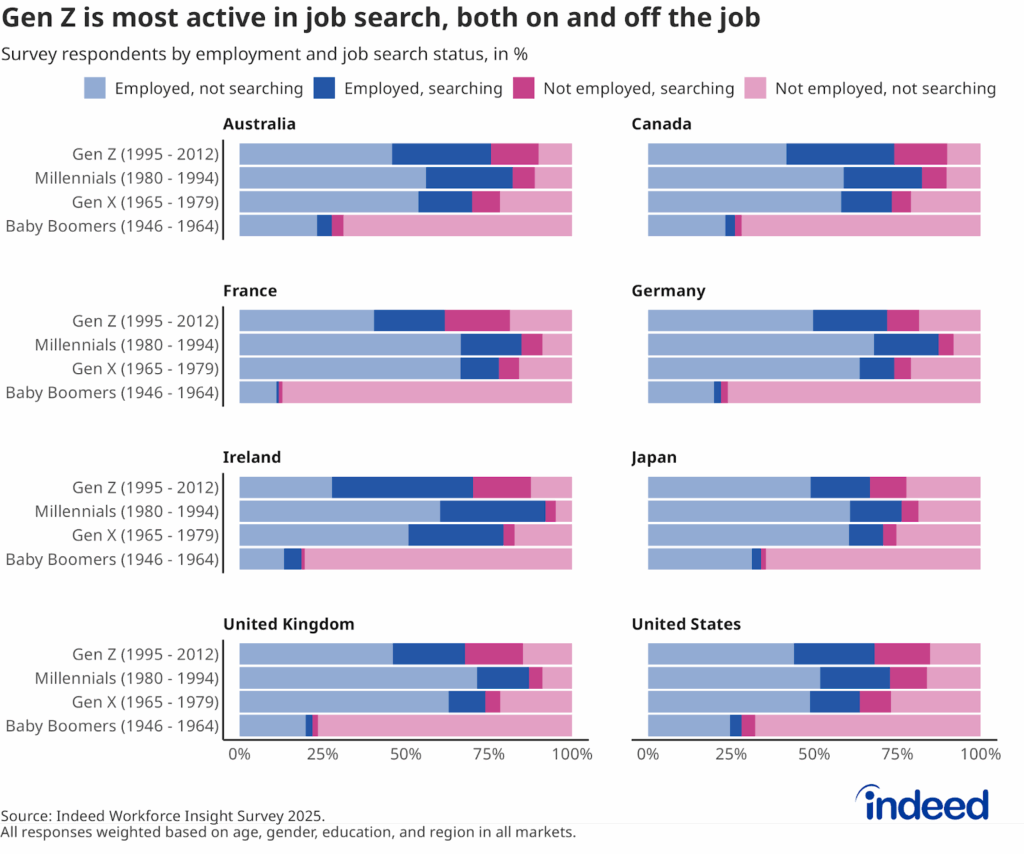
- Job search: Gen Z is the most active generation when it comes to job search.
- Working from home: The share of people working primarily in the office is relatively stable across generations, but preferences differ by age — millennials and Gen Z prefer more workplace flexibility.
- Across all generations, the share of employed individuals who work primarily in the office exceeds stated preferences.
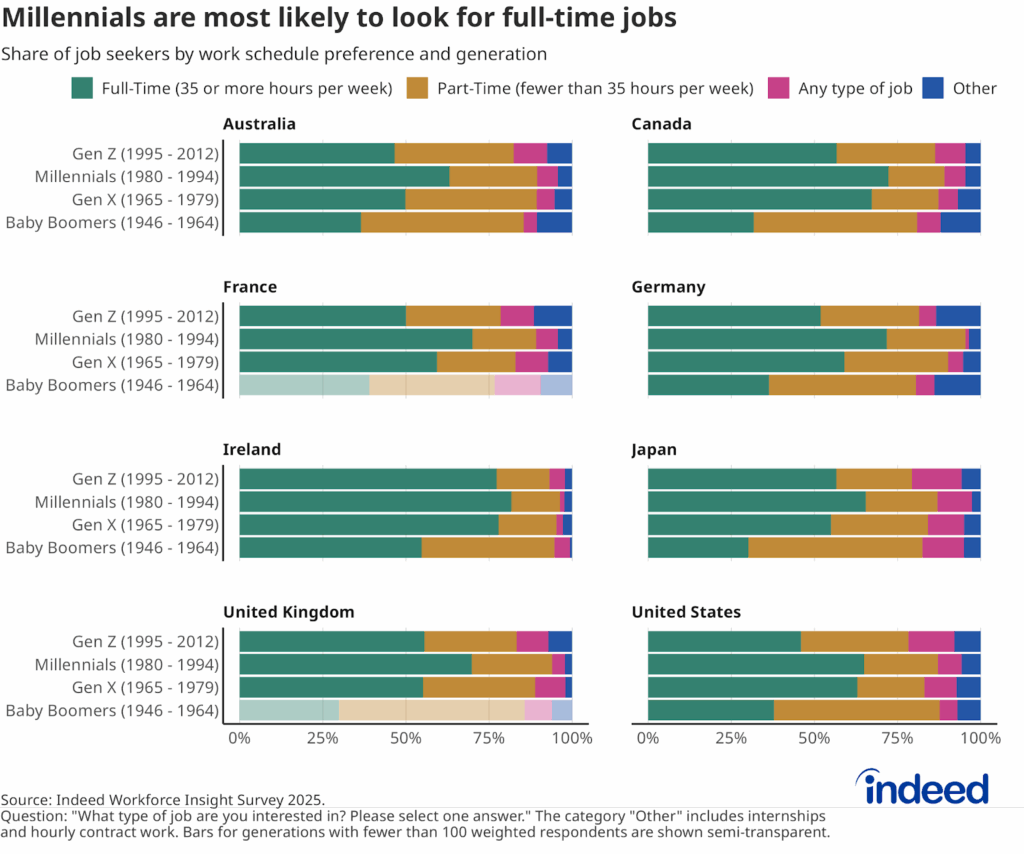
- Work schedules: Millennial job seekers are most likely to prefer full-time work, while part-time work is most popular among Baby Boomers. Gen Z and Gen X fall somewhere in between.
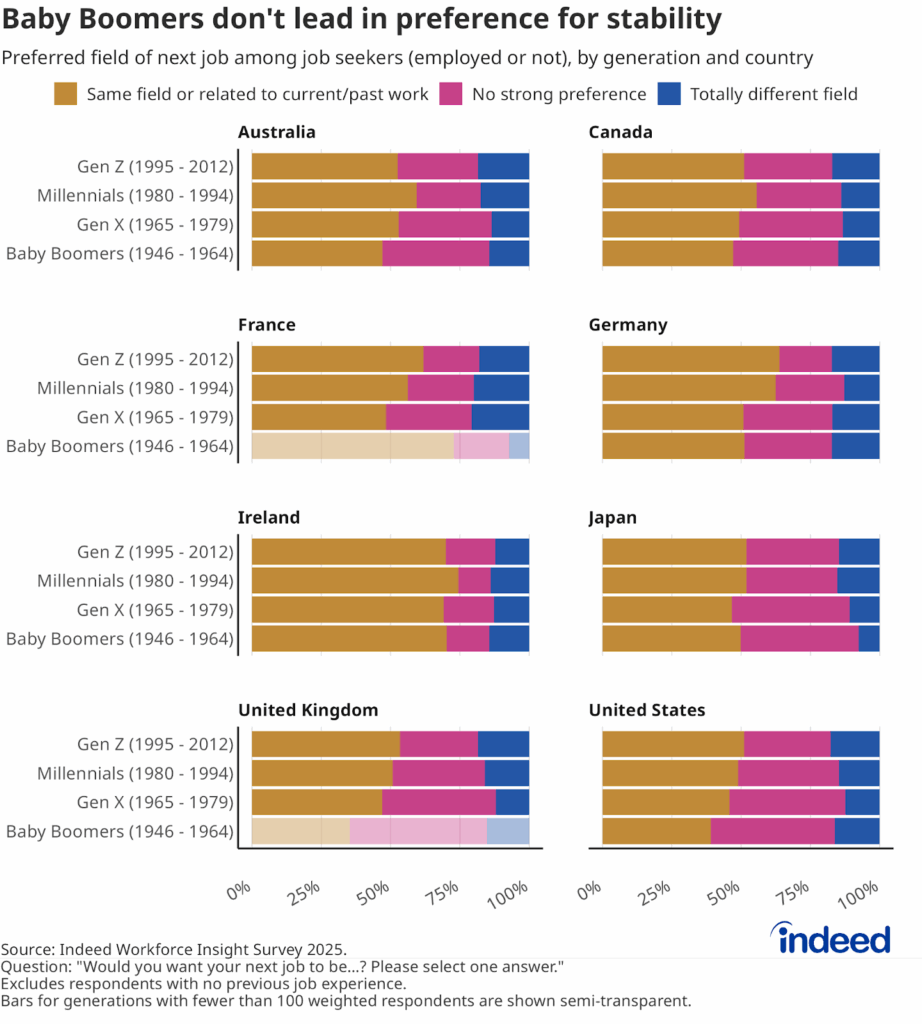
- Changing careers: Baby Boomer job seekers are the least opposed to changing career paths.
Some stereotypes hold a grain of truth: older generations tend to prefer in-office work, while younger ones often seek greater workplace flexibility. Part-time work is more popular among Baby Boomers, while Millennials prefer — or require — full-time jobs. When it comes to changing fields for the next job, however (and against popular belief), Baby Boomers aren’t the least flexible ones.
Active job search decreases with age
At the start of one’s career, every step counts. Early career decisions tend to define the pathways and successes throughout one’s work life. Younger workers tend to switch jobs more frequently as they work their way up the career (and wage) ladder. Later on, job tenure increases as job switching becomes less common. Higher job switching frequency among younger folks — as well as higher unemployment, typically lower job quality, and lower pay — means they are more likely to be on the lookout for job opportunities, both on and off the job (across all observed countries, Gen Z has the highest share of respondents actively looking for a job).
Millennials, who generally have the highest employment rates, rank second in job search, closely followed by Gen X. Those closest to and beyond the respective retirement age in different countries — Baby Boomers — are both least likely to be currently working and to search for jobs.
Hybrid work arrangements resonate with younger job hunters
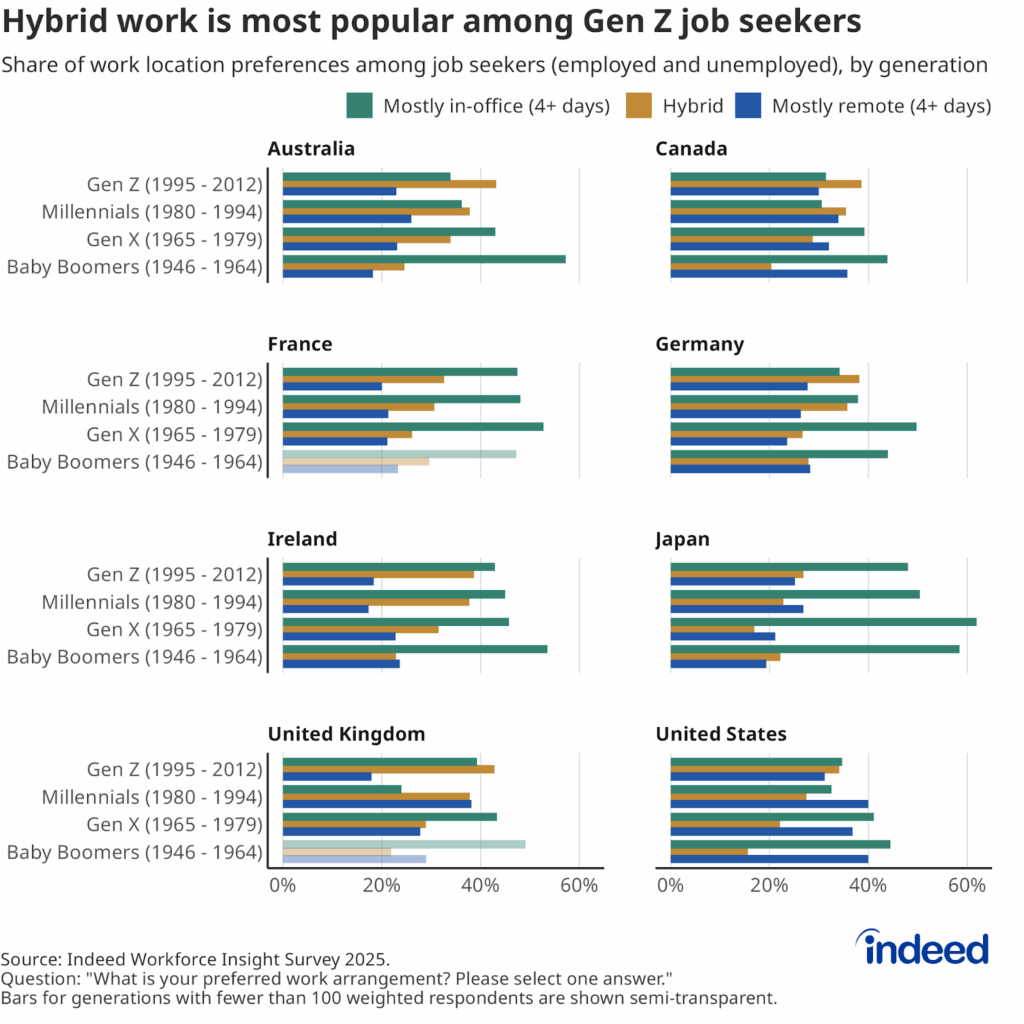
In-office work is the preferred work mode among job-seeking Baby Boomers and Gen X across all countries, among Millennials in Germany, and by a close tie among Gen Z in the US. It is the top choice across all generations in France, Ireland, and Japan. Hybrid work leads among Gen Z and Millennials in Australia and Canada, and among Gen Z in Germany and the UK. Among British and US Millennials, remote work is the most popular option, although in the UK, it is nearly tied with hybrid work.
Broadly speaking, preference for in-office work gradually increases with age, rising from Gen Z to Baby Boomers, while hybrid preferences decline across the same span. Hybrid arrangements are especially popular among Gen Z job seekers, who report the highest share of all generations seeking a 2–3 day office schedule and 2–3 days working from home.
Wishes to work from home or hybrid aren’t met in actual work arrangements
Job seeker preferences can help employers gauge how to best attract talent of different age groups. But the preferences of those already employed should not be overlooked, as they can help shape strategies to help retain talent. Among those currently employed (seeking or not), there is a clear gap between the share of respondents who prefer in-office work — defined as at least four days a week in the office — and the share who actually work primarily in the office. This gap is particularly pronounced for Gen Z and Millennial workers.
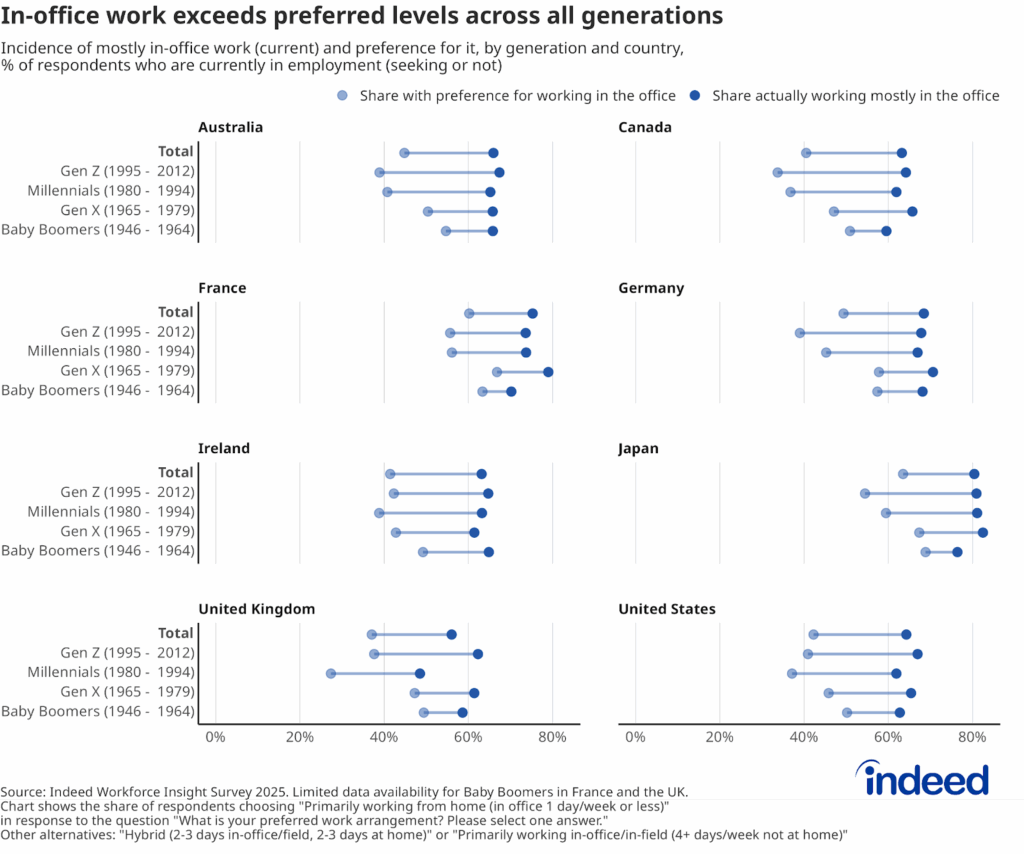
The countries with the highest shares of workers who primarily work in the office are Japan (around 80%) and France (75%). In both countries, a majority also prefers in-office work — 64% in Japan and 60% in France — but a substantial gap remains. Around one in six workers would prefer more flexibility than their current job allows. The UK has the lowest share of workers going to the office at least four days a week (under 56%), and only 37% have a preference to do so.
In most countries, preferences differ across generations. Actual work arrangements, however, are similar across age groups, sharply limiting the freedom in work location that Millennials and Gen Z are looking for. The share of employed respondents with a preference for in-office work ranges lowest among Millennials in the UK (27%), the United States (37%), Ireland and Australia (both 39%), and among Gen Z in Canada (34%) and Germany (39%). In France and Japan, although Gen Z shows the lowest preference within both countries, more than half of respondents in both generations still favor in-office work (55% in Japan and 56% in France).
Preferences show who wants — or needs — full-time employment
Among those currently seeking employment (regardless of their current employment status), preferences for full-time versus part-time work also differ clearly across generations. Millennial job seekers show the highest share preferring full-time schedules across all countries, ranging from 63% of respondents in Australia to 82% in Ireland. By contrast, only a minority of Baby Boomers who are looking for a job have a preference for full-time work in most countries (ranging from 30% in the UK to 38% in the United States), with the notable exception of Ireland, where 55% of this generation would opt to work full-time if given the choice. Part-time is most popular among job-seeking Baby Boomers, with preference rates from 44% in Germany to 56% in the UK — again, with the exception of Ireland (40%). Among Baby Boomers, part-time work is the preferred choice, as many are easing into retirement or seeking greater flexibility in their schedules.
Gen X generally falls between Millennials and Baby Boomers, with a moderate preference for full-time work. In most countries, their full-time preference is lower than that of Millennials but higher than Gen Z. In Japan, Ireland, and the UK, both generations show equal preference for full-time schedules. Part-time preferences for both Gen X and Gen Z are lower than those of Baby Boomers, reflecting a greater focus on full-time work among mid- and early-career generations. This is especially the case among younger Gen Z job seekers, while those aged 25 and over have preferences that are closer to those of Millennials.
Willingness to change fields: Older generations aren’t as rigid as you think
Older generations are often assumed to prioritize stability over career mobility, while younger workers are more open to change. However, Baby Boomers are (surprisingly) not the generation with the highest share of job seekers wanting to stay in the same or a related field to their current job: In Australia, Canada, and Ireland, Millennials are most likely to prefer staying in the same or a related field to their current or past work experiences. In France, Germany, the UK, and the US, this is most common among Gen Z. By contrast, Baby Boomers are more likely than other generations to say they have no strong preference in five out of the eight countries surveyed, showcasing their relative flexibility regarding late-career changes. This suggests that older workers are not less willing to make significant career changes — they may actually welcome them. For younger generations, early (and sometimes costly) career investments are still relatively fresh, creating an incentive to build on and leverage their expertise in their current field. Additional pressure for stability comes from family responsibilities, housing costs, and student loans, which usually peak during these life stages.
Conclusion
Generations approach work differently, shaping preferences for hours, location, and career moves. Baby Boomers tend to favor part-time and in-office work but are more open to career changes than commonly assumed. Younger generations prioritize flexibility when it comes to remote work, while often preferring full-time schedules and staying within the same or a related field when changing jobs. Employers could support older workers by offering contracts with fewer hours or hybrid arrangements. For Millennials, providing a trusting environment, clear career paths, and genuine remote-work options is key. Adapting work arrangements to generational preferences can enhance retention, job satisfaction, and productivity, while helping to address labor shortages in ageing societies.
Methodology
This post uses data from the 2025 Indeed Workforce Insights Survey, an online survey conducted for Indeed Hiring Lab by YouGov, of more than 80,000 adults from the US, UK, Germany, France, Japan, Ireland, Australia, and Canada. Sampling was random and representative, with all responses weighted based on age, gender, education, and region in all markets, and by race, aligned to the U.S. Census Bureau, American Community Survey, 2022. Fieldwork was conducted during the months of May and June 2025, with a total of n = 80,936 interviews globally, and a minimum of n = 10,000 interviews per market. This sample size provides a margin of error of ±1% at the 95% confidence level within each market.
Data for Gen Z, which includes young adults aged 18 and over, does not distinguish between those currently enrolled in education and those who are not.