
Key points:
- As of October 31, job postings had slumped to their lowest level since 2021, with year-over-year declines recorded in almost every sector tracked by Indeed.
- Year-over-year posted wage growth continued its downward trend, slowing to 2.5%.
- The regions most impacted by layoffs and the government shutdown lag behind less-impacted states.
Job postings continued to decline in October, reaching their lowest level since 2021 and sitting at just 1.7% above pre-pandemic levels as of October 31. This decline is widespread, with job postings in almost half (49%) of sectors sitting below their pre-pandemic baseline and all but four experiencing year-over-year declines.
While job postings have steadily declined month-over-month and are nearing pre-pandemic levels, it is worth noting that the labor market was quite strong in February 2020, with national unemployment rates at 60-year lows (3.5%). On its own, a return to the immediate pre-pandemic level in postings does not represent a sharp deterioration of the labor market, but it is certainly a departure from the post-pandemic boom of 2022.

Posted wages are also trending downward, with year-over-year growth slowing to 2.5% in September, continuing a persistent slowdown. The trajectory in wages now mirrors the cooldown in job postings as the labor market continues its sluggish trend. At the same time, annual inflation has ticked up and now exceeds annual wage growth, reducing consumers’ purchasing power even as prices continue to rise.

High-profile white-collar layoffs are making headlines, signaling both a post-pandemic correction and the potential growing impacts of new technology, including artificial intelligence. While AI isn’t the sole cause of the current slowdown, there are signs that some routine professional tasks in fields, including software, media, and marketing, are increasingly being automated.
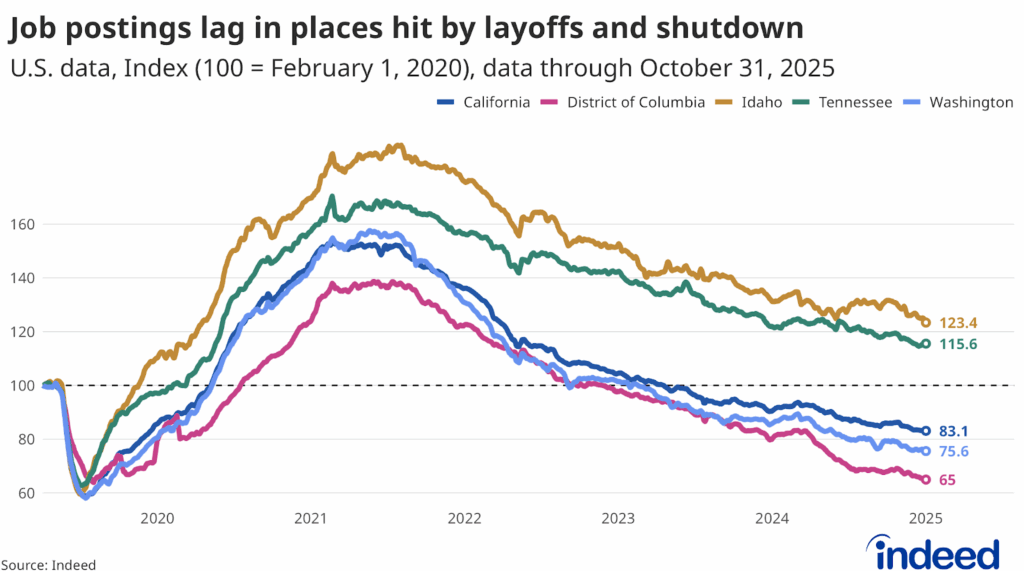
Regional differences are also apparent as these shifts unfold. Layoff announcements thus far have been highly concentrated in tech-heavy states, including California and Washington, and postings in these states are currently down 17% and 24%, respectively, compared to February 2020. At the same time, postings in Washington, D.C., which has been heavily impacted by funding cuts and the ongoing shutdown, are 35% below pre-COVID norms. But this isn’t the case everywhere. Job postings in states including Idaho and Tennessee — which have not been as impacted by widespread layoffs or federal funding volatility — remain well above their early 2020 norms, and recent local declines in those areas have been far more muted than in other states.
Businesses, job seekers, and policymakers rely heavily on up-to-date data to guide decisions, especially during times of uncertainty. The delayed release of September and October’s national jobs report only heightens the economic uncertainty that has characterized 2025. Federal data — particularly on prices and inflation — is difficult to replace. But in the absence of official government data as the shutdown continues, real-time indicators, including the Indeed Job Postings Index and the Indeed Wage Tracker, offer valuable, timely perspectives on labor market activity. As the shutdown continues, we will continue to analyze trends in job openings, wages, and job seeker behavior, including potential effects on federal employees.
Methodology
To calculate the average rate of wage growth in the Indeed Wage Tracker, we follow an approach similar to the Atlanta Fed US Wage Growth Tracker, but we track job postings, not individuals. We begin by calculating the median posted wage for a given country, month, job title, region, and salary type (hourly, monthly, or annual). Within each country, we then calculate year-on-year wage growth for each job title-region-salary type combination, generating a monthly distribution. Our monthly measure of wage growth for the country is the median of that distribution. Alternative methodologies, such as the regression-based approaches in Marinescu & Wolthoff (2020) and Haefke et al. (2013), produce similar trends.
Data on seasonally adjusted Indeed job postings are an index of the number of seasonally adjusted job postings on a given day, using a seven-day trailing average. February 1, 2020, is our pre-pandemic baseline, so the index is set to 100 on that day. We seasonally adjust each series based on historical patterns in 2017, 2018, and 2019. We adopted this methodology in January 2021. Data for several dates in 2021 and 2022 are missing and were interpolated. Non-seasonally adjusted data are calculated in a similar manner, except that the data are not adjusted to historical patterns.
The number of job postings on Indeed.com, whether related to paid or unpaid job solicitations, is not indicative of potential revenue or earnings of Indeed, which comprises a significant percentage of the HR Technology segment of its parent company, Recruit Holdings Co., Ltd. Job posting numbers are provided for information purposes only and should not be viewed as an indicator of performance of Indeed or Recruit. Please refer to the Recruit Holdings investor relations website and regulatory filings in Japan for more detailed information on revenue generation by Recruit’s HR Technology segment.