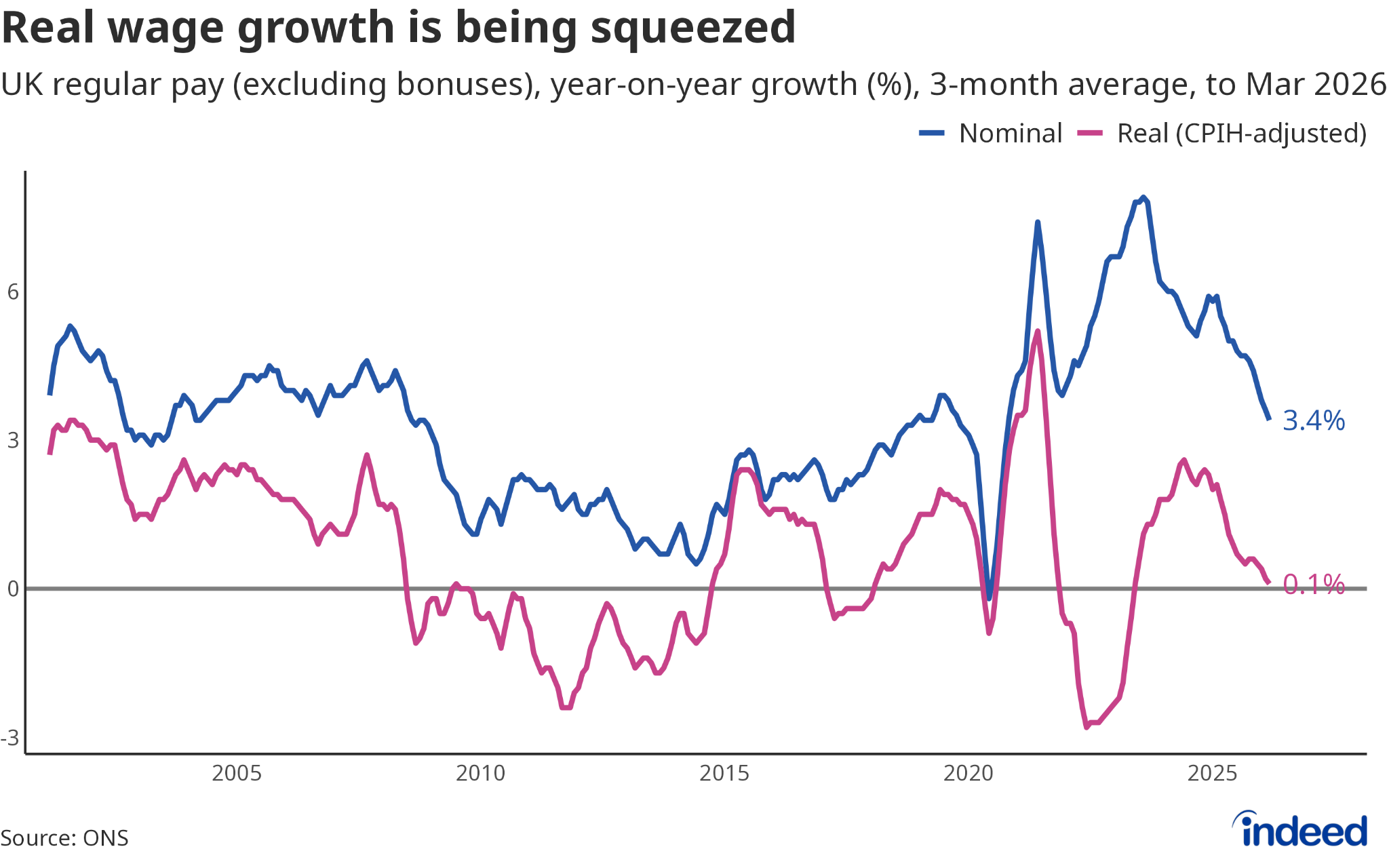
Key points:
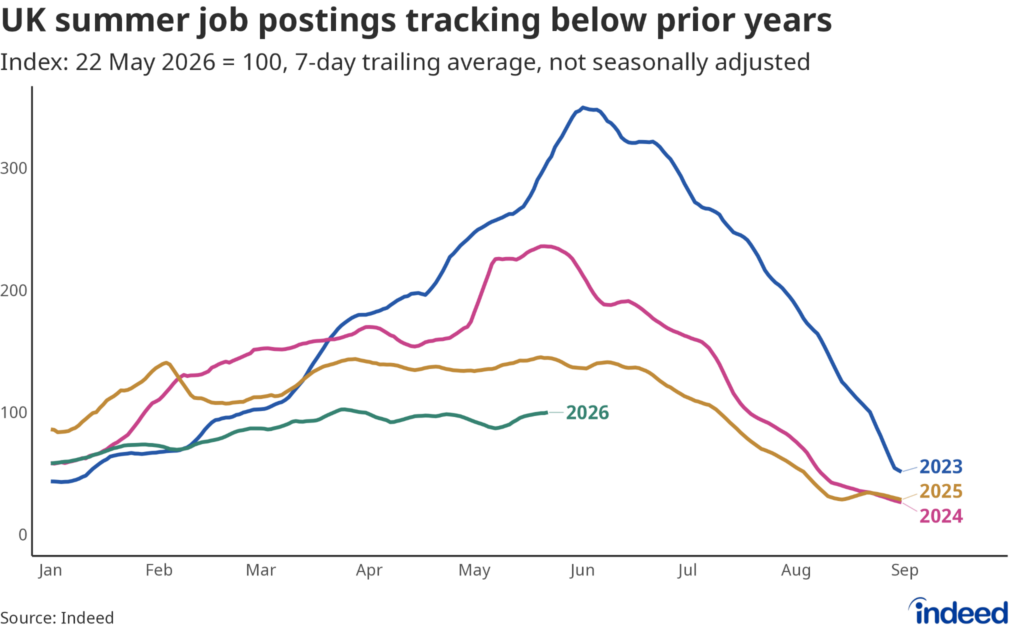
- Summer job postings are off to their slowest start in years, running almost 30% below 2025 and well below the 2023 peak.
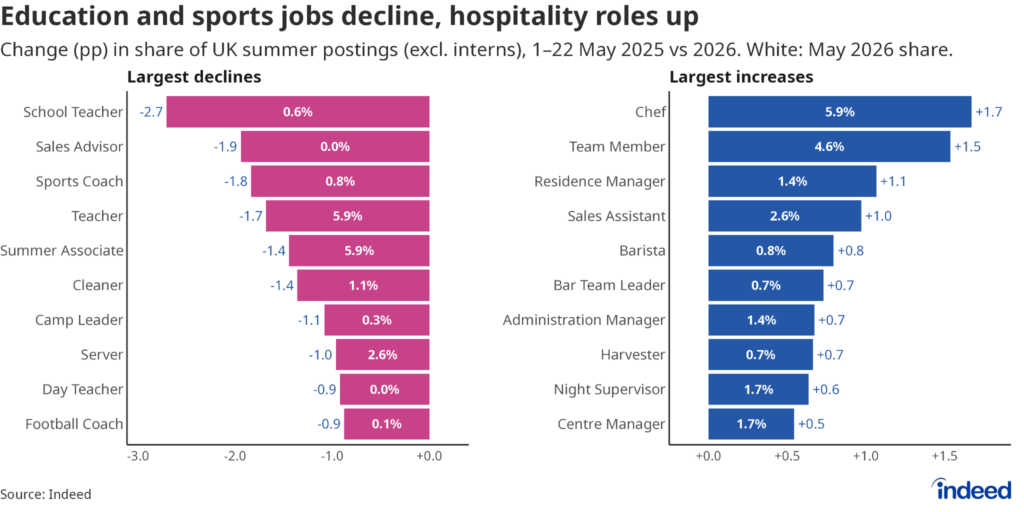
- The composition is shifting away from education and sports coaching toward hospitality and customer-facing services.
- The overall labour market remains fragile, with decade-high youth unemployment a particular concern.
Our Labour Market Updates examine important trends using Indeed and other labour market data. Our European Labour Market Overview chartbook provides a more comprehensive view of the European labour market. Other data, including the Indeed Wage Tracker, is regularly updated and can be accessed on our data portal.
The UK labour market has continued to soften, with the latest official figures showing vacancies dropping to a five-year low, payrolled employment falling and unemployment rising. Youth unemployment is a particular concern, reaching its highest level in more than a decade.
Overall job postings on Indeed have broadly stabilised over the past month, though remain subdued. As of 22 May, postings stood 29% below their 1 February 2020, pre-pandemic baseline, a 10.6% decline from a year earlier.
Spotlight: Summer jobs are trending below previous years
The annual summer job recruiting cycle in the UK generally starts ramping up in January, before cooling in mid-May. However, aside from its distinctive monthly trajectory, summer job postings have been evolving in line with broader economic trends. For 2026, this has meant a further weakening in summer hiring appetite relative to 2025, extending a multi-year decline and suggesting another soft summer labour market for British youth.
We track seasonal demand by tallying UK job postings on Indeed that explicitly include the term “summer” in their job title, excluding postings whose titles also reference internships, work placements, apprenticeships or graduate programmes. Summer job postings throughout 2026 have run consistently below their 2025 levels and, as of 22 May 2026, were down 31% from a year earlier. This continues a downward trend that began after 2023: summer postings in late May 2026 are 71% below their 2023 peak.
The composition of summer postings is also shifting. Comparing the first three weeks of May 2025 with the same period in 2026, the job titles losing the most share are concentrated in education and sports coaching. School teachers fell by 2.7 percentage points of the summer-postings mix (a substantial share of UK “summer teacher” demand comes from residential English-language summer schools). Sports coaches (-1.8 pp), teachers more broadly (-1.7 pp), day teachers (-0.9 pp), camp leaders and football coaches also saw falls.
The titles gaining share sit squarely in hospitality and customer-facing services. Chefs (+1.7 pp), team members (+1.5 pp), residence managers (+1.1 pp), sales assistants (+1.0 pp), baristas, bar team leaders, night supervisors and harvesters are all accounting for a larger slice of summer postings than they did a year ago. Absolute numbers are still down, but food service, accommodation and seasonal agriculture employers are punching above their 2025 weight within what summer hiring there is.
Conclusion
The May data extend the cooling trend that has shaped the UK labour market over the past year. The slow start to the summer hiring season suggests employers are cautious about adding seasonal headcount, an unwelcome development given how much summer employment matters to particular groups of workers. For the youngest jobseekers, a first summer job is often more than a source of income – it’s an introduction to the world of work and can help build foundational skills.
But it isn’t only young people who depend on the summer season. For many workers in hospitality, tourism, agriculture and retail, the summer months can be when the bulk of annual earnings are made. A softer season doesn’t just mean fewer shifts – it can mean a materially worse financial year, with limited opportunity to compensate later. With real wages already under pressure, a quieter summer hiring market is another squeeze on households that can least afford it.
Hiring Lab Data
Job postings data is available on our Data Portal. We also host the underlying job-postings chart data on GitHub as downloadable CSV files. Typically, it will be updated with the latest data one day after this blog post is published.
Methodology
Data on seasonally adjusted Indeed job postings is an index of the number of seasonally adjusted job postings on a given day, using a seven-day trailing average. Feb. 1, 2020, is our pre-pandemic baseline, so the index is set to 100 on that day.
To calculate the average rate of wage growth, we follow an approach similar to the Atlanta Fed US Wage Growth Tracker, but we track jobs, not individuals. We begin by calculating the median posted wage for each country, month, job title, region and salary type (hourly, monthly or annual). Within each country, we then calculate year-on-year wage growth for each job title-region-salary type combination, generating a monthly distribution. Our monthly measure of wage growth for the country is the median of that distribution.
We track summer hiring appetite by tallying UK job postings on Indeed that include the term “summer” in the job title, excluding postings whose titles also reference internships, work placements, apprenticeships or graduate programmes (e.g. “intern”, “internship”, “placement”, “apprentice”, “graduate”). We track internship postings separately, tallying postings whose job titles contain “intern” or “internship”. This method doesn’t capture the full extent of seasonal demand but provides a gauge of recent trends and how summer postings compare to prior years. All posting data presented reflects 7-day trailing moving averages.
The number of job postings on Indeed.com, whether related to paid or unpaid job solicitations, is not indicative of potential revenue or earnings of Indeed, which comprises a significant percentage of the HR Technology segment of its parent company, Recruit Holdings Co., Ltd. Job posting numbers are provided for information purposes only and should not be viewed as an indicator of performance of Indeed or Recruit. Please refer to the Recruit Holdings investor relations website and regulatory filings in Japan for more detailed information on revenue generation by Recruit’s HR Technology segment.