Key points:
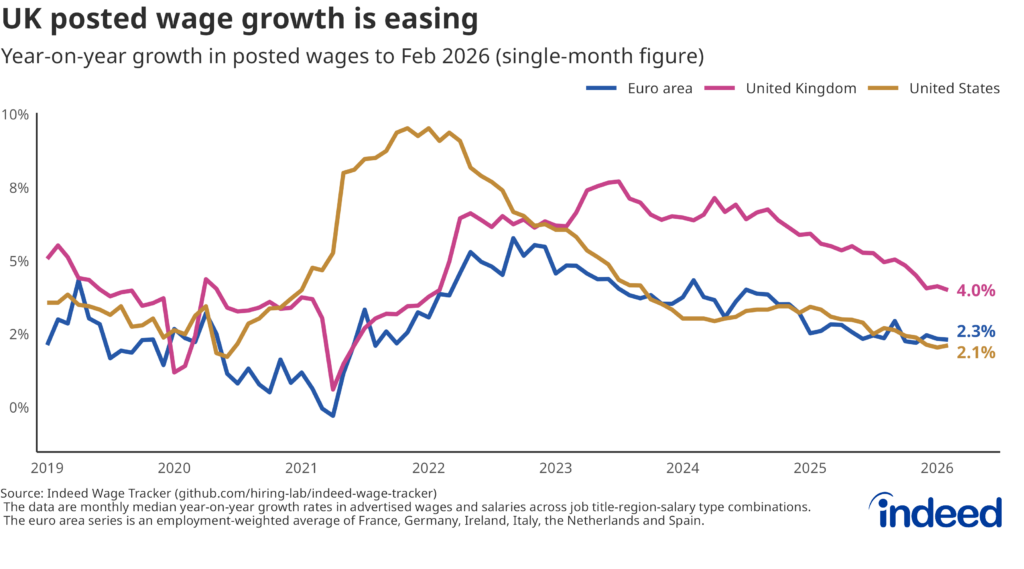
- Overall UK job postings sit 27% below their pre-pandemic baseline, with annual posted wage growth easing to a four-year low of 4.0% in February as the labour market continues its gradual cooling.
- The outbreak of war in Iran and the resulting spike in global energy prices have clouded the outlook, with inflation fears pointing to tighter monetary policy and intensifying cost pressures on businesses.
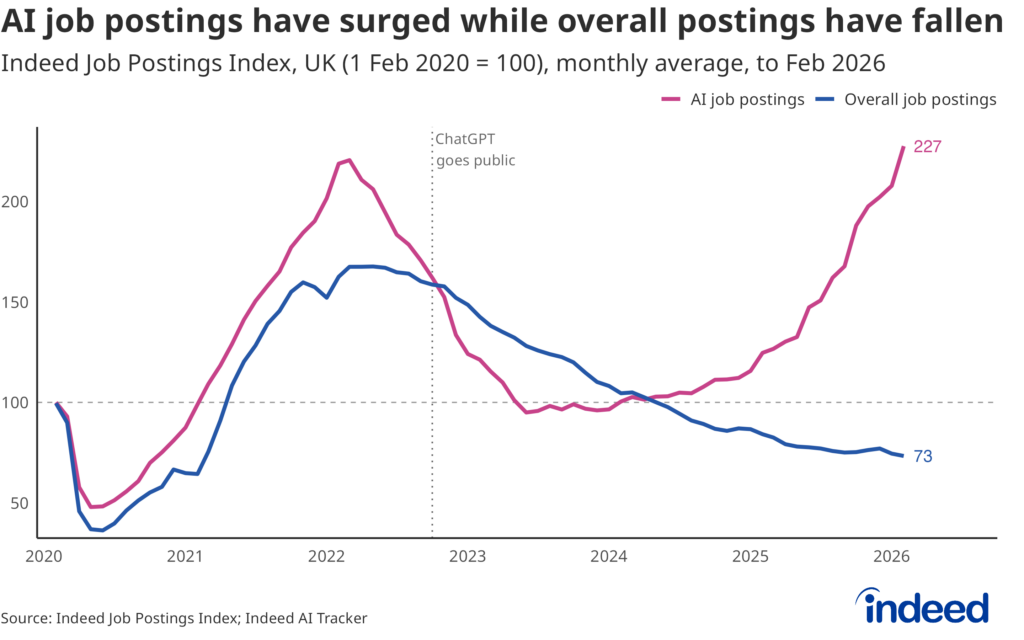
- Against this backdrop, one area stands out: postings mentioning AI have climbed to 127% above pre-pandemic levels, underscoring how rapidly employers are embedding AI into their hiring even as the broader market retreats.
Our Labour Market Updates examine important trends using Indeed and other labour market data. Our European Labour Market Overview chartbook provides a more comprehensive view of the European labour market. Other data, including the Indeed Wage Tracker, is regularly updated and can be accessed on our data portal.
While overall UK job postings have continued to gradually fall, those postings mentioning AI are heading in the other direction. Whereas overall postings sat 27% below their pre-pandemic baseline as of end-February, postings with AI mentions were 127% above it – a divergence that has widened sharply since the public launch of ChatGPT in late 2022. As of end-February, around 7.5% of UK job postings had AI mentions.
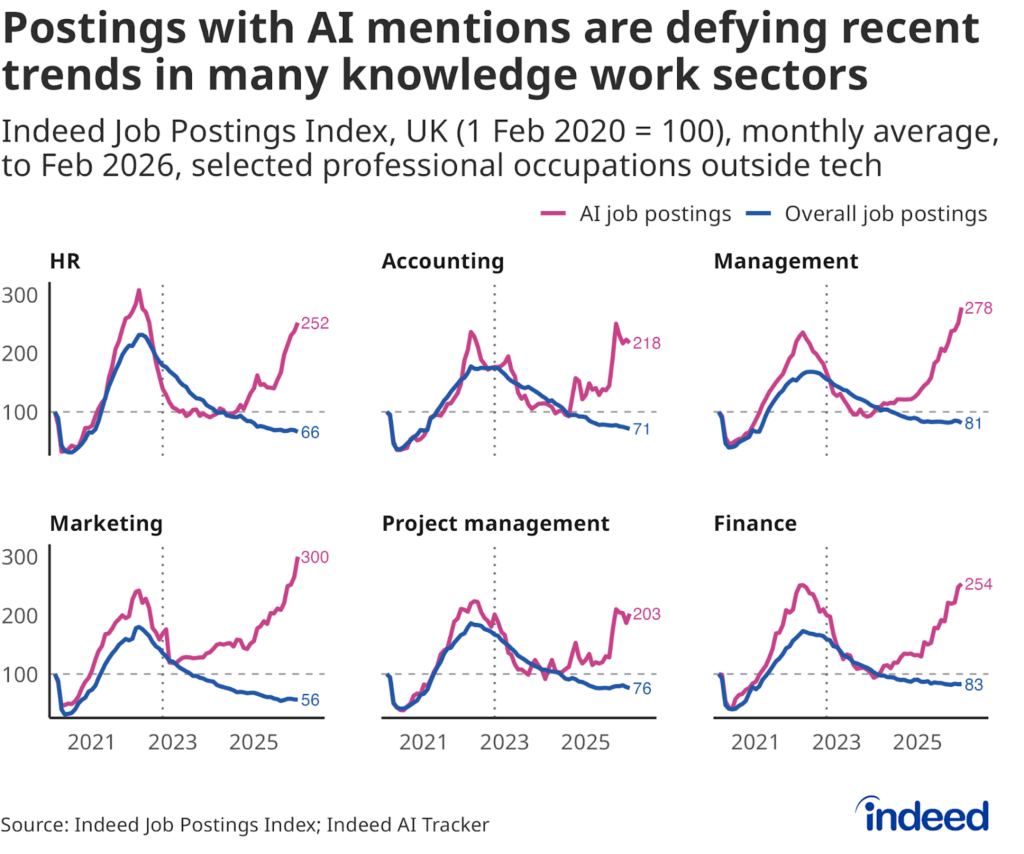
The surge is not confined to the technology sector. Across knowledge-work occupations – from finance and marketing to HR and project management – postings referencing AI have risen steeply even as overall hiring in those sectors has softened. This suggests that employers are not simply hiring more AI specialists; they are increasingly expecting workers across a broad range of roles to engage with AI tools as a routine part of the job.
What these postings signal about the nature of work is harder to pin down. A mention of AI in a job posting signals everything from a requirement that candidates have deep technical expertise in machine learning to a simple notice that AI may be used in the hiring or screening process. What the data do make clear, however, is that the pace at which employers are articulating AI expectations – whatever their precise content – has accelerated dramatically. And in several sectors that have otherwise seen a striking decline in overall job postings, including marketing, HR and accounting, the number of job posts mentioning AI in these fields has more than doubled. For workers navigating a subdued job market, the growing prevalence of AI references in postings may increasingly shape which roles they are considered qualified for. The category with the highest share of AI-related postings is data & analytics at 47%, followed by software development at 41%.
Job Postings: Subdued, but stable
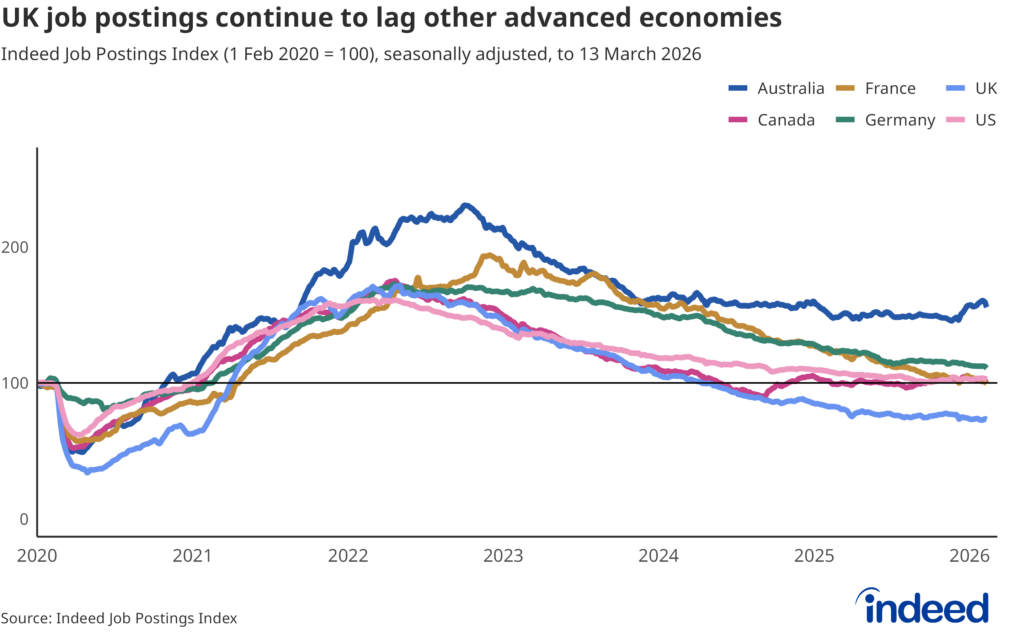
Though UK job postings remain subdued, they have remained relatively stable in recent months at around 27% below pre-pandemic levels. That’s in contrast to global peers, where postings are generally at or above baseline. UK employers were already cautious before the outbreak of war in Iran, with the subsequent spike in global energy prices set to intensify cost pressures facing businesses.
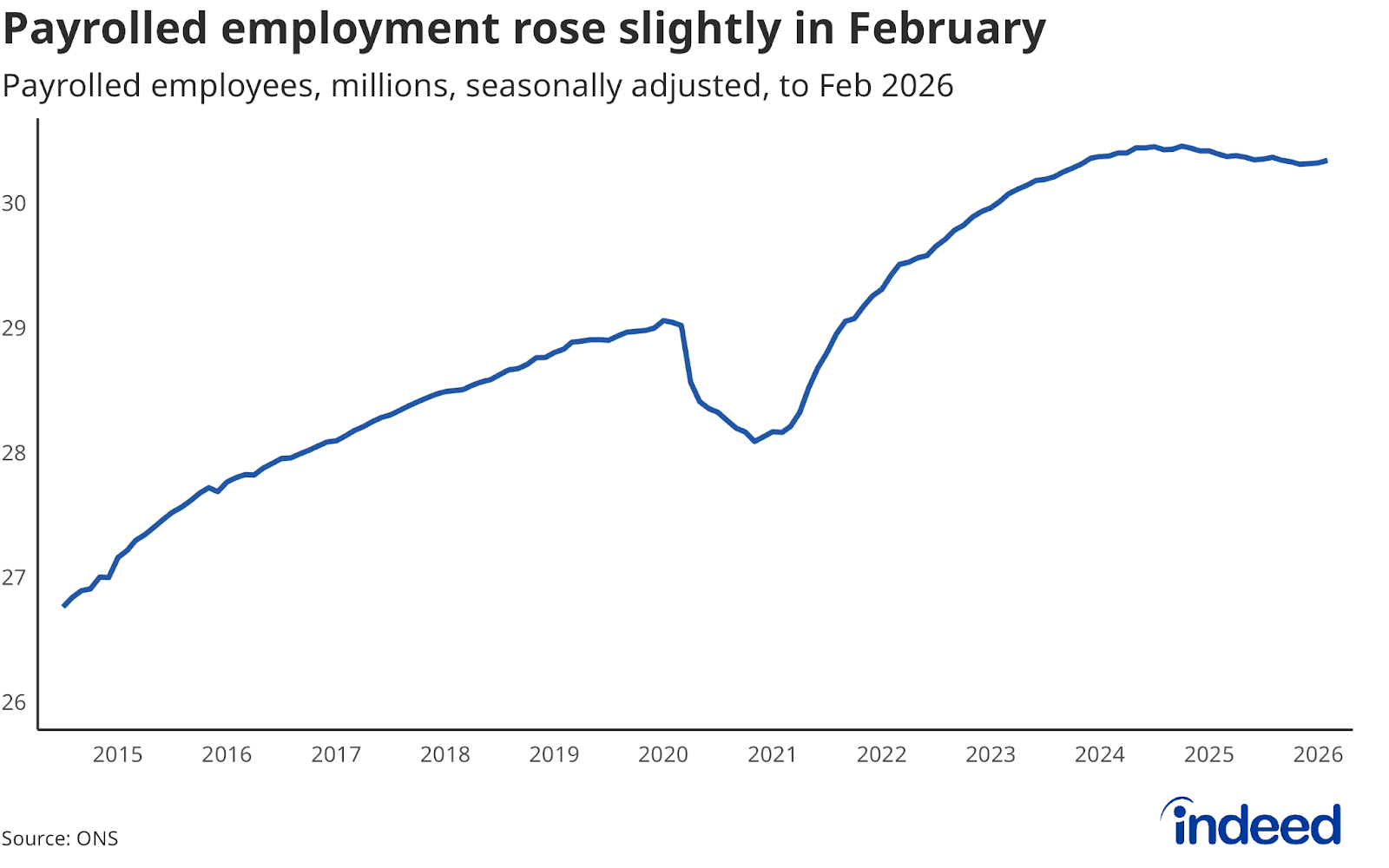
There remain few signs of an acceleration in job losses, with leading indicators including redundancy notifications remaining modest and the latest payrolls data having levelled out. But that equilibrium could be tested should energy costs stay high in a long-lasting conflict scenario, putting renewed pressure on firms to find savings.
Posted wage growth has eased further
UK posted wage growth continues to ease. The Indeed Wage Tracker recorded 4.0% year-on-year growth in February – the lowest reading in four years – as the post-pandemic wage surge continues its gradual unwind.
Official data tell a similar story. Annual growth in regular pay eased to 3.8% in the three months to January 2026, according to the ONS. The headline is flattered by public sector pay, which rose 5.9% annually – partly reflecting the timing of pay awards that fell earlier in 2025 than in 2024. Strip that out, and private-sector regular pay growth of 3.3% offers a cleaner read on underlying pay pressures: modest and continuing to cool.
Before the outbreak of war in Iran, this combination of easing wages and contained inflation expectations had set the Bank of England on a clear path toward further rate cuts. That calculus has now shifted. The surge in global energy prices has revived fears of persistent inflation, and with it the prospect of the Bank having to hold rates higher for longer. Financial markets have moved to price in rate hikes, which may overstate the case – but the rate relief businesses and households had been counting on this year looks out of reach for now. At a time when the labour market is already softening, the removal of that support could prove a meaningful headwind.
Conclusion
The UK labour market enters this period of heightened uncertainty from a position of gradual cooling rather than acute stress. Job postings remain well below pre-pandemic levels, wage growth is easing, and hiring intentions have softened – yet the more alarming signals of a sharp deterioration, such as a surge in redundancies or a collapse in payrolls, have so far failed to materialise.
The war in Iran and the energy price shock it has unleashed represent a significant new headwind. Higher energy costs will squeeze margins, particularly in energy-intensive sectors, and the resulting inflation persistence may deny businesses and households the relief of further rate cuts they had been anticipating. Whether this tips a cooling labour market into a contraction will be influenced by the duration of the conflict.
Amid this uncertainty, the rapid growth of AI-related job postings offers a striking counterpoint. While the broader market retreats, demand for roles explicitly referencing AI integration continues to accelerate. It is a signal that, for some employers, technological transformation is pressing ahead regardless of the macroeconomic backdrop. How far this dynamic can offset weakness elsewhere remains to be seen, but it serves as a reminder that structural change in the labour market does not pause for geopolitical shocks.
Hiring Lab Data
Job postings data is available on our Data Portal. We also host the underlying job-postings chart data on GitHub as downloadable CSV files. Typically, it will be updated with the latest data one day after this blog post is published.
Methodology
Data on seasonally adjusted Indeed job postings is an index of the number of seasonally adjusted job postings on a given day, using a seven-day trailing average. Feb. 1, 2020, is our pre-pandemic baseline, so the index is set to 100 on that day.
To calculate the average rate of wage growth, we follow an approach similar to the Atlanta Fed US Wage Growth Tracker, but we track jobs, not individuals. We begin by calculating the median posted wage for each country, month, job title, region and salary type (hourly, monthly or annual). Within each country, we then calculate year-on-year wage growth for each job title-region-salary type combination, generating a monthly distribution. Our monthly measure of wage growth for the country is the median of that distribution.
The number of job postings on Indeed.com, whether related to paid or unpaid job solicitations, is not indicative of potential revenue or earnings of Indeed, which comprises a significant percentage of the HR Technology segment of its parent company, Recruit Holdings Co., Ltd. Job posting numbers are provided for information purposes only and should not be viewed as an indicator of performance of Indeed or Recruit. Please refer to the Recruit Holdings investor relations website and regulatory filings in Japan for more detailed information on revenue generation by Recruit’s HR Technology segment.