Key points:
- Unemployment rate holds steady at 5.2%, the highest in five years.
- Wage growth continues to ease, hitting its lowest since 2021.
- The Bank of England faces a stagflation dilemma as global energy prices spike.
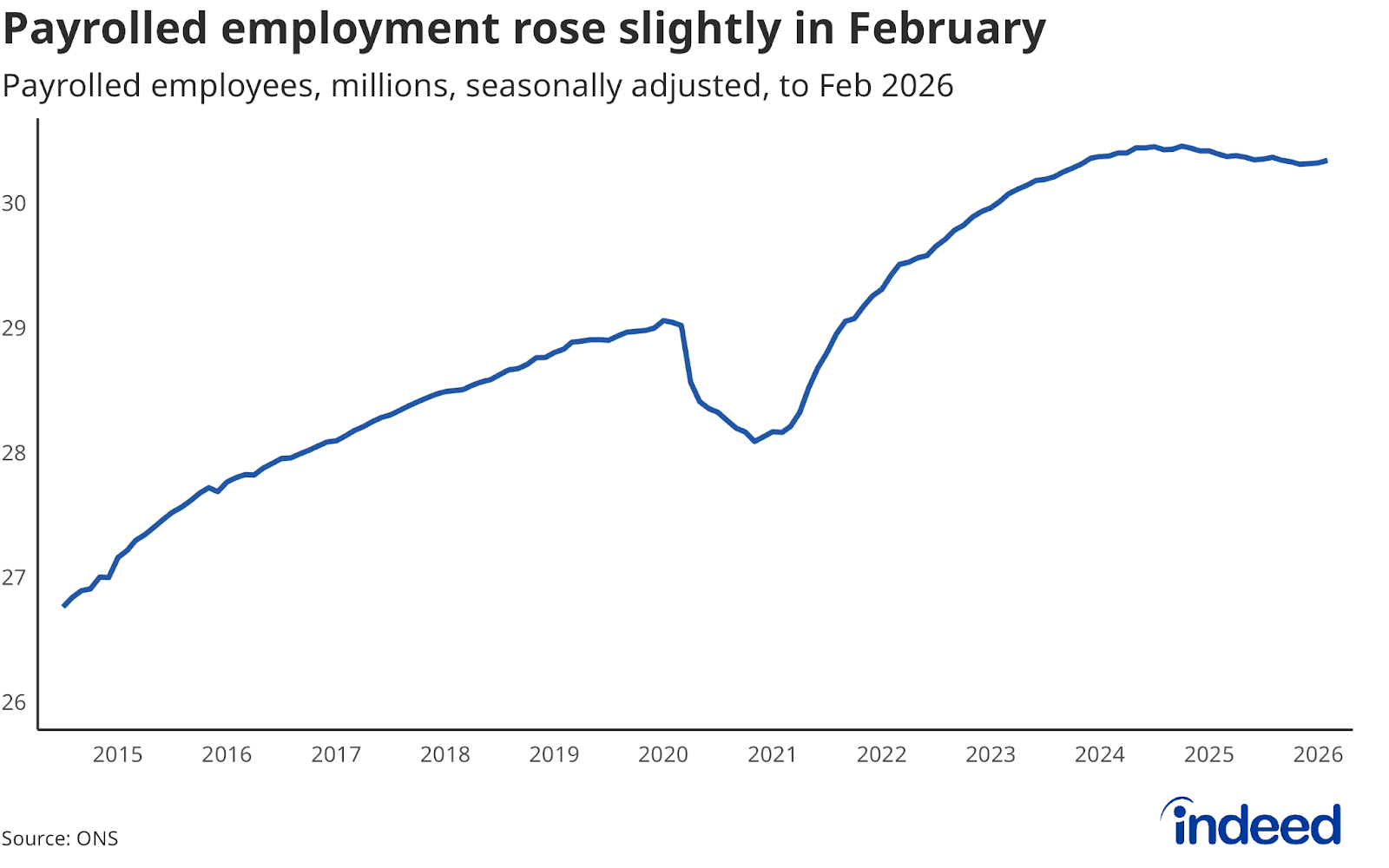
The UK labour market stabilised at the start of the year following a period of weakness, with the unemployment rate steady at 5.2% and payrolled employment showing a 20,000 rise. But the latest figures only offer a look in the rear-view mirror, with the stagflationary impact of the conflict in Iran threatening a renewed weakening of labour market conditions.
Spiking global energy prices will add to businesses’ cost pressures, complicating the picture for the Bank of England. The Bank left interest rates on hold today but hinted at possible interest rate hikes later this year should a prolonged conflict fuel persistently high inflation pressures. That’s despite the labour market having clearly weakened recently alongside easing pay pressures, which would otherwise argue for lower interest rates to cushion the economy. The labour market is now much softer than it was when the previous energy price shock occurred in 2022 (following the invasion of Ukraine), meaning workers have less bargaining power to push for higher wages to restore purchasing power.
Indeed wage growth slowed to its lowest in over five years at 3.8% year-on-year for regular pay in the three months to January. With wage growth on a downward trajectory and inflation pressures on the rise, we could see an end to the period of real terms wage growth seen since mid-2023 and a gradual erosion of workers’ pay packets.