
Key points:
- Job switching varies by occupation: Around 2.4% of Indeed users in the UK change jobs each month, with 63% of these moving into a different occupation. Turnover is highest in entry-level roles such as loading & stocking, food preparation & service, and hospitality & tourism, and lowest in occupations like beauty & wellness, nursing, and electrical engineering.
- Barriers and accessibility influence mobility: Roles with lower entry requirements or more generalised skills attract more external talent, while specialised professions such as nursing, dentistry, and software development experience lower inflows and stronger occupational attachment.
- Demand and skill investment drive retention: Occupations with high demand or significant barriers to entry see fewer workers leaving. High-demand or specialised roles, especially in healthcare, have lower exit rates, whereas temporary or junior roles in sectors like hospitality and retail experience much higher exit rates.
People change jobs for a variety of reasons. Higher pay or career advancement are obvious motivators, but many workers also seek reduced stress, better job security, and/or improved work–life balance. Others are driven by external factors, like a relocation or change in health, or negative experiences in their current role, such as redundancy.
Around 2.9 million people in the UK changed jobs in 2025, according to the Office for National Statistics (ONS). Approximately 1.2 million UK workers also switched career paths, leaving their previous industry entirely.
Hiring Lab used Indeed data to track career pathways based on the job histories users record on their CVs, allowing us to see where talent comes from and where it goes. Each month, around 2.4% of UK Indeed users with an uploaded CV change jobs. Around 63% of these workers move into a different occupation.
Some occupations are far more attractive to external talent than others, and workers also show very different levels of attachment across occupations. One important caveat is that job-switching rates observed on Indeed are likely higher than in the wider labour market. As a job-matching platform, Indeed naturally attracts users who are actively looking for new opportunities, while those who are content in their roles are less likely to engage.
Occupations where job switching is most and least common
Between 2022 and mid-2025, around 2.4% of Indeed users in the UK – roughly one in 42 – switched into a new job each month. However, job switching rates varied markedly across occupations.
Turnover was highest in the loading & stocking and food preparation & service categories, where around 3.2% of workers moved into a new job each month. That was followed by hospitality & tourism and data & analytics (both 2.9%). Higher mobility in these roles likely reflects a combination of lower pay and a greater prevalence of entry-level positions. These jobs are often seen as stepping stones, attracting younger workers who tend to switch jobs more frequently.
In contrast, greater workforce stability is evident in occupations such as beauty & wellness (1.6%), nursing (1.7%) and electrical engineering (1.8%), where job switching is less common.
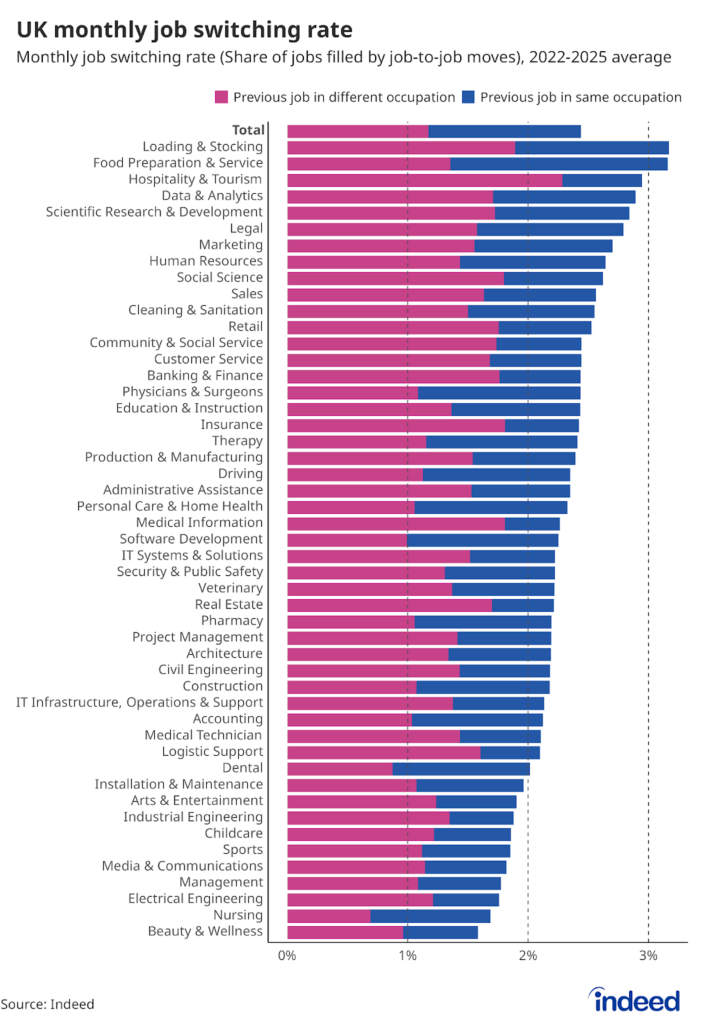
Some occupations are also more attractive or accessible to external talent. Hospitality & tourism, medical information, real estate and logistic support, for example, all see a high volume of job switchers coming from other fields.
These roles typically have lower barriers to entry or rely on more generalised skills that overlap with other occupations, making career transitions easier. By contrast, professions such as nursing, dentistry and software development require specialised skills or extensive education and training, limiting the pool of external candidates.
The jobs that people don’t want to leave
Some occupations appear to inspire stronger loyalty than others or are simply harder to leave. Factors such as work–life balance, pay and conditions, passion for the work, or a desire not to “waste” one’s education or training can all play a role.
Between 2022 and mid-2025, dental was the profession with the lowest overall exit rate, with just 37% of job switchers leaving the field. Within the sector, however, leaving rates varied widely – 75% of dental assistants that got a new job ended up leaving the dental sector, compared to just 17% of dental hygienists. Other occupations with relatively low exit rates included software development (41%), personal care & home health (42%), driving (43%) and nursing (46%), highlighting a clear healthcare theme among workers most likely to stay in their chosen field.
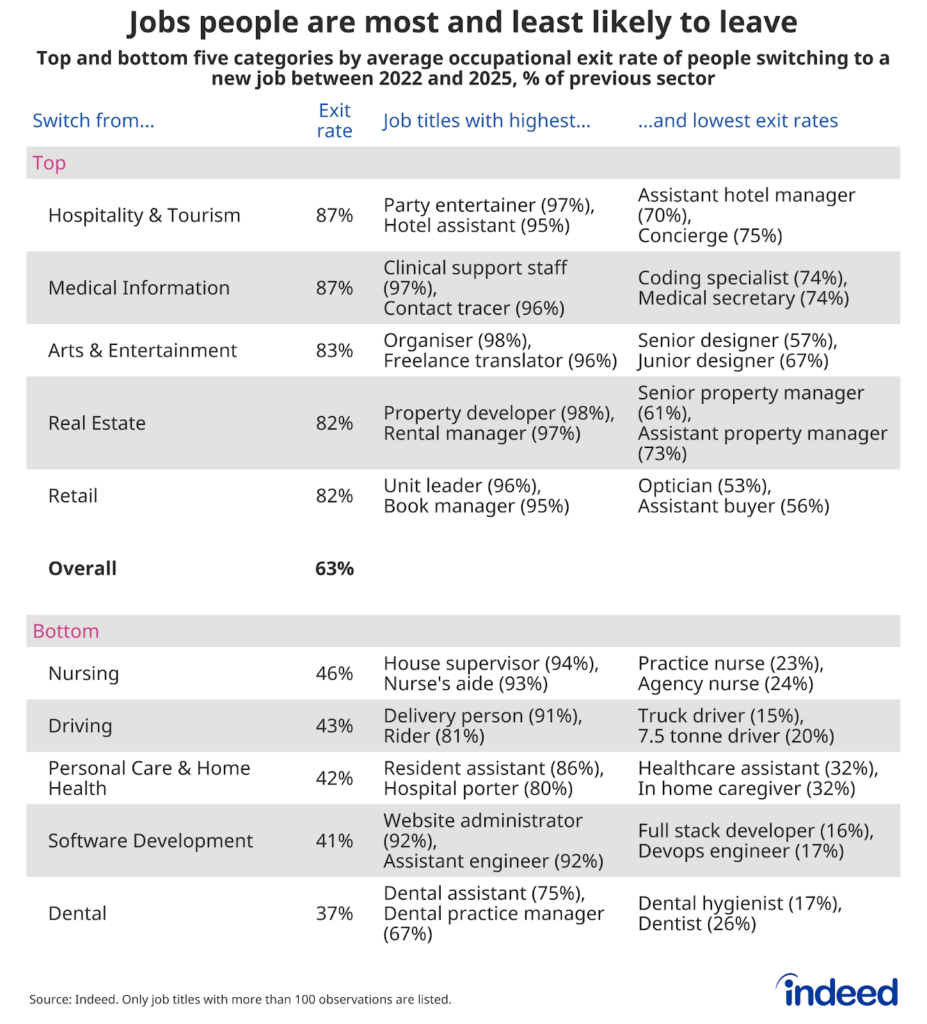
A common, though not universal, factor among these loyal professions is a high barrier to entry. Workers often invest significant time in gaining experience, education, qualifications and training. This long-term commitment may reflect passion for the work, the sacrifices made to reach their current position, or a reluctance to “waste” that investment by leaving the profession.
At the other end of the spectrum are occupations that are often treated as temporary waypoints rather than long-term careers. In hospitality & tourism and medical information, 87% of job leavers between 2022 and mid-2025 exited the occupation altogether, ahead of arts & entertainment (83%), real estate (82%) and retail (82%).
Many roles in these fields are junior or entry-level in nature. Hospitality, in particular, is frequently a first step into the labour market for young people, but seldom a destination they remain in over the longer term.
High-demand occupations are ‘stickier’
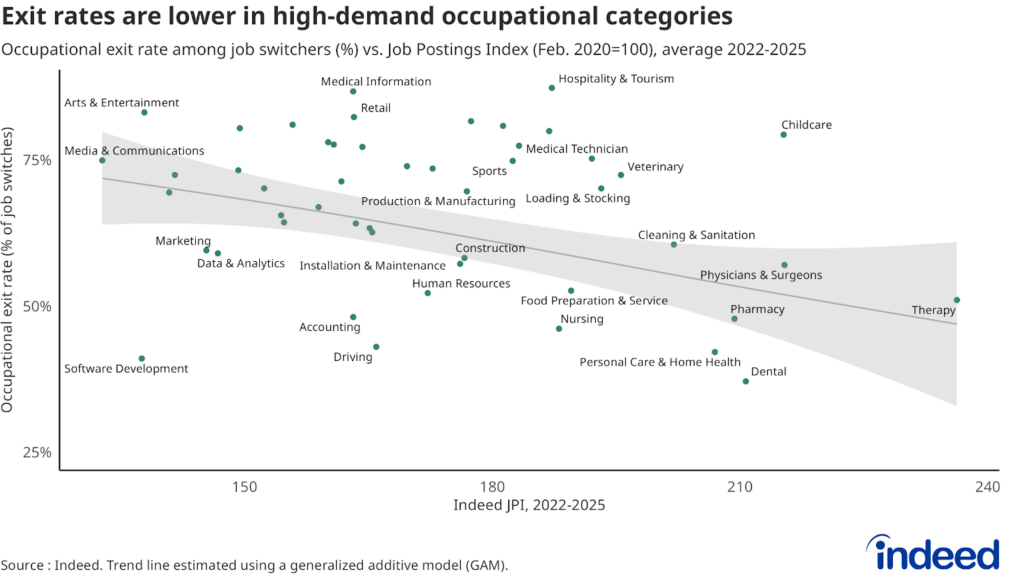
Occupational exit rates appear to move with relative demand conditions. Occupations with stronger hiring demand – as reflected in higher average Indeed Job Posting Index (JPI) values – tend to see a smaller share of job switchers leaving for other occupations. This suggests that when workers perceive good prospects and a degree of security within their current occupation, they are more likely to remain on that career path.
Conversely, weaker demand or limited advancement opportunities can act as push factors, increasing the likelihood that job switchers look beyond their current occupation. The data also show that roles requiring highly specialised skills – particularly in healthcare – exhibit consistently lower exit rates, pointing to stronger occupational attachment and fewer viable outside options.
The interactive chart below shows the mobility flows between different professional categories. It indicates where incoming workers come from and which categories outgoing workers are moving towards.
Conclusion
Job mobility varies widely across the UK labour market, with important implications for recruitment and staff retention. While around 2.4% of Indeed users change jobs in an average month, rates range from 3.2% in loading & stocking to 1.6% in beauty & wellness.
High-turnover roles often serve as entry points for junior workers, providing valuable experience, but retaining staff in these positions can be challenging. Low-turnover occupations face a different issue: attracting external talent is harder, making training and development essential to fill vacancies.
Ultimately, retention differs markedly by occupation. Nurses, dentists and tech workers may move between employers to seek better conditions or opportunities, but they seldom leave their profession entirely.
Methodology
We identify job switches based on the start and end dates of work experiences communicated on individual resumes. We limit our analysis to profiles in which the job start and end dates include the year and the month, rather than only the year. We focus on the 2022 to mid-2025 post-pandemic period.
A job switch is any job start preceded by another work experience. We define the job switch rate as the ratio of the number of job experiences starting in month t that were preceded by other job experiences on the resume, divided by the total number of job experiences in the dataset that include month t. The occupation switch rate is calculated as the ratio of the number of job experiences starting in month t, with previous experience in a different occupation, divided by the total number of job experiences in the dataset that include month t.
The occupational exit rate among job switchers is calculated as the ratio of the number of experiences in category i, which are followed by a job experience in a different category during period t, divided by the total number of experiences in category i that precede a job experience in period t. The calculation is based on switches from one stable job to another (>6 months tenure in both jobs) to avoid capturing seasonal jobs or internships, with a maximum gap of 6 months in between.
If the occupational exit rates of job switchers appear high, there are a few important caveats to remember. First, since Indeed is a job matching platform, individuals in long-term, stable employment relationships who don’t actively search for jobs are less likely to be represented in our data. Second, resume-writing conventions may differ across occupations and job types, affecting how experiences are reported. For instance, self-employment and freelance work may be reported by summarizing multiple short-term engagements under a single, continuous role, only distinguishing a new experience if it represents a significant shift. Third, some occupational categories — such as management or administrative assistance — are more likely to attract talent from a broad range of occupations. This can inflate apparent switching rates into and out of those roles.