
Higher earnings may open the door to a job search, but many workers walk through it carrying far more than financial goals. Their motivations reveal a more comprehensive picture of what makes work worthwhile.
Workers look for new jobs for many reasons, but one stands above the rest: higher pay. That priority is nearly universal, ranking as the highest priority among survey respondents across North America, Europe and the Asia-Pacific. Yet the motivations behind job searches today reveal a labour force that values far more than a bigger paycheck. Workers across countries, demographics, and industries are also seeking roles that feel sustainable, supportive, and aligned with their values and identities.
In our 2025 Indeed Workforce Insights Survey, which polled workers in the United States, Canada, the UK, Australia, Ireland, Germany, France and Japan, we asked employed jobseekers to select between 5 and 10 motivators from a list of 24 possible reasons to search for new work. While pay dominated, a broader story emerged — one that reflects shifting expectations in an era shaped by inflation, burnout, and rethinking the role work should play in life.
Pay tops the list, but it’s not the whole story
In every country surveyed, higher pay was the number one motivator for jobseekers. In the US and Canada, 69% of seekers selected this reason, by far the most-cited factor. Though not quite as dominant in Europe and Asia-Pacific, higher pay was still a clear leader over other motivating factors.
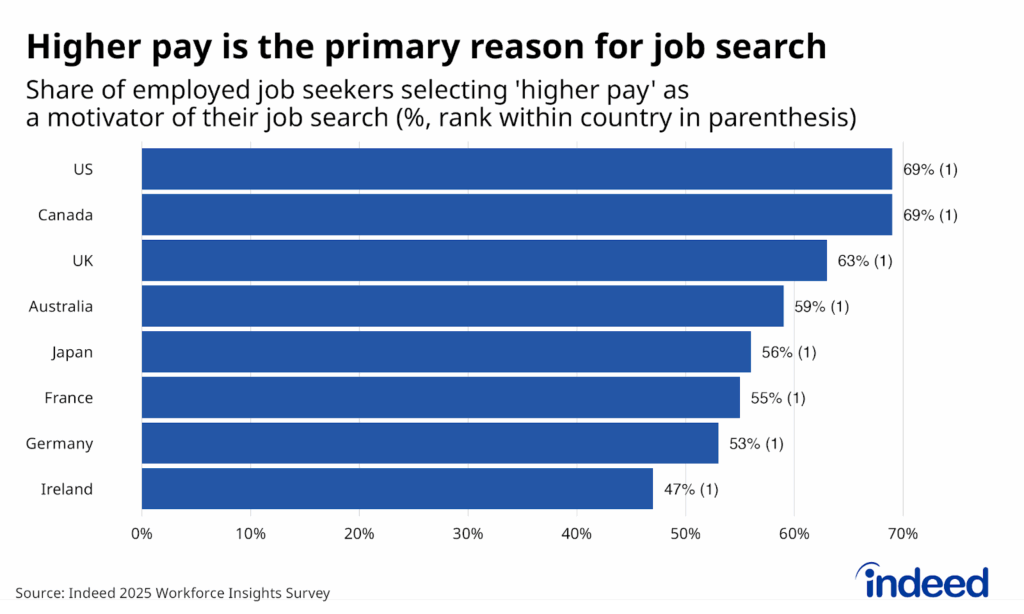
It’s not surprising: rising costs of living remain a challenge, and workers continue to prioritise financial security over other benefits. Yet focusing solely on pay would obscure what is becoming an increasingly complex matrix of worker needs.
Several non-pay factors were chosen by roughly a quarter to a third of UK jobseekers, suggesting that what people want from work is multidimensional. Respondents were also looking for:
- Better benefits (39%)
- Better growth opportunities (33%)
- A role aligned with interests or values (32%)
- A more stimulating role (32%)
- Better company culture (29%)
- More flexibility to work from home (27%)
- Better work-life balance (26%)
These motivations reflect a workforce that is not merely chasing a paycheck, but seeking jobs that support stability, health, personal growth, and a sense of belonging.
How motivations shift across countries: Benefits are key
Across all eight countries surveyed, workers share several core priorities: a better work-life balance, increased flexibility, healthier work cultures and greater control over how they use their time. However, underneath these similarities lie notable differences in how workers rank what matters most, revealing how cultural norms and labour-market structures shape the search for new work.
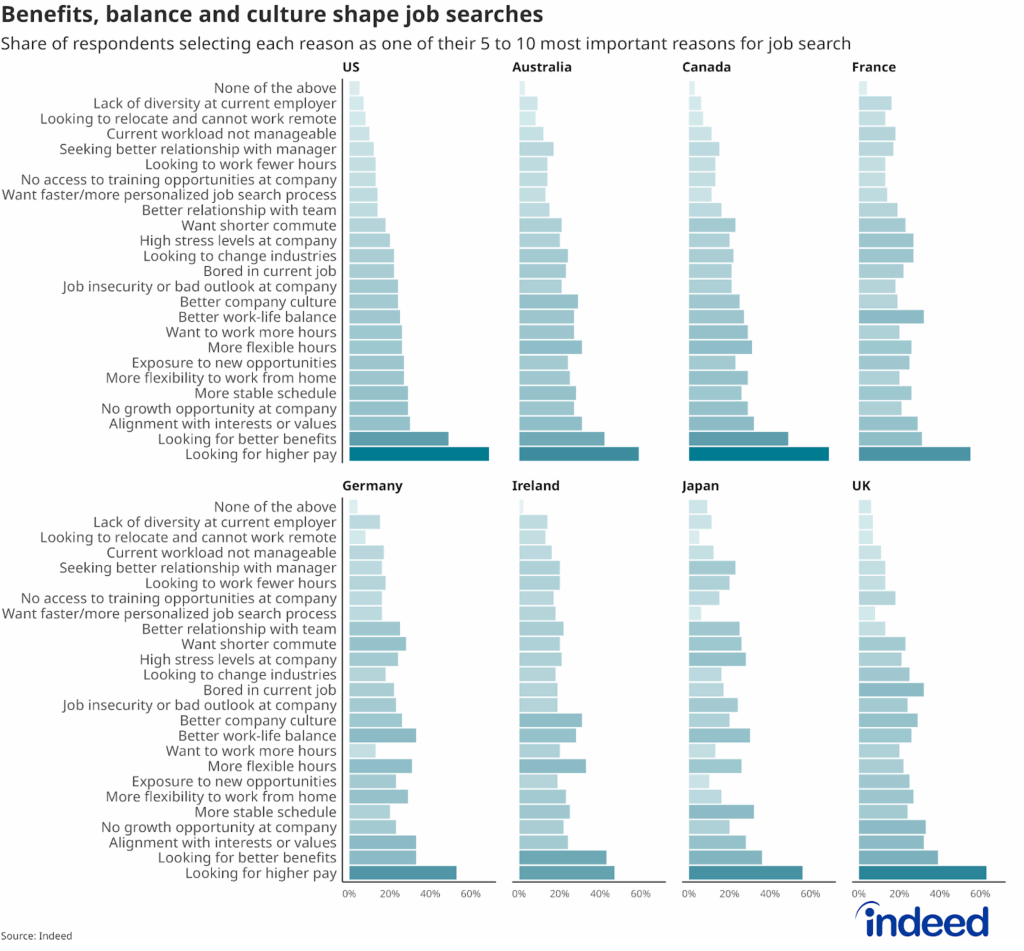
Better benefits consistently appear as the second-highest motivator (with the exception of France, where they rank third). However, while the ranking is similar, the meaning of “benefits” varies among workers by country.
In the US, benefits often carry outsized weight because employer-sponsored health insurance is foundational to financial stability. In Canada, the UK, Ireland, and Australia, where public healthcare systems cover most essential medical needs, workers are more likely to associate better benefits with retirement plans, paid leave, supplemental health coverage, family support or overall job security. In Japan, benefits often signal stability and long-term employment, including bonuses, transportation allowances, and company-based social protections.
Across these markets, the through-line is not one specific perk but the broader idea of a stronger, more reliable safety net — a package that reduces financial risk and makes a job feel secure and stable.
How motivations shift across countries: Balance, culture and commute
France and Germany, however, tell a different story. In both countries, the second-most selected reason for searching is a better work-life balance or avoiding excessive overtime (joint-second for Germany, along with better benefits). In Japan, it was the fourth-highest ranked reason.
Seeking a better company culture was also particularly important in Ireland, Australia, and the UK, where it was the fourth, fifth, and sixth-most selected reason, respectively.
Commute time offers another point of divergence. While “wanting a shorter commute” ranks tenth or lower in most countries, it rises to the seventh-most selected motivator in both Germany and Japan. Dense transit networks, rising transportation costs and a strong preference for efficient daily routines may all play a role.
A desire for roles that more closely align with personal values or interests was a common theme across countries, ranking seventh or higher in every country and making the top three in the US, Canada, Australia, and Germany. This emphasis on meaning underlines the importance of work as a source of identity, autonomy and purpose — not just income.
Beyond pay: Understanding the new mix of priorities
For workers everywhere, compensation remains the clearest motivator. However, the broader mix of needs — whether benefits, balance, purpose or predictability — shows that jobseekers are evaluating the whole package. Employers that adapt to these priorities will be best equipped to attract and retain talent in a market where expectations continue to evolve.
Methodology
This analysis utilises data from the 2025 Indeed Workforce Insights Survey, an online survey conducted for Indeed Hiring Lab by YouGov, of more than 80,000 adults from the US, the UK, Germany, France, Japan, Ireland, Australia, and Canada. Sampling was random and representative by age, gender, education, and region in all markets, and by race, aligned to the U.S. Census Bureau, American Community Survey, 2022. Fieldwork was conducted during the months of May and June 2025, with a total of n = 80,936 interviews globally, and a minimum of n = 10,000 interviews per market. This sample size provides a margin of error of ±1% at the 95% confidence level within each market.
Special thanks to Ashley Rappa for her assistance in the writing of this piece.