
Key points:
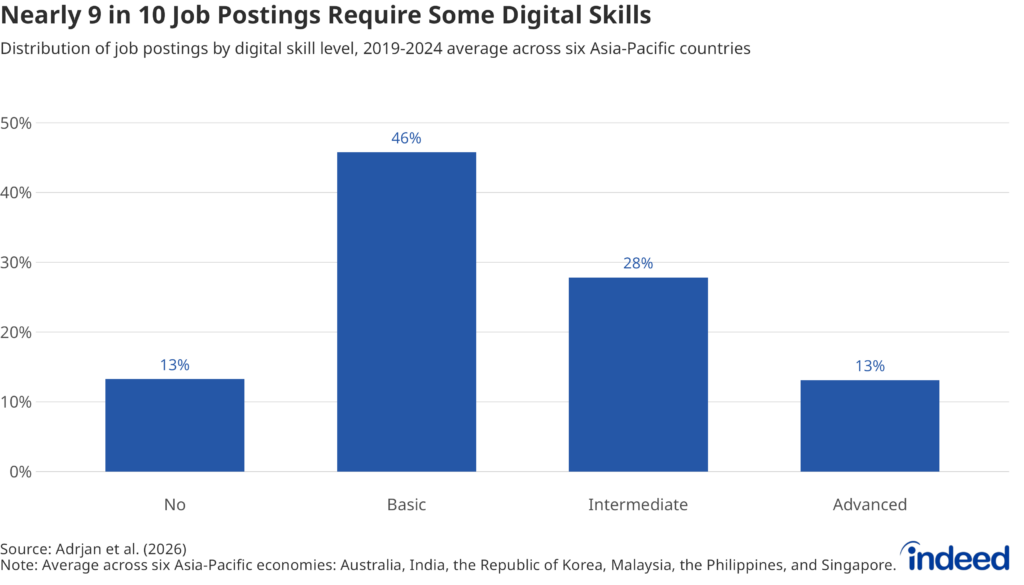
- Nearly 9 in 10 job postings across six Asia-Pacific economies demand at least some level of digital skills, with 46% requiring basic skills, 28% requiring intermediate proficiency, and 13% requiring advanced skills.
- Between 2019 and 2024, digital upskilling has been concentrated in low- and mid-digital occupations — jobs that previously required limited digital skills now increasingly ask for basic or intermediate proficiency.
- While tech occupations like software development and data analytics have the highest share of digitally intensive postings, the occupations changing fastest are not in tech. Traditionally lower-digital occupations like sports, education, and construction have seen the biggest increases in digital skill requirements.
- Digital skills carry a steep wage premium compared to jobs requiring no digital skills — about 3.6% for basic, 11% for intermediate, and 26% for advanced skills — and AI skills add another 3.6-6% on top.
Digital tools have become part of daily life across Asia and the Pacific, and labour markets are following the trend. Employers increasingly expect workers to be comfortable with technology — whether they are teachers, shop assistants, or software engineers. Yet until recently, policymakers had limited evidence on how deeply digital technologies had penetrated labour markets across the region, and which skills employers actually reward most.
To fill this gap, together with the Asian Development Bank, we analysed more than 6 million job postings on Indeed across six countries — Australia, India, the Republic of Korea, Malaysia, the Philippines, and Singapore — spanning 2019 to 2024. We classified each posting’s required level of digital skills (none, basic, intermediate, or advanced) and AI skills (none, AI use, or AI development).
The results paint a clear picture: digital skills are no longer the preserve of the tech sector; they are spreading across the occupational spectrum, reshaping what employers expect from workers in virtually every field.
Almost all jobs now require digital skills
On average across the six countries, 46% of job postings require basic digital literacy, such as using email, preparing simple presentations, or entering data in spreadsheets. 28% require intermediate skills, ranging from managing online content to performing basic coding, and 13% require advanced digital skills, including programming, cloud computing, or working with AI and big data. Only about 13% of postings require no digital skills at all.
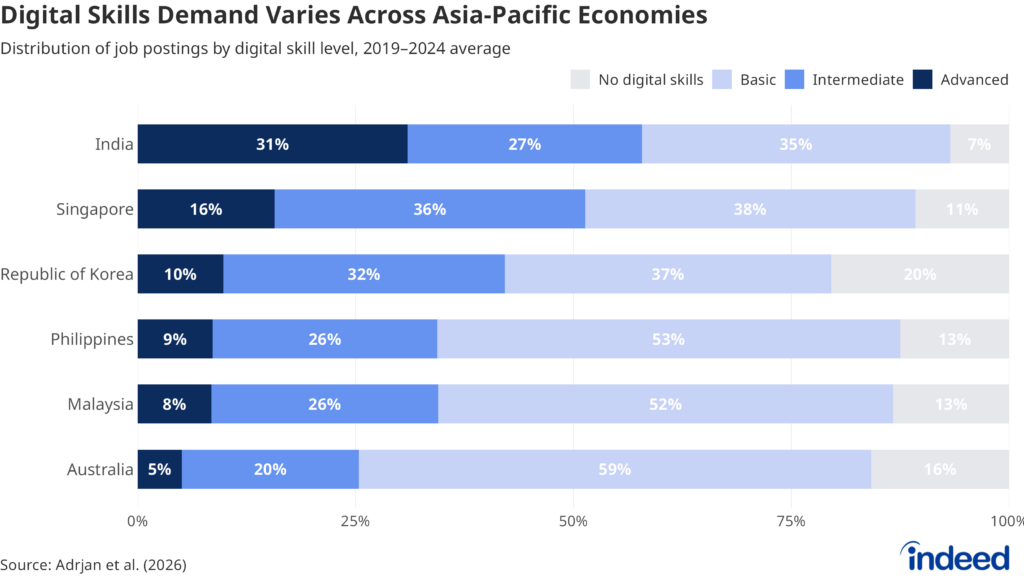
These shares vary across countries to some extent. India and Singapore tend to have higher concentrations of digitally intensive postings — over half of postings in each require intermediate or advanced digital skills, reflecting their larger tech and services sectors. Australia and the Philippines, by contrast, have a greater share of postings in hands-on occupations with lower digital requirements: roughly three-quarters of Australian postings and two-thirds of Philippine postings require only basic or no digital skills. Importantly, however, the share of postings requiring basic and intermediate digital skills is relatively high across all countries.
Jobs that used to require few digital skills are catching up
Between 2019 and 2024, the largest shifts in digital skill requirements occurred not among highly digital occupations, but among jobs at the lower and middle end of the digital spectrum.
To make these comparisons, we summarise each occupation’s digital requirements with a digital skill “score” ranging from 0 (no digital skills required in a particular occupation) to 1 (all postings in a particular occupation require advanced digital skills). We classify job titles into three groups based on their average digital skill score in 2019: low-digital (score ≤ 0.33), mid-digital (0.33–0.67), and high-digital (≥ 0.67).
To give a sense of what these groups look like, in 2019, about 45% of postings in low-digital job titles — such as tutors, nurses and delivery drivers — required no digital skills at all, with most of the rest requiring only basic proficiency. In mid-digital job titles — such as customer service representatives, administrative assistants, marketers, and project managers — the vast majority already required basic or intermediate skills. In high-digital titles — such as software engineers, business analysts, and graphic designers — nearly all postings required intermediate or advanced skills.
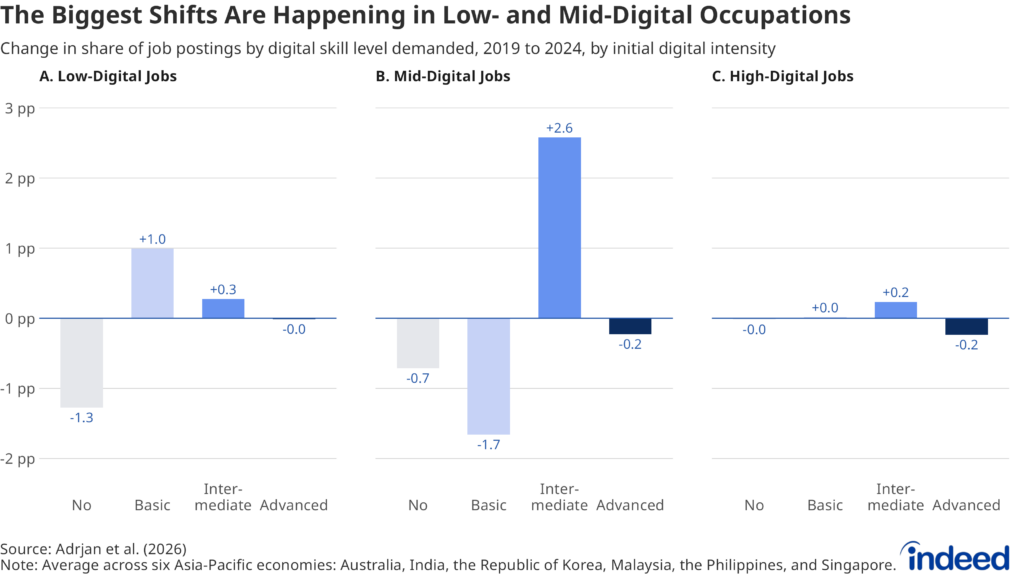
Among traditionally low-digital occupations, the share of postings requiring no digital skills fell by 1.3 percentage points, while the share requiring basic skills rose by 1.0 pp and intermediate skills by 0.3 pp. A similar pattern holds for mid-digital occupations, where basic skills demand dropped by 1.7 pp in favour of a 2.6 pp increase in intermediate skills.
By contrast, high-digital occupations such as software engineers and graphic designers — those already requiring advanced skills — saw relatively little change. This makes sense: these roles were already highly digitalised, leaving less room for further digital penetration.
In short, the digital transformation of jobs in Asia-Pacific is raising the digital floor, asking workers across a wide range of occupations to do more with technology than they did five years ago.
A closer look at occupations reveals who is catching up
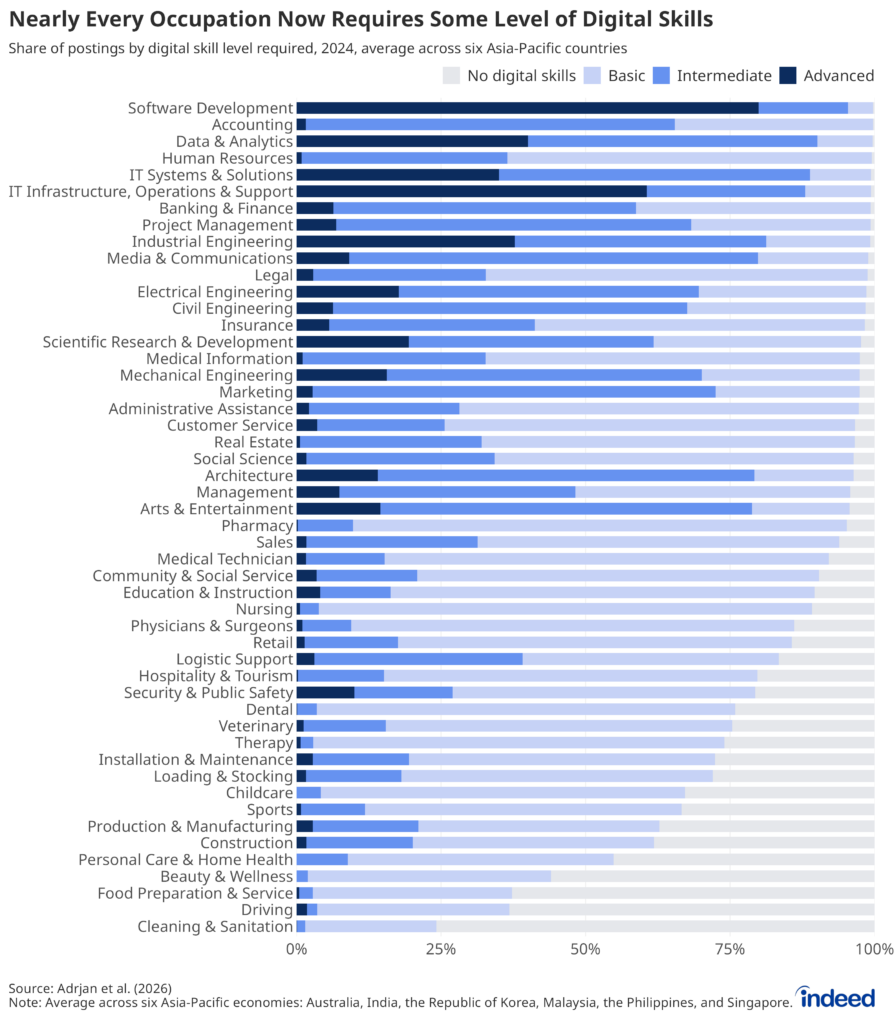
How digitally intensive is each occupation today? The chart below breaks down the share of job postings by digital skill level required across roughly 50 occupational categories, averaged across the six Asia-Pacific countries in 2024.
At the top, software development, data & analytics, and IT systems & solutions are near-completely digital, with the vast majority of postings requiring intermediate or advanced skills. But the more striking finding is how far down the chart digital requirements reach. Even among occupations in the bottom third — hospitality & tourism, security & public safety, logistic support, retail — a substantial share of postings require at least basic digital skills such as email, office software, or point-of-sale systems. Construction, production & manufacturing, and installation & maintenance may rank low on overall digital intensity, but more than a quarter of their postings still demand some digital proficiency. It is only in a handful of occupations at the very bottom — cleaning & sanitation, driving, food preparation — that a clear majority of postings truly require no digital skills at all. In other words, digital literacy has become a baseline expectation across nearly the entire occupational spectrum, not just in white-collar or tech-adjacent roles.
To understand where change is happening, we decomposed each occupation’s change in the digital skill score between 2019 and 2024 into two components. Adoption measures the growth in the share of postings that moved from requiring no digital skills to requiring at least some — a sports coaching role that now expects fitness tracking apps and video analysis tools, an education position that now requires virtual classroom platforms, or a retail role that now asks for point-of-sale or inventory management systems. Upgrading captures the shift toward higher skill levels among postings that already required some digital proficiency — a marketing role moving from social media management to data analytics and campaign optimisation, an insurance job shifting from basic spreadsheets to digital underwriting tools, or a pharmacy role moving from basic record-keeping to automated dispensing systems.
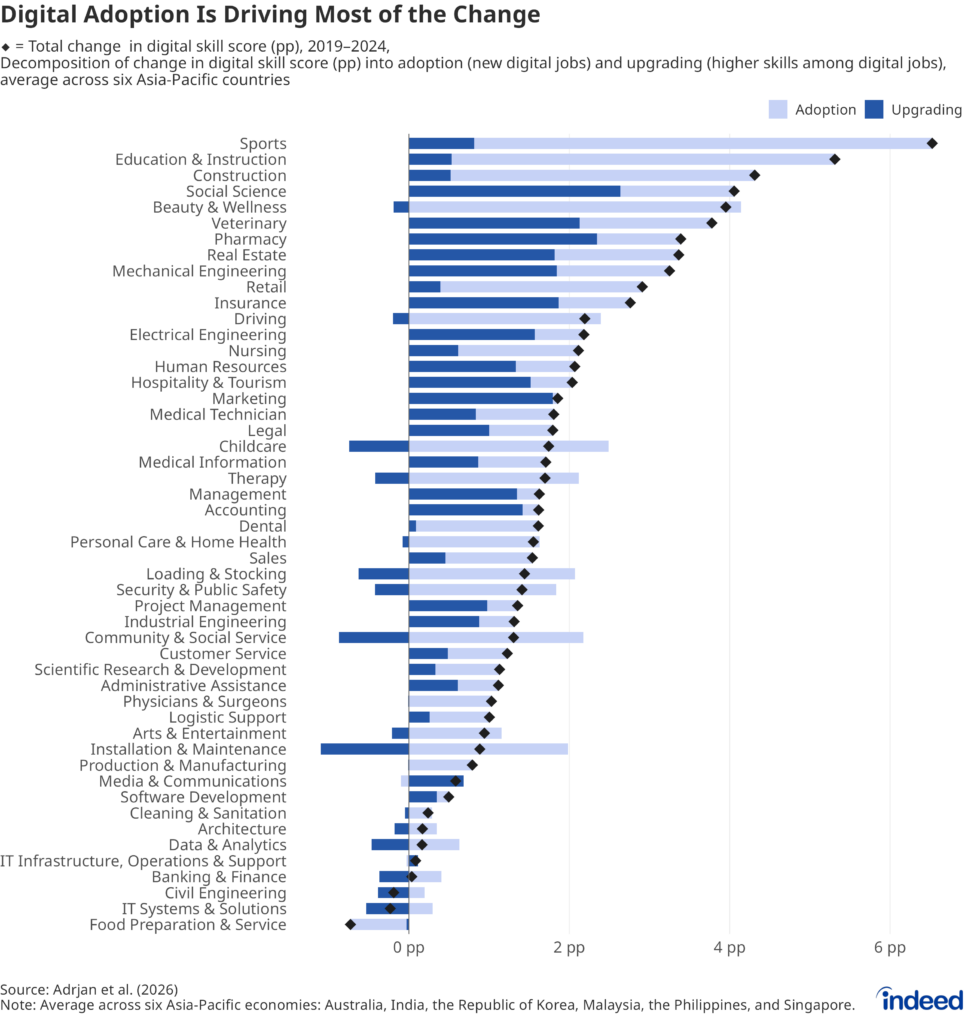
The largest gains appear in occupations that were traditionally low-digital. Sports, education & instruction, and construction each gained 4–7 percentage points, driven by a mix of adoption — more postings requiring digital skills for the first time — and upgrading, as roles that already demanded basic proficiency shifted toward intermediate tools such as data analytics, project management software, and digital content platforms.
Among mid-digital occupations, retail and insurance stand out. Retail roles increasingly require inventory management systems, e-commerce skills, and CRM software, while insurance postings now routinely ask for data analytics and digital underwriting tools — well beyond the basic spreadsheet use that once sufficed.
At the other end, already highly digital occupations such as software development and data & analytics show minimal change, as do physical, hands-on roles like food preparation and cleaning & sanitation — the former already saturated with advanced requirements, the latter yet to be reshaped by digital tools.
Across nearly all occupations, a clear pattern emerges: adoption is widespread and accounts for the larger share of the total change. The digital transformation is not just about raising the bar for workers who already use digital tools; it is about bringing digital skills to jobs that previously required none.
Digital skills pay — and AI skills command an extra premium
Does all this digitalisation translate into higher pay? The answer is a clear yes. Using posted wage data from Indeed, we estimated the wage premium associated with each level of digital skills, controlling for country, job title, pay frequency, province, firm, a rich set of non-digital task requirements, and time. In other words, we compare postings within the same job title and firm that do and do not require digital skills, and calculate the difference in average salary.
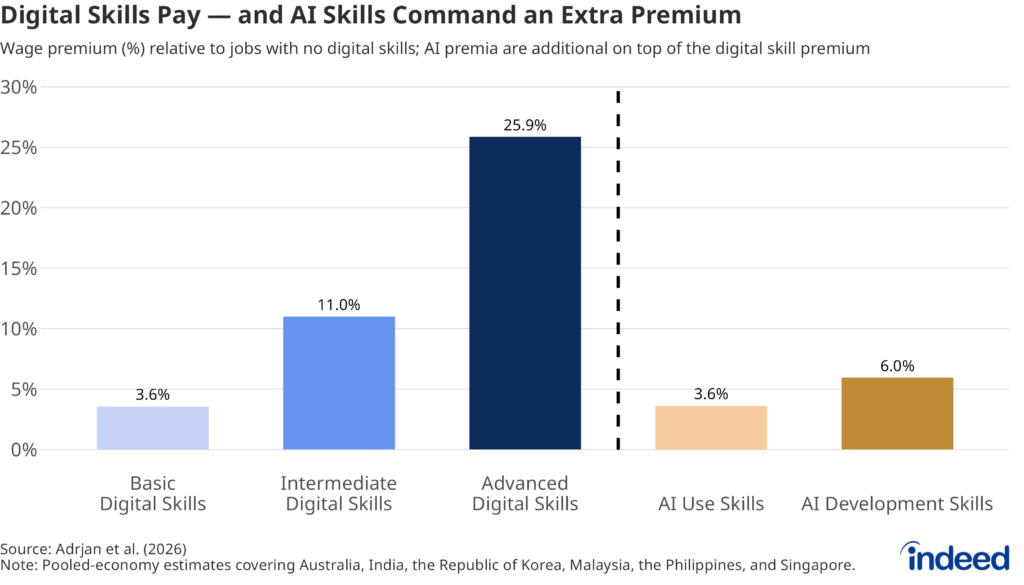
The gradient is steep: relative to jobs requiring no digital skills, basic digital skill jobs pay 3.6% more, intermediate skill jobs pay 11.0% more, and advanced skill jobs pay about 26% more. Each step up the digital ladder carries a meaningful and increasing wage premium, all within the same job title and the same firm. This is not about switching to a higher-paying occupation; it is about the value employers place on digital proficiency in the role you already have.
AI skills carry an additional premium on top of the digital skill premium. Jobs that require workers to use AI tools — such as integrating large language models or applying AI for data analysis — pay about 3.6% more than otherwise identical postings, even after accounting for the digital skill level. Jobs that require AI development skills — building or fine-tuning AI systems from scratch — appear to pay an additional 6% on top.
And that premium matters, because AI demand is spreading to new jobs. For example, in Australia, 5.8% of job postings mentioned AI by the end of 2025, double the rate from a year earlier. Likewise, since the launch of ChatGPT in late 2022, the share of intermediate-digital-skill postings requiring AI use has more than doubled, reaching nearly 2% by the end of 2024. Among advanced-digital-skill postings, the share has climbed to almost 11%. This is no longer a niche confined to tech companies. Employers across consulting, engineering, marketing, and healthcare are increasingly looking for people who can work alongside AI, not just build it.
What this means
The data point to a labour market where digital skills are becoming table stakes across Asia-Pacific. For workers, especially in mid-digital-skill occupations, the demand for digital requirements is likely to continue. Investment in learning practical digital tools, even basic ones, can offer meaningful wage returns. For employers, the steep wage gradient suggests that workers who bring digital proficiency are in high demand and short supply. Offering training and upskilling opportunities is not just good practice but a competitive advantage in hiring.
These findings can help policymakers across the region make more informed investments in skills development. Building digital foundations early in education is essential. Examples from the region — such as Japan’s GIGA School Program, which made programming compulsory from elementary school, and Singapore’s SkillsFuture for Digital Workplace, which provides foundational digital training across sectors — illustrate different approaches that could help workers enter the labour market ready for the digital demands they will face. But supporting workers already on the job matters just as much. Expanding vocational and mid-career training programs in the occupations where digital demand is rising fastest can help workers in fields like retail, insurance, and healthcare keep pace with changing employer expectations.
Countries that invest early and consistently in digital capabilities will be better prepared for the jobs emerging today and in the future.
Methodology
This analysis draws on a sample of approximately 6 million job postings from Indeed, covering Australia, India, the Republic of Korea, Malaysia, the Philippines, and Singapore from January 2019 through December 2024.
Digital skill requirements were classified into four categories (no digital skills, basic, intermediate, advanced) using OpenAI’s GPT-4.1 mini, applied to each job’s description text. AI skill requirements were similarly classified into three categories (no AI, AI use, AI development). To control for compositional changes in the types of jobs posted over time, the analysis focuses on within-job-title variation in digital skill requirements. Country-level aggregates are constructed using time-invariant employment weights at the job-title level.
Wage premia are estimated from regressions on posted wages, controlling for country, job title, pay frequency, province, firm, a rich set of non-digital requirements, and time fixed effects.
To examine how digital skill requirements have evolved across occupations with different starting points, we classify job titles into three groups based on their average digital skill score in 2019: low-digital (score ≤ 0.33), mid-digital (0.33–0.67), and high-digital (≥ 0.67). Changes in the score over time are decomposed into adoption — the contribution from jobs moving from “no digital skills” to requiring at least some — and upgrading — the shift toward higher skill levels among jobs that already required some digital proficiency.
Further details are available in: Adrjan, Aoki, Ciminelli, Döttling, and Garcia-Mandicó (2026), “Skills that Pay: Digital Skills Demand and Wage Premia in Asia and the Pacific”