
Key points:
- Around 6.2% of Australian job postings on Indeed mention artificial intelligence in their job descriptions, while 8.5% of employers have at least one AI-related job posting.
- Government adoption of artificial intelligence lags overall adoption. Just 2.7% of government job postings mention artificial intelligence, rising to 4.0% when education and health are excluded.
- Around 30% of Australian job postings are in occupations with a high exposure to artificial intelligence. This share has remained stable since mid-2023, suggesting that AI hasn’t meaningfully affected job creation over that time.
A growing share of Australian businesses and organisations now use artificial intelligence (AI) technologies, but adoption remains uneven and concentrated among a relatively small number of employers. Adoption also appears slower across key government departments.
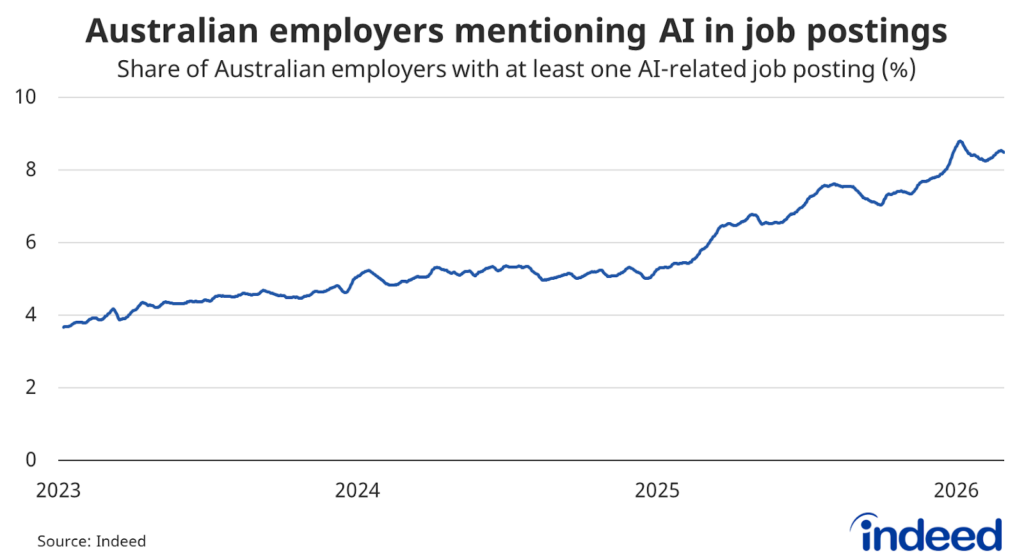
In early 2026, 8.5% of Australian employers on Indeed had at least one job posting mentioning AI, up from just 5.8% a year earlier. However, two-thirds of AI-related postings came from just 1% of employers. Nevertheless, these mentions are spread across a mixture of large, medium and small enterprises.
Using Indeed metrics, we examine how often AI appears in Australian job postings, providing a granular and timely measure of employers’ strategic investments and hiring priorities. A mention of AI in a job posting can refer to AI-related skills, including those required to develop or use AI tools. But it may also reflect a broader range of contexts, including employers using AI in recruitment or even employers spruiking their AI usage and investment.
AI adoption in Australia continues to rise
In February, 6.2% of Australian job postings on Indeed mentioned AI in their job descriptions, up from 3.3% a year earlier. After remaining relatively stable throughout 2023 and 2024, references to AI surged in 2025 as Australian employers came to grips with the capabilities and limitations of the available AI tools. Strong growth has continued in early 2026.
Adoption varies considerably by occupation, with occupations more highly exposed to AI transformation typically adopting these tools more quickly. In February, 43% of postings in both software development and data & analytics mentioned AI in their job descriptions. These occupations sit at the forefront of AI-related transformation, helping develop, train and implement AI tools.
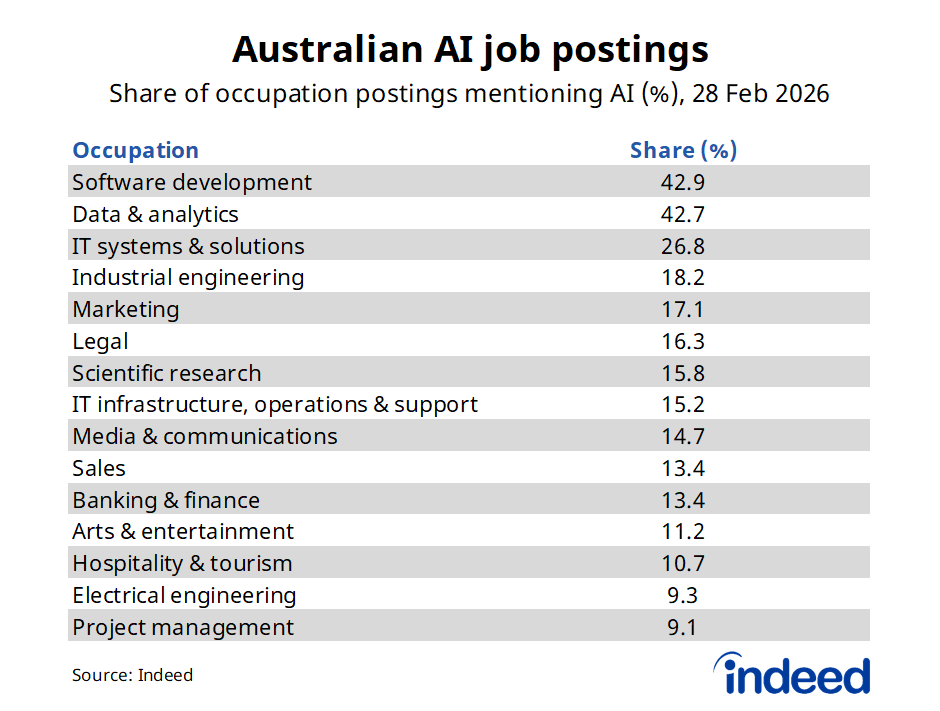
Other major adopters include IT systems & solutions (27%), industrial engineering (18%), marketing (17%) and legal (16%). In these occupations, AI references typically relate to using existing AI tools within daily workflow rather than developing them.
AI adoption has also become more broad-based over the past year. In February, almost half of occupations had an AI share exceeding 5%, compared to close to a third a year ago. Nevertheless, these AI trends are still primarily driven by a relatively small group of employers.
Most firms aren’t advertising for AI-related skills
In February, 8.5% of employers had at least one AI-related job posting, up from 5.8% a year ago and 4.9% two years ago. Yet, despite this, the concentration of AI postings has changed little. Almost two-thirds of AI-related postings came from the top 1% of firms by AI posting volume, a share largely unchanged over the past two years.
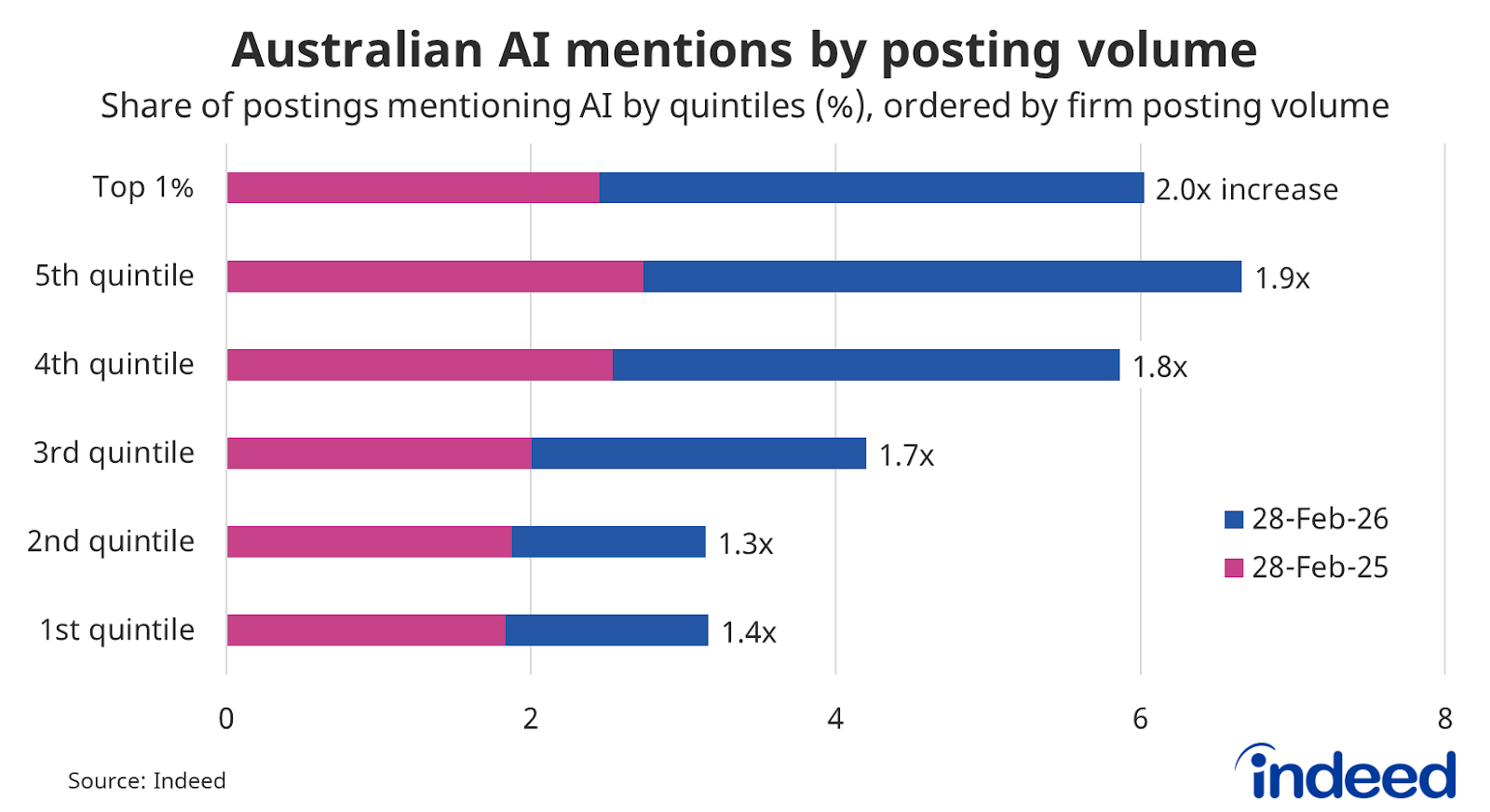
Interestingly, AI-related job postings aren’t necessarily concentrated among large employers. We find that employers in the top 1% by total posting volume are no more likely to mention AI in their job descriptions than employers in the top quintile (top 20%).
In February, 6.0% of job postings among the top 1% of employers mentioned AI, compared with 6.7% among the top 20% of employers. Among the two bottom quintiles – typically smaller employers with only a few job vacancies – the AI posting share was 3.1-3.2%.
An adoption gap has emerged over the past year, which we expect to widen further in the near term. The AI posting share for the top 1% of employers is 2 times higher than a year ago, compared with a ratio of 1.3-1.4 among employers in the bottom two quintiles.
Large businesses are adopting AI faster
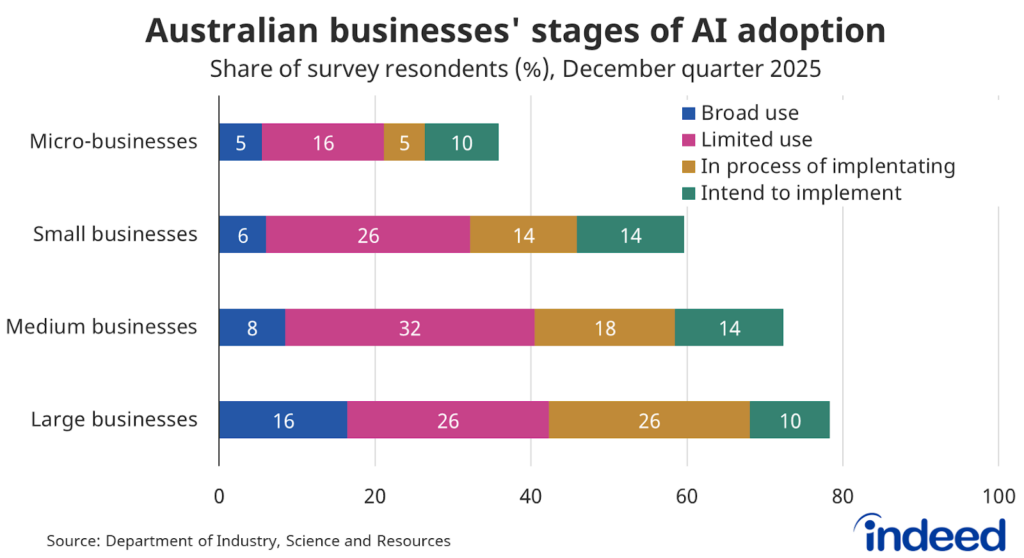
The federal government’s AI Adoption Tracker also shows faster adoption among larger employers.
In the December quarter, 78% of large businesses (200 to 500 employees) had some degree of AI adoption. Some 16% of companies reported broad use, 26% had limited use, 26% said they were in the process of implementation and 10% said they intended to implement some variety of AI tools in the future.
Adoption was lower among smaller firms: 72% of medium-sized businesses (20-199 employees), 60% of small businesses (5-19 employees) and 36% of micro businesses (0-4 employees) reported some level of adoption.
Large businesses stand out in two ways. Firstly, they are more likely to report broad AI usage – double the rate of medium-sized firms and more than triple that of micro businesses. Secondly, they have higher rates of AI usage being currently implemented – almost double small businesses and more than five times higher than micro firms.
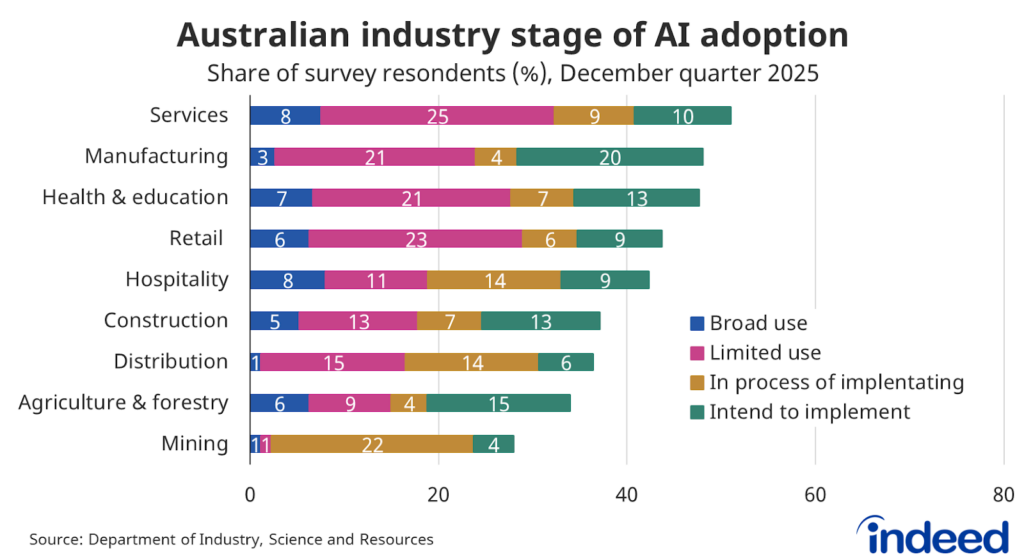
Adoption rates also vary considerably across industries, though broad usage remains generally uncommon, ranging from 8% of respondents in services and hospitality to just 1% in mining and distribution. Limited usage is more common, with around one quarter of respondents in services reporting limited AI use, ahead of retail (23%), manufacturing (21%) and health & education (21%).
Undoubtedly, mining is the slowest adopter at the industry level; however, there are plans to change that. Around 22% of mining respondents reported implementing AI tools, but whether that leads to broad or limited use remains to be seen.
The potential economic impact of AI depends critically on how widely the technology spreads. For now, usage in Australia appears too narrow to meaningfully affect nationwide labour productivity measures, but there are certainly signs that larger businesses are moving toward broader adoption and implementation.
Government adoption still lags behind
Our data also suggests that government adoption of AI lags the broader economy. This holds true for a broad measure of government jobs covering both federal and state governments, as well as a narrow measure that excludes healthcare and education. This narrow measure focuses more on core government departments and agencies.
In February, 2.7% of government job postings mentioned AI in their job descriptions, compared with 6.2% across Australia overall. Education and healthcare – two sectors where AI usage is limited – weigh heavily on the government average. Excluding these sectors raises the government AI posting share to 4.0%.
Australia’s AI posting share exceeded the narrow government rate in June last year and surpassed the broader government rate in November 2024. This suggests government adoption is lagging 9 to 16 months behind overall adoption, though that gap may widen since overall adoption is growing at a faster pace.
In December, the federal government released its National AI Plan, aimed at accelerating the development and adoption of AI technologies. Training initiatives and increased investment in AI data centres are central to the plan. However, a lack of clear AI safety guardrails raised some eyebrows, particularly given earlier expectations that strong guardrails would form a central pillar of the federal government’s approach.
Regulatory certainty and appropriate safety guardrails will play a critical role in shaping the trajectory of AI adoption in Australia. The National AI Plan represents a step forward, though Australia’s position as a relatively small player in the global AI ecosystem suggests that international regulatory developments may ultimately play a larger role in determining adoption.
Has AI led to reduced hiring?
While Australia’s AI share has grown strongly, overall hiring trends show little sign of disruption.
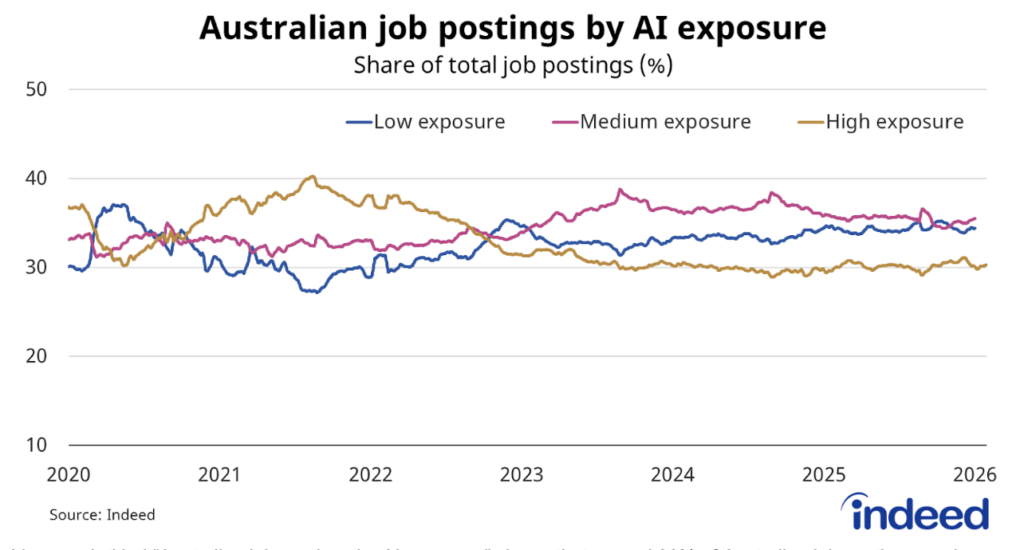
Since mid-2023, around 30% of Australian job postings have been in occupations with high exposure to AI tools – as defined by Indeed’s 2025 AI at Work report. High-exposure occupations include a range of tech roles, as well as occupations including accounting, marketing, administrative assistance and banking & finance.
Although high-exposure occupations briefly accounted for 40% of job postings in September 2021, that figure was artificially inflated by pandemic-related lockdowns across several Australian states, temporarily affecting hiring in low-AI-exposure occupations (retail, hospitality, trades, etc.) that were more impacted by pandemic restrictions. By mid-2023, the high-exposure share had settled at around 30% and has remained there ever since.
This stability suggests that recent job posting trends in Australia reflect the broader economic cycle rather than widespread AI-related displacements.
Job postings in software development and data & analytics, the two occupation categories with the highest exposure to AI, are actually higher than a year ago. While that may appear at odds with high-profile tech layoffs, such as those for Atlassian and Block, it perhaps reflects growing demand for tech-related skills outside the tech sector as businesses across many industries pursue AI transformation.
Conclusion
Australia’s adoption of artificial intelligence continues to accelerate, with a growing share of employers referencing AI in job postings. However, adoption remains uneven, government adoption continues to lag and nationwide trends are still driven primarily by a handful of employers.
For now, the labour market impact of AI appears limited. The share of job postings in occupations with high exposure to AI has remained stable in recent years, suggesting that broader economic conditions, rather than AI adoption, are driving hiring trends.
As AI tools mature and become easier to integrate into everyday workflows, adoption will likely spread further across industries, government and firms of varying sizes. How quickly that takes place will depend on a combination of technological progress, regulatory clarity, investment in skills and the willingness of Australian businesses to take risks.
Methodology
AI-related job postings are identified using keywords from job descriptions, consistent with the Indeed AI Tracker. Government job postings were identified using a combination of state and federal government-related feeds on the Indeed platform, as well as identifying government-related company IDs. Local government or council jobs were not considered.
Employer size percentiles are calculated for each specific date based on total job posting volume. The composition of employers may change over time based on how many outstanding roles they are hiring for. For example, one month an employer might be in the top 10% for posting volume, but in another month where they are more active they might fall in the top 1%.