
Key points:
- Entry-level roles for apprentices and trainees declined 23% last year and are tracking lower again in early 2026.
- Australia’s vocational education system is smaller than it used to be, with course completions down 64% from their 2012-13 peak.
- Employers are increasingly targeting global talent to address skill shortages, with temporary skilled visas for key apprenticeship occupations five times higher than in 2021-22.
- Despite fewer job postings, jobseeker search activity hasn’t increased, suggesting employment remains relatively easy to find.
Widespread skill shortages have been a thorn in the side of many Australians over the past few years. Anyone trying to build or renovate a home has struggled to find electricians, plumbers and builders.
But it’s not just ‘tradies’ that are hard to find. Restaurants struggle to find qualified workers, hairdressers are understaffed and childcare providers cannot find enough educators. These constraints disrupt business operations and surely haven’t helped Australia’s ongoing productivity problem.
According to Jobs and Skills Australia, one-fifth of occupations have faced persistent shortages over the past four years. That jumps to 37% of occupations in the technicians & trade workers category, where apprenticeships are often an entry-point – higher than for any other occupational group.
On Indeed, we observe quite different trends. While postings for apprentices were around 80% above pre-pandemic levels in both 2022 and 2023, they have been on a downward trajectory since 2024. In 2025, job postings for apprentices and trainees (henceforth referred to as ‘apprentices’ or ‘apprentiseships’) fell 23%, returning to 2019 levels, and so far are tracking lower again in early 2026.
At first glance, reduced job postings and persistent skill shortages appear at odds. However, unable to attract domestic apprentices, some employers have instead focused on attracting experienced overseas talent. Australia’s apprenticeship system faces a talent pipeline problem: even with a range of incentives, including free TAFE in some states, it isn’t producing enough skilled workers to meet demand.
Employer demand for apprentices has declined
As Australia emerged from the pandemic, employer demand for apprentices soared. Job postings rose sharply as households and businesses caught up on nearly two years of delayed economic activity. At its peak in 2022, job postings mentioning apprenticeships in their job title were 82% above their 2019 baseline.
Conditions have since soured. Postings fell 27% in 2024 compared to a year earlier, and a further 23% last year. In early 2026, employer demand is tracking 21% lower again and is now well below pre-pandemic levels.
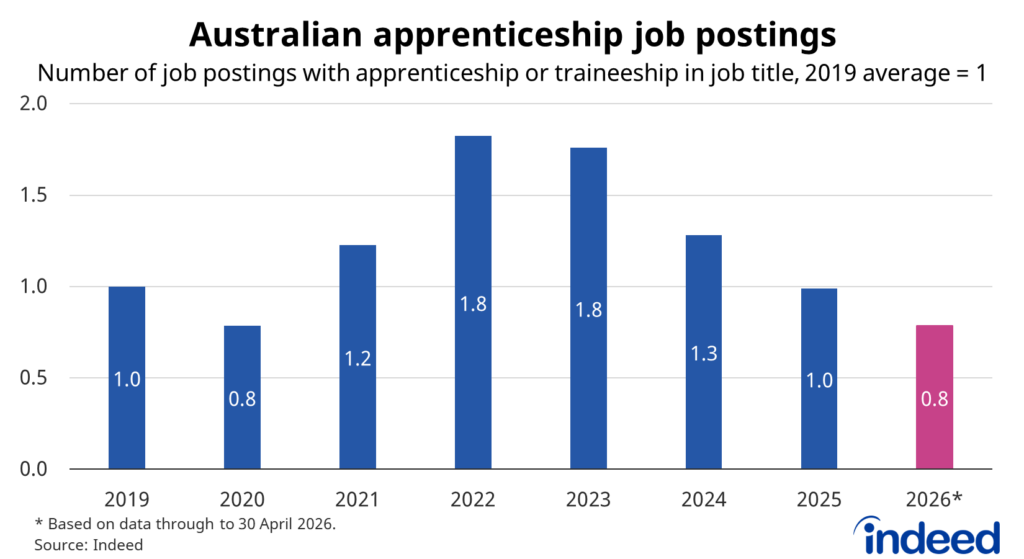
The decline in apprenticeship opportunities has outpaced the broader labour market slowdown. Apprenticeship postings accounted for 1.2% of all job postings in 2025, down from 1.4% in 2024 and 1.7% in 2023. A challenging economic environment and tighter hiring budgets have hit skilled entry-level roles especially hard, particularly in the private sector.
Employer demand easing across the country
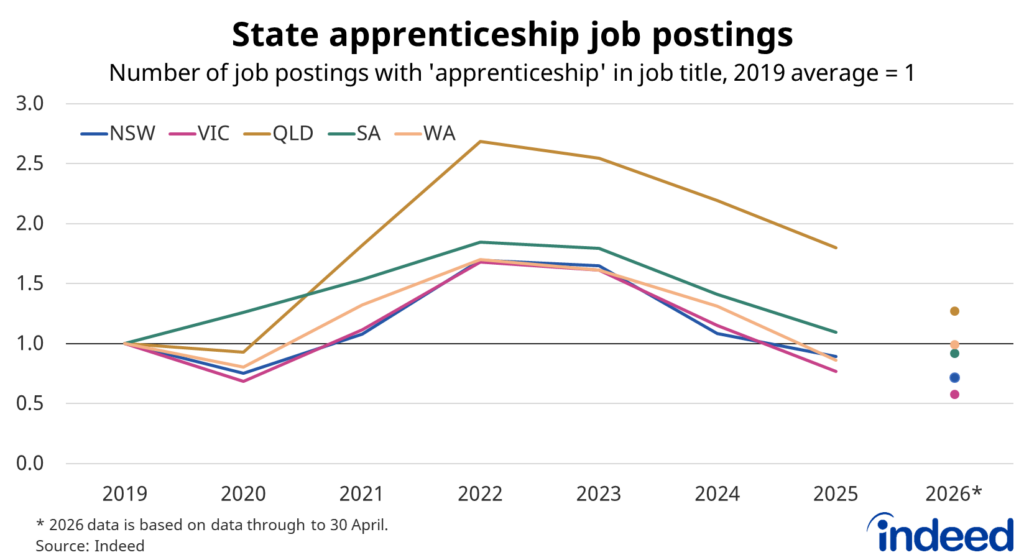
Australia’s apprenticeship market varies considerably by region, shaped by local industry composition, infrastructure pipelines, population growth, and – often critically – state government policy.
Queensland remains the standout. While apprenticeship postings have declined from their 2022 peak, they were still 80% above their 2019 baseline last year. Demand has eased further in early 2026, but is still healthy overall.
Brisbane’s 2032 Olympic Games will support a long-term construction and infrastructure pipeline, underpinning demand for apprentices over the next half-decade.
Demand elsewhere hasn’t fared as well. In Victoria, apprenticeship postings were 23% below pre-pandemic levels in 2025, down 54% from their peak, and are tracking even lower this year. New South Wales has performed only marginally better.
Financial incentives encourage employment
Employers can access a range of financial incentives to hire apprentices; however, support was reduced in some cases at the beginning of this year.
Employers in new energy or housing construction can receive the Key Apprenticeship Program Employer Incentive, which provides up to $2,000 after 6 months and $3,000 after 12 months for hiring full-time apprentices (halved for part-time).
Other employers can access the Priority Hiring Incentive, which offers $1,000 after 6 months and $1,500 after 12 months for hiring full-time apprentices (halved for part-time). This payment was halved beginning on 1 January 2026. Both incentives apply to jobs on the Australian Apprenticeship Priority List.
Obviously, reduced incentives can influence demand, shifting the financial arithmetic that determines whether an employer wants an experienced candidate or one who still requires considerable training. The fall in apprenticeship job postings in early 2026 may partly reflect these changes.
At the state level, incentives vary, but Queensland warrants a mention. Queensland continues to support apprentices on both the demand and supply sides. Fee-free TAFE and free apprenticeships for under-25s boost the talent pipeline, while the state’s ‘Back to Work’ program offers employers up to $15,000 incentive to hire young people.
Australia’s vocational education system isn’t big enough
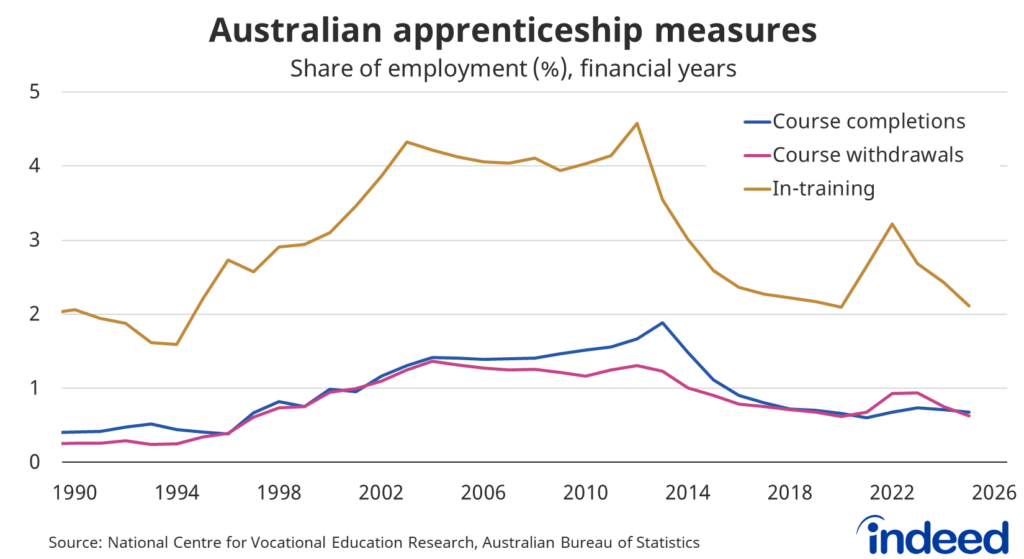
Regardless of financial incentives, the more pressing problem is the talent pipeline. Australia’s vocational education system is much smaller than it once was. The number of people in training, as a share of total Australian employment, has fallen by around 54% since its 2011-12 peak, while the course completion rate has tumbled almost 64% from its peak a year later. In four of the past five years, course withdrawals have exceeded completions – reversing historical norms.
The post-pandemic jump in apprenticeship training, which saw it climb to 3.2% of employment in 2021-22, is well and truly over. Outside the pandemic, this is the lowest level in over three decades.
It’s also taking longer for people to complete their apprenticeships. By 2020, the average completion time had reached 833 days – more than two years and around seven months longer than in 2011-12. Of apprentices who started between 2021 and 2024, just 23% have completed their training so far, though that figure will rise – completion rates typically settle between 50-60%.
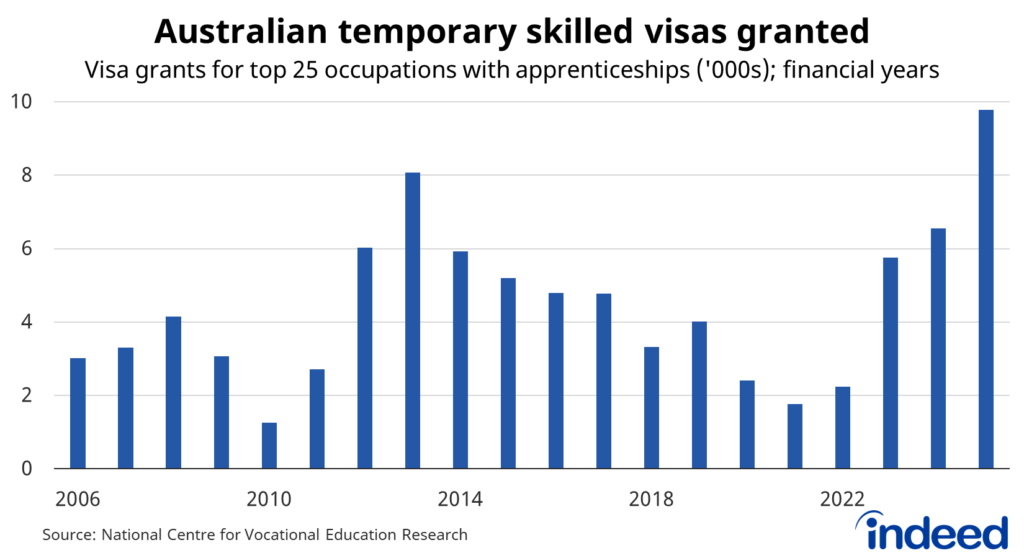
In response, many employers have turned their attention overseas. In 2024-25, around 9,800 temporary skilled visas were granted to workers in the top 25 apprenticeship occupations. That’s more than four times higher than in 2021-22 and around 2.5 times the number of visa grants in the two years before the pandemic began. Some employers might be ditching entry-level apprentices in favour of experienced workers who can contribute immediately.
That said, the inflow from overseas is still relatively small compared to the overall system. Around 100,000 apprenticeships were completed in 2025.
Apprenticeships remain gender-segregated
The talent pipeline also faces a diversity problem. Men and women pursue apprenticeships, but rarely in the same roles. Many occupations seeking apprentices are dominated by a single gender.
Apprenticeship opportunities are most common for electricians, accounting for 7.9% of all apprenticeship postings, followed by educators (6.1%), plumbers (5.9%), mechanics (5.5%) and chefs (4.2%).
‘Tradies’ remain overwhelmingly male. In 2025, 98% of electricians and 97% of plumbers, mechanics and carpenters were men. By comparison, education roles skew towards women, accounting for 93% of childcare workers and 95% of early childhood specialists.
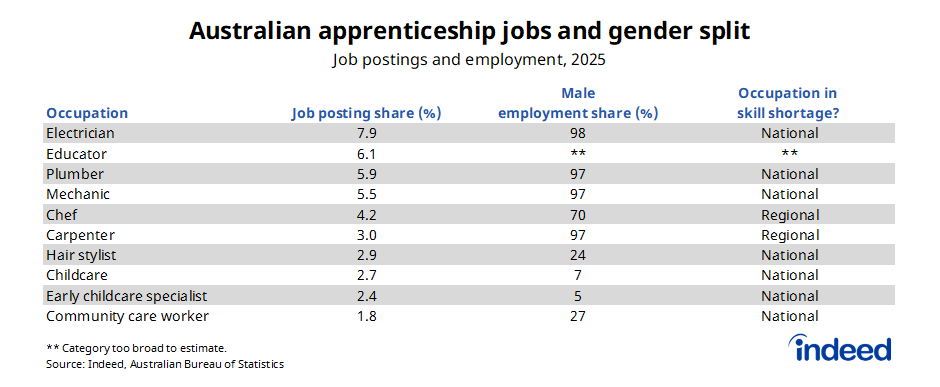
Creating more inclusive workplaces, ensuring safe working environments and overcoming corrosive gender stereotypes remains a key challenge across many of these sectors. While efforts to increase female ‘tradies’ have gained momentum, progress has been slow. It could take generations to see meaningful change to the number of women working as mechanics, electricians, plumbers or carpenters – or, for that matter, men in key early education roles.
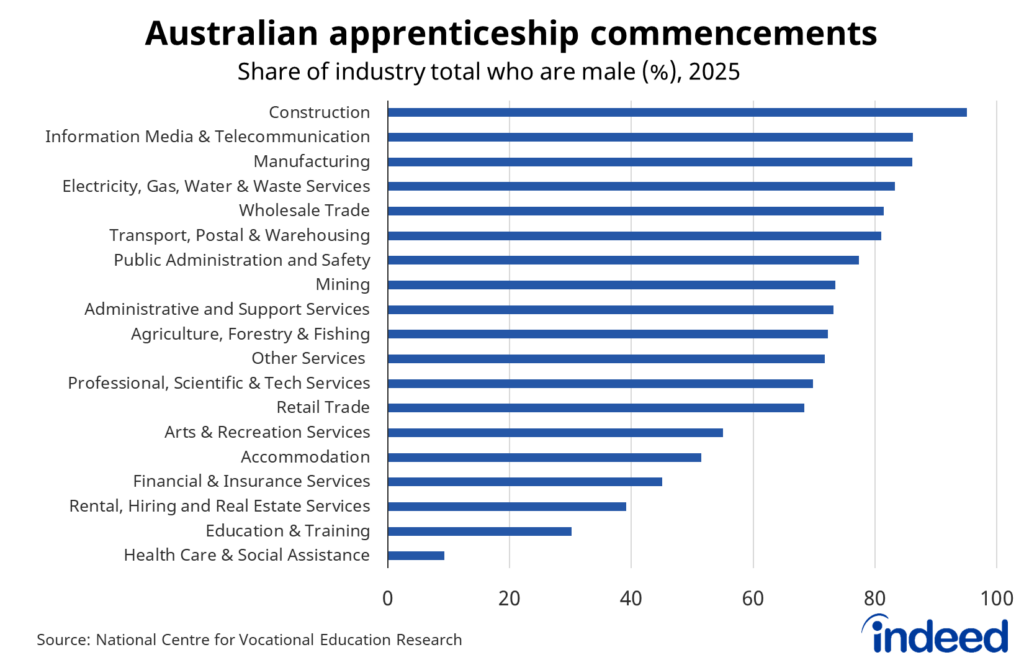
Around 95% of construction apprentices in-training were men last year, higher than for any other industry, followed by 86% in information media & communications and manufacturing, highlighting the challenge. Healthcare & social assistance and education & training skew heavily towards women, as expected.
Fewer jobs, but apprentices aren’t panicking
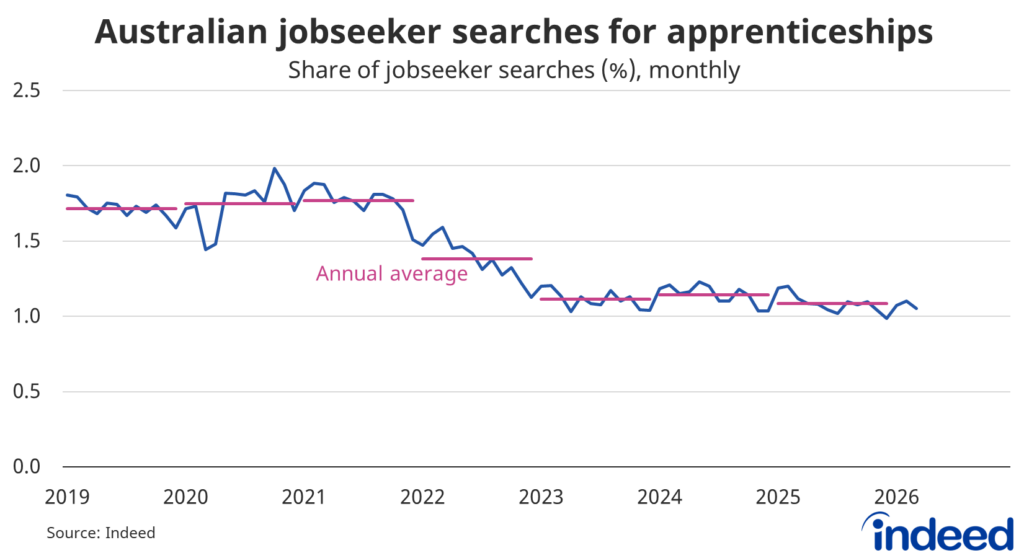
Consistent with trends among university graduates, jobseeker searches for apprentice roles remain low. This suggests limited friction in the apprentice market, despite fewer job opportunities. Aspiring apprentices continue to find work relatively quickly, requiring fewer searches than before the pandemic.
In 2025, around 1.1% of jobseeker searches on Indeed were for apprenticeship jobs, consistent with search trends from the previous two years. So far, those trends have held in early 2026.
If opportunities for apprenticeships were too low – insufficient to meet the supply of candidates – search activity would likely increase as jobseekers struggle to find work. They’d search more often, click on more jobs, and apply more frequently. Thankfully, that isn’t yet the case, although conditions could change as employers grapple with heightened economic uncertainty, including the ongoing conflict in the Middle East.
Conclusion
Australia’s apprenticeship system is in need of repair: employer demand has retreated, the training pipeline continues to leak, and the workforce remains stubbornly siloed by gender. Faced with skill shortages the domestic system cannot resolve, many employers have turned to global talent instead.
Australia needs more people entering training and, more importantly, finishing it. And that means making apprenticeships genuinely attractive for both employers and workers. Many of these roles offer strong wages, low exposure to artificial intelligence and have persistently high demand. Existing incentives may appear generous, but the data speaks for itself.
Critical skill shortages slow down infrastructure projects, weigh on productivity and make it more difficult for Australian businesses to realise their full potential. Strengthening Australia’s apprenticeship system should be a key economic priority for federal and state governments.
Thankfully, those in power recognise the need for reform. Last year, the federal government released their strategic review of Australia’s apprenticeship system, outlining 34 recommendations to fix the existing system. These recommendations cover the issues raised in this blog post – along with many others. Now they just need to be implemented.
Methodology
An Australian apprenticeship typically involves a combination of on-the-job and structured learning. The Australian government defines an Australian apprenticeship as a combination of apprenticeships in a skilled trade, such as plumbers or electricians, as well as traineeships in non-trade occupations, such as aged care and childcare. In this blog post, we have adopted the same broad definition.
Apprenticeship or traineeship job postings are defined as those that feature phrases such as ‘apprenticeship’ or ‘traineeship’, along with variations, in their job title. Similarly, jobseeker searches for apprenticeship or traineeship opportunities are those who use these phrases when searching for jobs on the Indeed website.
Data on occupation shortages comes from Jobs and Skills Australia, with occupations defined at the 6-digit level based on the ANZSCO 2022 classifications.