
Key Points:
- As of Q4 2025, about 1 in 6 active Indeed job seekers were already holding more than one position at the time of their search.
- Despite gig work playing an increasingly large role, workers with multiple jobs are heavily concentrated in traditional service-sector and hourly roles.
- Application behavior before and after taking on a second job shows a pattern of urgency more consistent with financial pressure than casual interest in extra income.
In a labor market defined by low hiring and low firing, where fewer workers are quitting, and fewer employers are adding headcount, a growing share of workers appear to have arrived at their own solution: If you can’t find a better job, find a second one. At the end of 2025, nearly 16% of active Indeed job seekers (those who started at least one application on Indeed in a given month) were already holding multiple jobs during their search for a new/additional one; a development that can tell us a lot about the health of the labor market
A workforce that is increasingly doubling up is not a workforce at rest. Rather, it’s a workforce under quiet, persistent pressure. This trend has proved durable enough across booms, busts, and everything in between to suggest that for a meaningful share of American workers, one job is not enough.
Service sectors account for a large portion of multiple jobholders
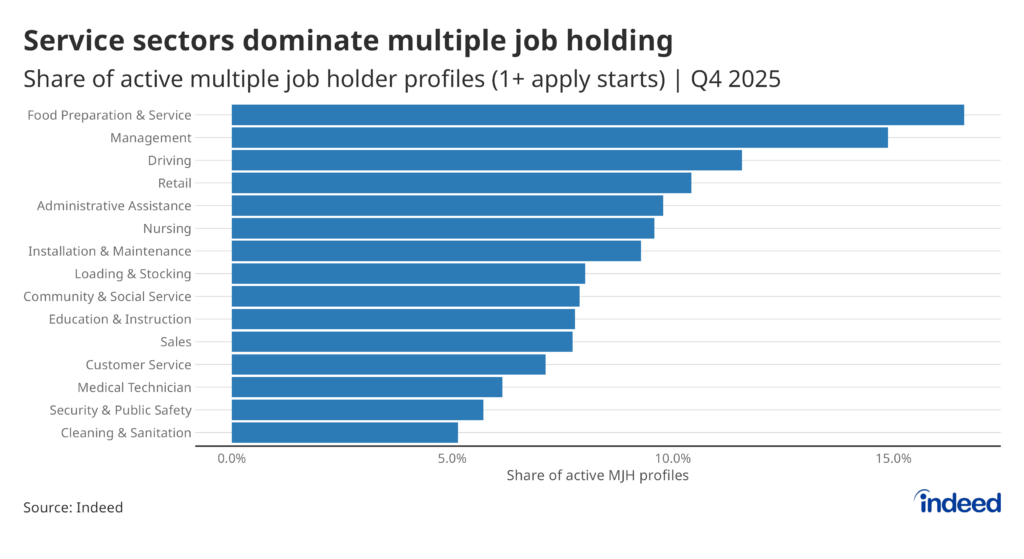
Service-sector jobs, which tend to involve variable hours, higher turnover, and shift-based scheduling, are most common for those holding down multiple jobs. Those jobs make it more practical to hold two or more roles simultaneously and to change jobs when needed. Almost 17% of active job seekers who hold multiple jobs work in food preparation & service, more than any other category. Management (which includes service-sector managers), driving, retail, and administrative assistance follow close behind. Other shift-heavy occupations, including nursing and installation & maintenance, round out the top of the list, suggesting that the common thread isn’t a particular occupation but rather the structure of the work itself. These are roles where hours flex, schedules rotate, and a second job can slot into the gaps.
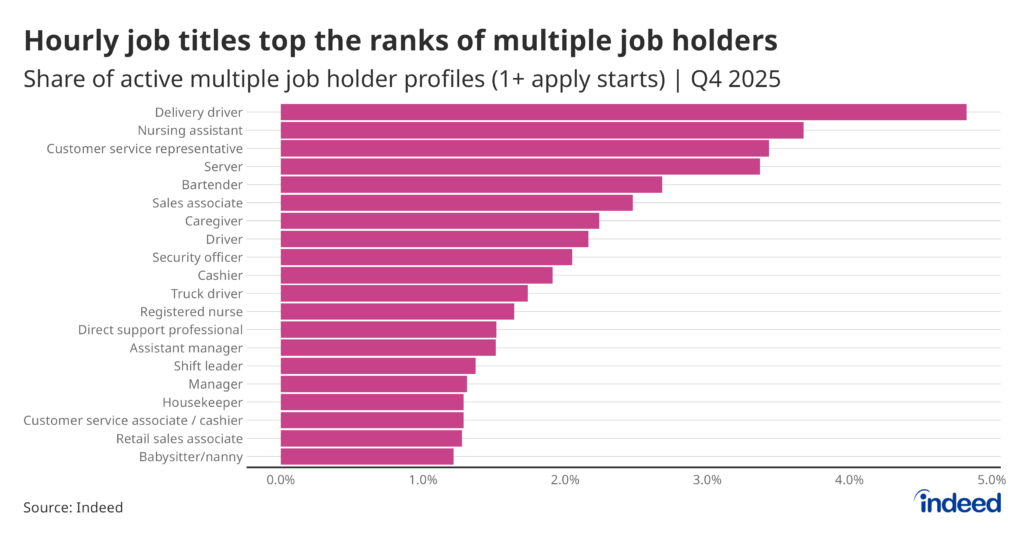
Focusing on individual job titles sharpens the picture further. Delivery drivers alone account for nearly 5% of all active multiple job holder profiles, reflecting both the growth of gig-adjacent delivery work and the ease of fitting driving shifts around other employment. Nursing assistant and customer service representative follow at around 3.5% each, with server and bartender next. The list reads like a cross-section of the hourly economy: security officer, cashier, truck driver, caregiver, housekeeper. These are not workers assembling a portfolio of varied professional experience. They are, for the most part, picking up a second job that looks a lot like their first.
Put another way, workers aren’t just staying in their lane; many are doing the exact same job for two different employers at the same time. This is clear when you look at the combinations of job titles for workers’ primary and secondary jobs. The most frequent combination among active multiple job holders isn’t two different jobs; it’s the same job twice. Nursing assistants who work another nursing assistant job are the most common, followed by doubled-up licensed practical nurses. Even after setting aside identical-title pairs, the pattern barely shifts: bartender and server is the top cross-title pairing, followed by delivery driver and driver.
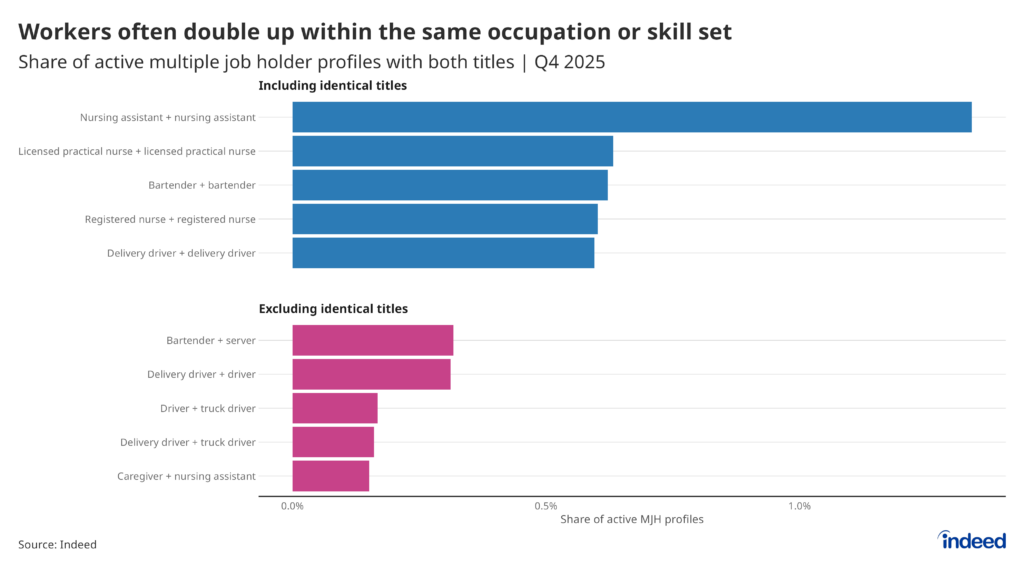
Bar graph titled “Workers often double up within the same occupation or skill set” showing the share of active multiple job holder profiles holding the top title pairings in Q4 2025, split into two panels: one including identical title pairs (e.g., nursing assistant + nursing assistant) and one excluding them (e.g., bartender + server). Identical-title pairings dominate, with nursing assistant + nursing assistant leading by a wide margin, while the closest non-identical pairings tend to come from adjacent roles within the same field.
The concentration of hourly and service-sector workers helps explain why the share of active job seekers holding more than one job (~16%) is notably higher than the BLS data, which puts multiple job holding at slightly above 5% of total employment. The two numbers are measuring very different things, and the gap between them is informative. The BLS figure measures multiple job holding as a percentage of the entire workforce, and since most workers hold only one job, the rate remains relatively low. The Indeed figure, by contrast, is drawn from workers who are actively applying, capturing a larger share of workers who navigate employment not as a sequence of jobs, but as a constant, overlapping search.
Is everyone a gig worker now?
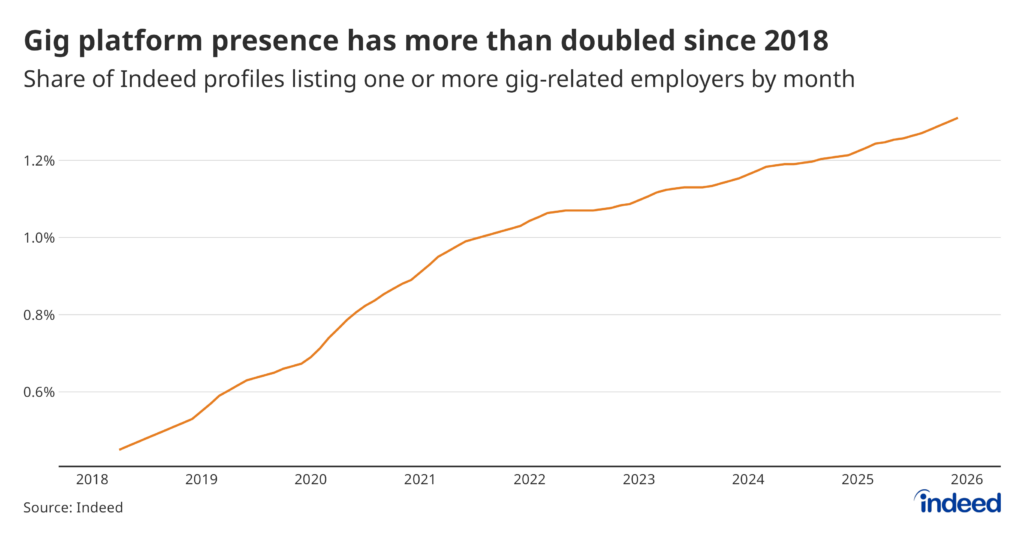
With this distinction in mind, it is also important to consider how much of the multiple job-holding trend is driven by gig platforms, including DoorDash and Uber. About 1.3% of all Indeed profiles listed a gig platform employer by the end of 2025, up from roughly 0.5% in 2018. That is a small share, but a meaningful one, especially given the fact that many workers may not formally list supplemental gig roles on their profiles, and others frequently cycle through platform-based work as financial needs dictate. Both, however, suggest that the actual share of workers doing gig work is likely higher.
Among active multiple job holders, the share with gig platform experience is even higher, with nearly 5% of those profiles including a gig-related employer. That share roughly doubled between 2018 and 2023, then leveled off and edged slightly lower through 2025. Gig work is part of the multi-job story, but it isn’t the whole thing; Indeed data show that there are many workers holding down two or more jobs with traditional employers, and not just supplementing a day job with app-based delivery shifts.
Why do people want to work multiple jobs?
Indeed data provide insights into multiple-job-holding patterns as well as potential motivations for holding more than one position. While a mix of factors is likely at play, economic necessity is one obvious frontrunner. Analysis of application behavior shows that job search intensity surges in the months leading up to a transition into multiple job holding. On average, in the month before a transition, application intensity (measured by the number of applications started) surges at three times the rate of the typical Indeed profile. A worker who is somewhat comfortable and simply looking to pick up extra spending money, or find the right flexible arrangement, doesn’t triple their application rate in the months before taking a second role. That kind of urgency likely represents a gap between what a primary job pays and what a household needs, potentially driven by a reduction in hours, an unexpected expense, and/or the slow erosion of purchasing power as prices outpace wages.
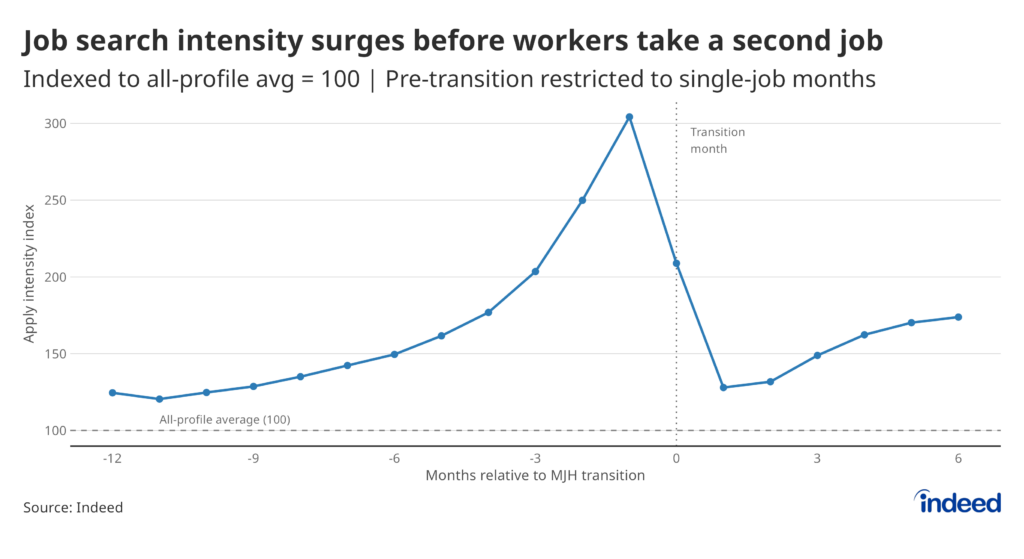
What happens after the transition is just as telling. Apply intensity drops sharply in the month after a second job begins, then climbs again after six months on the job. This pattern suggests that adding a second job satisfies some of the immediate pressure driving the search, but doesn’t resolve it entirely. These workers keep applying, just at a lower intensity.
Conclusion
Multiple job holders aren’t just gig workers and side hustlers; they are servers, nursing assistants, and retail workers. The application intensity data paints a picture of underlying pressure that’s hard to dismiss. Workers don’t triple their search rate in the months before taking on a second role because they’re casually exploring options; they do it because something isn’t adding up. Some may be looking to swap an existing job or add to an already busy work life, while others may keep searching for the single job that meets their needs and eliminates the pressure to hold multiple roles. Whatever the motivation, in a labor market where hiring has slowed and quits have fallen, a growing share of workers have found that the way to keep moving may not be by finding a better job, but by finding another one.
Methodology
We count a profile as a multiple job holder when it shows two or more jobs at different employers overlapping for two or more consecutive months. Jobs listed as ongoing are closed out at the month the worker last actively updated their profile. A profile is “active” in a month if it has at least one application start that month.
Gig presence is measured by matching employer names against a fixed list of platforms: Uber, Lyft, DoorDash, Instacart, Grubhub, Postmates, Shipt, Gopuff, TaskRabbit, Amazon Flex, Walmart Spark, Rover, Thumbtack, Handy, Fiverr, Upwork, Veho, Roadie, Wonolo, Instawork, Turo, Dolly, Bellhop, Care.com, Favor Delivery, and Bite Squad. This measure is employer-based, not role-based: it captures anyone listing one of these companies as an employer, including full-time and corporate staff, not just platform gig workers.
All figures are self-reported and reflect Indeed’s user base, which may differ from the overall US workforce. Monthly series are smoothed with a three-month trailing average.